
Burgundy: a complete guide to Clos de Vougeot
Charles Curtis MW explores the history and ownership of Burgundy's iconic Clos de Vougeot appellation, looking at the terroir and taste profile of these renowned wines and selects 23 from the walled Grand Cru vineyard that are worth seeking out.

The Via Agrippa is an old road, built by the general that Caesar Augustus appointed to rule Gaul. In the region of Vidvbia, the Gallo-Roman town known as Nuits-Saint-Georges today, it follows the fault-line of the Côte d’Or.
It was rebaptised the Route des Grands Crus nearly two thousand years later, after countless generations of monks who had settled along this trade route had developed winemaking to a fine art.
Scroll down for Charles Curtis MW’s Clos de Vougeot grand cru tasting notes and scores
Clos de Vougeot history
The first to plant here were to the monks of Vergy, whose monastery was founded in the 9th Century and reported to the Benedictine order of Cluny.
Reform-minded monks broke off and formed the Cistercian order, whose base at the Abbey of Cîteaux was begun in 1098. The Cistercians gradually consolidated their vineyard holdings on the slope next to the source of the river Vouge, and this site, known as the Clos de Vougeot, became legendary.
It was rumoured that the wines from the grapes at the top of the slope were never sold, but reserved for the Pope; those of the centre, for the crowned heads of Europe, while the monks enjoyed the produce of those at the base of the slope near the ancient Roman road.
An apocryphal tale, to be sure, but for such an iconic vineyard, the wines of the Clos are often still considered variable, yet superb wines abound, and attentive Burgundy lovers can find great bargains in grand cru red Burgundy.
Carving up the Clos
In time, the monk’s vineyard grew to nearly 51 hectares, ranking it among the largest of the grands crus in Burgundy. It did not spring forth fully formed, however, but was assembled patiently over nearly two hundred years.
It is uncertain when the walls of the Clos itself were built, with various dates suggested in the 13th and 14th centuries. The vineyard remained a monopole of the Abbey until the Revolution when the church was dispossessed of its lands. These were sold as ‘biens nationaux’, the property of the revolutionary state.
The Clos was sold in one block in 1791 and changed hands several times before it became the property of Julien-Jules Ouvrard, son of Napoleon’s banker. Ouvrard died in 1861, and the property remained with his heirs until 1889, when they sold it to six local negociants.
Among the largest purchasers of the Clos at this time was Léonce Bocquet, who owned nearly one-third of the vineyards, along with the château itself. The Liger-Belair family, the Beaudets of Beaune, and the Rebourseau clan from Gevrey were also among the initial purchasers.
Portions were subsequently re-sold, and by the end of the century there were 15 proprietors, with Bocquet among the largest. Unfortunately, he declined to replant despite the incursions of phylloxera, conditions declined, and his fifteen hectares were sold by his heirs in 1920 to 22 different buyers, bringing the total number of proprietors to 40.
Today, there are 82 owners in the Clos de Vougeot.

Instrumental families
The largest modern owner of vines in the Clos is Château de la Tour, with 5.48 hectares. The bulk of their vineyard surrounds a smaller château constructed by Beaudet about half-way up the slope on the northern edge of the clos.
Beaudet’s descendants still own this magnificent holding, which is managed today by François Labet. The domaine also has a parcel at the top of the slope and two small parcels that descend to the Route des Grands Crus.
Château de la Tour
Château de la Tour is among the few producers with enough land to produce more than one cuvée. In fact, there are three: the Cuvée Classique, an old vine version (‘Vieilles Vignes’), made exclusively from hundred-year-old vines, and in certain years, a cuvée made from the bunches nearest the trunk of the centenary vines, named ‘Homage à Jean Morin’ in honor of his grandfather.
Labet took over in 1984 and began to experiment with whole cluster fermentation in the late ’80s; he has been using 100% whole cluster fermentation since the early 90s. Labet began to farm organically in 1992 and biodynamically in 2015, although they have not pursued formal certification of either.
Today his consulting oenologist is the talented young Sylvain Pataille from Marsannay.
At the domaine, winemaking is carried out in concrete vats on natural yeast following a cold maceration of 7 to 10 days, and the wines in general age twelve months in cask. Broadly, the oak regime is 50% for the ‘Cuvée Classique’ and 80 – 90% for the old vine cuvées. The domaine purchases staves for the barrels and has them aged 36 months outdoors they are made into casks by cooper Stéphane Chassin. Labet refers to this method as his ‘made-to-measure’ barrels. His approach yields powerful, tannic wines, with a slightly earthy, almost ‘sauvage’ edge and a hint of wild herbs from the whole bunch fermentation.
Méo-Camuzet
A second important family-owned parcel is the one owned by Jean-Nicolas Méo and Domaine Méo-Camuzet.
Etienne Camuzet purchased this parcel in the 1920 sale of the Bocquet estate. There was fear at the time that this vineyard, considered a national treasure, would fall into foreign hands.
Despite interest from abroad, Vosne-Romanée vigneron Camuzet rallied his neighbours to purchase the vines. Camuzet, the widely-respected regional representative in the Assemblée Nationale, saved the day, and retained a magnificent parcel of 2.75ha up-slope from Château de la Tour’s vines, along with a smaller block of 0.25ha to the south.
During his political career, Camuzet maintained the family vineyards, although sharecroppers worked the vines on his behalf. When he passed away in 1944, the estate passed to his daughter, Maria Noirot, who kept the sharecroppers in place.
Mme. Noirot passed away in 1959, and the estate passed in turn to her nephew Jean Méo, who had left Vosne to pursue a business career in Paris as the CEO of the oil company Elf. Méo, too, kept the metayers in place, who at this point included Henri Jayer and Christian Faurois.
Méo managed the estate until 1984, renaming it Méo-Camuzet in 1981, and beginning to estate bottle in earnest in 1983. His son Jean-Nicolas took over in 1984, although initially the sharecroppers stayed in place while he finished his studies. He began to work with these vignerons in 1985, and took over entirely in 1989.
Although the vines are farmed along organic lines, the domaine is not certified. In the winery, the approach is the opposite of Château de la Tour. Everything is normally destemmed before fermentation on native yeasts in concrete tanks. Extraction begins with pumping over, changing to punching down near the end of the fermentation. This approach yields a wine of surpassing elegance and finesse, yet one that in no way lacks depth.
Gros family
Another family instrumental in the evolution of the wines of the Clos de Vougeot is the Gros family, whose domaine was founded in 1860.
The founder’s grandson Jules Gros changed the name to Gros-Renaudot to include his wife, and in 1920 they purchased two marvelous parcels from the break-up of the Bocquet estate. The first was in a portion of the vineyard known as Grand Maupertui. This plot is nearly a hectare, and is farmed today by Anne Gros. She uses it to make one of the most exquisite wines of the Clos.
The vines here are very old – the parcel was originally planted in 1905, although subsequent replantings lowered the average age to 70. Gros destems all of the grapes in the winery, which are fermented in stainless steel tanks, with a combination of gently punching down and pumping over. There is a particular emphasis here on choosing the date of harvest according to the taste of the skins in order to avoid astringency in the wines, and the result has an exuberant, expressive purity of fruit that is consistently delightful.
The second parcel purchased by Jules Gros was in the north-east corner of the Clos, nearest to the Musigny appellation in neighbouring Chambolle-Musigny. This parcel is 1.55ha in size and is currently worked by Domaine Gros Frère et Soeur, although from 2020, it is said it will be shared with Domaine A.F. Gros. Here the fruit is destemmed and gently heated to concentrate the wine before fermentation and aging in cask. This gives a firm, substantial style quite the opposite of that produced by his cousin.
Clos de Vougeot variability
Tasting through the wines of the Clos, one realises that one thing is certain: the vineyard is not homogeneous and does not produce wine of equal quality throughout.
From its inception until the sale by the Ouvrard heirs, the vineyard was a monopole, and the wines would have been blended. Even in the monks’ time when yields were much lower, the property could make 300 – 350 barrels of wine.
The harvest has increased over time, and today the entire vineyard can yield twice that, producing as much as 200,000 bottles of wine.
Today, however, most holdings in the Clos de Vougeot are so small that producers are compelled to blend all their fruit to achieve economies of scale and are limited by their parcels’ location. This is one of the causes of variability. ‘It is easier to make ten barrels rather than one,’ according to François Labet.
Another source of variation is the complexity of the site. The slope of the Clos is relatively gentle, approximately 3-4 %, rising from 240 to 265 meters.
The top of the vineyard is on thin clay soils over a base of Bajocian limestone. Jean-Nicolas Méo reports that his topsoil in the upper portion of the Clos is only 40cm deep. The middle of the slope is slightly younger limestone from the Bathonian age. However, it is covered here by a much more generous layer of marly clay with a generous inclusion of limestone pebbles. The bottom of the slope has even deeper marl and clay soils with a large proportion of silt and sand and is less well-drained than the other two sections.
In spite of these general characters, however, the tripartite division has always been an oversimplification.
The northern part of the vineyard is bordered by Musigny, and has a strong influence from the cool air streaming down from the Combe d’Orveau that the southern part does not, where it is bordered by Grands Echézeaux. The vines here undulate gently along the Côte, further increasing the complexity of the vineyard.
Labet points out that the real dividing line is the old Roman road along the fault line, demonstrated by the fact that the wines made to the east of this line all share regional appellation status.
Complex terroir
Despite the variation from top to bottom and from north to south, there is only one lieu-dit: Clos de Vougeot. In previous times, however, workers in the Clos have given unofficial names to many lieux-dits. Dr. Lavalle, in his 1855 book, described more than two dozen, many of which are no longer recognised. A number of these, however, have come down to our day.
The upper part of the vineyard along the western edge includes the former lieux-dits Musigni, La Garenne, Plante Chamel (sometimes called Plante Homor), and Plant l’Abbé, as one moves from north to south. This section is normally considered at the same time as the next section, which includes the old lieux-dits of Montiottes Hautes, Les Chioures, Quartier de Marei Haut, Grand Maupertui, Petit Maupertui (sometimes written ‘Maupertuis’ with an ‘s’). This upper section is almost entirely surrounded by grands crus, with Musigny to the north-west and Grands Echézeaux to the south-west.
The middle section of the vineyard included the upper part of Montiottes Basses, Dix Journaux, Quartier de Marei Bas, the upper part of Baudes St.-Martin, and Baudes Hautes. The southern portion here is bordered by Echézeaux and to the north by Vougeot premier cru.
The bit along the Route Nationale includes the lowest portion of Montiottes Basses, Quatorze Journaux, the lower portion of Baudes St.-Martin, and Baudes Basses. This part of the vineyard is bordered by village-level wines in Vosne-Romanée to the south and north by village or premier cru vines in Vougeot.
Although the site has an undeniably complex terroir, this is not the only factor that complicates the evaluation of these wines.
According to Labet; ‘It’s not just the location – there are three factors: the site, the vines, and the vignerons.’
Within the Clos, there are many sites with old vines, including the hundred-year-old plot of Château de la Tour and the parcel farmed by Anne Gros. The vines of Château de la Tour’s immediate neighbour, however, have been largely replanted. This parcel is in the hands of Domaine Henri Rebourseau, named for the grandson of the 18th-century founder.
Rebourseau was one of the original purchasers of the vineyards from the Ouvrard heirs. Management of the estate passed in 1980 to Jean de Surrel, great-grandson of Henri Rebourseau, who began to farm using organic and biodynamic principles, although the domaine is not formally certified.
In 2018, however, the family sold a majority stake to the family of French billionaire Martin Bouygues, also owner of Bordeaux’ second-growth Château Montrose in St-Estéphe. Bouygues retained Bénigne and Louis de Surrel to run the estate under the watchful eye of Hervé Berland, the former managing director of Château Mouton-Rothschild who left to work for the Bouygues family in 2012 and now oversees their vineyard operations and considerable investment.
Given the prices commanded by these wines, investment is inevitable. One example is Domaine Leroy.
Domaine Leroy is the owner of three parcels: one in La Garenne, one in Baudes Saint-Martin and one in Baudes Basses. The wine achieves its immense concentration and power through intense attention to detail in the vineyard and meager yields.
The result is gratifyingly delicious—and dizzyingly expensive. However, collectors will line up to pay the price in one of the ultimate demonstrations that ultimately François Labet is right: location isn’t everything after all; the quality of the vines and the skill of the winemaker are also paramount.
In the Clos de Vougeot, we are often lucky to have the confluence of the three.
Charles Curtis MW’s Clos de Vougeot tasting notes and scores
Related Articles
Join Charles Curtis MW for a superb Burgundy masterclass at DFWE London
Burgundy 2019 en primeur: Full report plus top-scoring wines
Off-piste Burgundy: Value alternatives
Domaine Arnoux-Lachaux, Clos de Vougeot Grand Cru, Burgundy, France, 1971
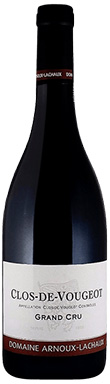

This wonderfully preserved example from Robert Arnoux shows what can become of these wines with time. From the parcel in Quartier de Marei Haut...
1971
Domaine Arnoux-LachauxClos de Vougeot Grand Cru

Domaine Georges Mugneret-Gibourg, Clos de Vougeot Grand Cru, Burgundy, France, 2010
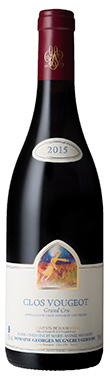
A stunning wine of limpid clarity and expressiveness, the Mugneret-Gibourg comes from a parcel in Les Chioures between Méo and Lamarche. Dr. Mugneret purchased...
2010
Domaine Georges Mugneret-GibourgClos de Vougeot Grand Cru
Chateau de la Tour, Vieilles Vignes Hommage à Jean Morin, Clos de Vougeot Grand Cru, Burgundy, France, 2017
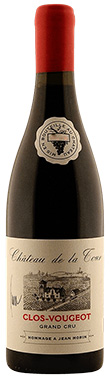
Crazy wine. For this cuvée, Labet selects only the first bunch after the graft on vines at least 100 years of age. The cuvée...
2017
Chateau de la TourClos de Vougeot Grand Cru
Domaine Leroy, Clos de Vougeot Grand Cru, Burgundy, France, 2009
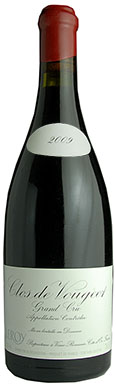
Madame Leroy owns three parcels in the Clos: one in Garenne, just south of the château, a large one in the center of the vineyard...
2009
Domaine LeroyClos de Vougeot Grand Cru
Domaine Méo-Camuzet, Clos de Vougeot Grand Cru, Burgundy, France, 2018
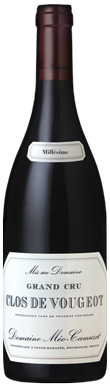
The Méo section of the Clos is extremely well placed: the majority is in Chioures, near the top. Lavalle referred to this as ‘Musigny-Chioures,'...
2018
Domaine Méo-CamuzetClos de Vougeot Grand Cru
Domaine François Lamarche, Clos de Vougeot Grand Cru, Burgundy, France, 2018
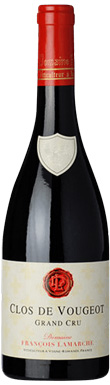
Nicole Lamarche is producing masterful wines from her holding in the Clos. The domaine owns four parcels: two smallish ones in the northwest section...
2018
Domaine François LamarcheClos de Vougeot Grand Cru
Anne Gros, Le Grand Maupertui, Clos de Vougeot Grand Cru, Burgundy, France, 2012
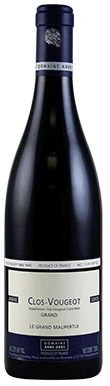
According to Anne Gros, her 2012 Clos de Vougeot is; 'The best I've ever made.' It shows a bright, fresh character and subtle, nuanced...
2012
Anne GrosClos de Vougeot Grand Cru
Chateau de la Tour, Vieilles Vignes, Clos de Vougeot Grand Cru, Burgundy, France, 2017

There is impressive concentration here given the vintage, with a blackberry and plum fruit coloured with a profoundly savoury earthy quality and hints of wild...
2017
Chateau de la TourClos de Vougeot Grand Cru
Domaine Thibault Liger-Belair, Clos de Vougeot Grand Cru, Burgundy, France, 2017
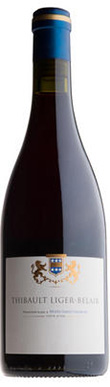
Produced from the long rows of vines at the southern end of the Clos, almost to the wall that borders Echézeaux. The parcel transverses...
2017
Domaine Thibault Liger-BelairClos de Vougeot Grand Cru
Bouchard Père & Fils, Clos de Vougeot Grand Cru, Burgundy, France, 2017
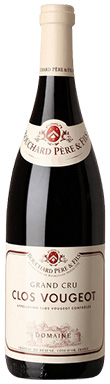
Impressive wine. Bouchard owns two parcels of almost equal size, one near the top of the slope in Plante l'Abbé, planted in 1956, and one...
2017
Bouchard Père & FilsClos de Vougeot Grand Cru
Bouchard Père & Fils, Clos de Vougeot Grand Cru, Burgundy, France, 2018
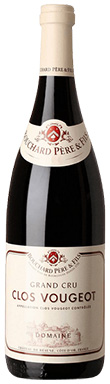
The harvest in 2018 started on September 4th. It is impossible not to love this wine, although it is entirely different than the previous...
2018
Bouchard Père & FilsClos de Vougeot Grand Cru
Domaine de la Vougeraie, Clos de Vougeot Grand Cru, Burgundy, France, 2018
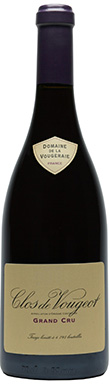
In 2018 the harvest began on September 5th. The bunches were very healthy, and nearly 70% of the grapes were fermented as whole clusters...
2018
Domaine de la VougeraieClos de Vougeot Grand Cru
Domaine Faiveley, Clos de Vougeot Grand Cru, Burgundy, France, 2018
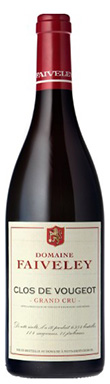
Domaine Faiveley owns three parcels in the Clos de Vougeot, totaling 1.27 hectares, including one in Grand Maupertui next to Anne Gros, another in Baudes...
2018
Domaine FaiveleyClos de Vougeot Grand Cru
Domaine Jean Grivot, Clos de Vougeot Grand Cru, Burgundy, France, 1998
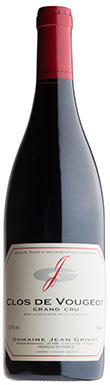
The Grivot domaine owns a large parcel in Quatorze Journaux that extends from the Château de la Tour holding to the Route Nationale. Grivot...
1998
Domaine Jean GrivotClos de Vougeot Grand Cru
Domaine Joseph Drouhin, Clos de Vougeot Grand Cru, Burgundy, France, 2018
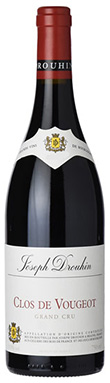
As with most recent vintages, this is made using only the parcel located at the middle of the slope on the northern end of the...
2018
Domaine Joseph DrouhinClos de Vougeot Grand Cru
Domaine Thibault Liger-Belair, Clos de Vougeot Grand Cru, Burgundy, France, 2018
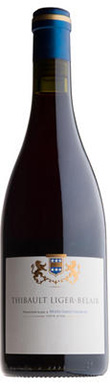
The 2018 Clos de Vougeot shows a bit of the heat and the concentration of the year: the harvest was nearly 20% down on 2017....
2018
Domaine Thibault Liger-BelairClos de Vougeot Grand Cru
Chateau de la Tour, Cuvée Classique, Clos de Vougeot Grand Cru, Burgundy, France, 2017
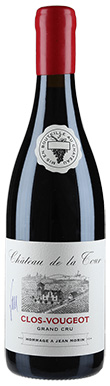
This wine is an impressive entry-point to the range. Fruit from the heart of the Clos is picked ripe, given an extended cold soak,...
2017
Chateau de la TourClos de Vougeot Grand Cru
Domaine de la Vougeraie, Clos de Vougeot Grand Cru, Burgundy, France, 2017
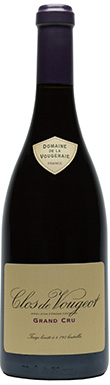
The Boisset family’s Domaine de la Vougeraie owns just over a hectare of vines in Montiottes Hautes at the top of the slope on the...
2017
Domaine de la VougeraieClos de Vougeot Grand Cru
Henri Rebourseau, Clos de Vougeot Grand Cru, Burgundy, France, 2018
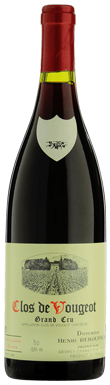
The domaine-owned 2.21-hectare block (the third-largest holding in the Clos) is mostly split between the sections known as the Clos Quartier de Marei Bas and...
2018
Henri RebourseauClos de Vougeot Grand Cru
Domaine Gros Frère et Sœur, Clos de Vougeot Grand Cru, Burgundy, France, 2018
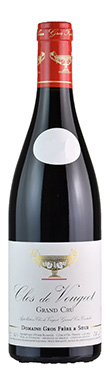
Muscular, dense, and dark in colour, this is heavily oaked and very concentrated. It will please fans of powerful wines. There is a...
2018
Domaine Gros Frère et SœurClos de Vougeot Grand Cru
Domaine Joseph Drouhin, Clos de Vougeot Grand Cru, Burgundy, France, 2017
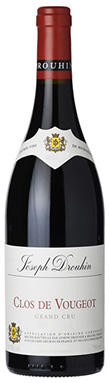
Domaine Joseph Drouhin owns two parcels that total 0.90 hectares. One is located in a long strip that stretches back from Chateau de la...
2017
Domaine Joseph DrouhinClos de Vougeot Grand Cru
Henri Rebourseau, Clos de Vougeot Grand Cru, Burgundy, France, 2017
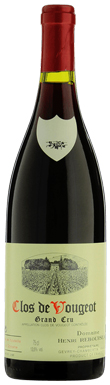
From their parcel at the very heart of the Clos, Rebourseau has crafted this deeply-coloured wine. The nose is initially marked by the oak treatment...
2017
Henri RebourseauClos de Vougeot Grand Cru