
Few names are as synonymous with contemporary St-Emilion as Château Pavie – one of just two St-Emilion estates currently with the top rank of premier grand cru classé A – and Gérard Perse, its late owner and former self-made supermarket mogul turned wine empire builder.
An unrelenting dream with quality and hospitality at its heart has seen the Perse universe evolve and expand from wine estates to hotels, restaurants, brasseries and now even an ice cream parlour all nestled among the cobbled streets of the medieval village, the crown jewel of the Right Bank region.
Scroll down to see notes and scores for Georgie’s top picks from Château Pavie
Historic and contentious
It’s not hard to see Pavie’s clear terroir credentials, given that vine cultivation here dates back to the 4th century – supposedly the oldest alongside Château Ausone.
It’s a rare and relatively extensive single block, comprising the famous limestone plateau and sweeping south-facing slopes that tumble into an amphitheatre of vines dropping from 85m to 20m and basking in the full sun above the Dordogne valley.
‘Wine is of course the main job,’ says Henrique Da Costa, son-in-law of Perse, who has for more than two decades been part of the family team running the estate with Perse’s daughter Angélique (pictured, below).
‘But it’s also everything around it – in order to give guests the full experience, you need gastronomy, you need hospitality. Quality, quality, quality – that was always Gérard’s rule.
And it shows. From the meticulously tended vines and beautifully adorned commemorative bottles to the magnificent marble-clad reception and tasting rooms and five-star accommodation.
Pavie’s success story is as impressive as Perse’s, with slick marketing and a bucketful of options for any wine lover wanting to enjoy the delights of the region.
But the estate and its methods have not been without controversy.
At times branded flashy and excessive, its wines have divided critical opinion, but there’s no doubting the perseverance of a man on a mission and a team dedicated to perfection.

A radical transformation
When Gérard Perse (pictured, below) purchased Château Pavie in 1998 from the Valette family, it was a shadow of its potential, having lost much of its prestige through the 1980s and early ’90s.
Though the terroir was hallowed, the vineyard was tired, the winery outdated and much of the equipment obsolete. But Perse had already spent five years learning the rhythms of St-Emilion.
He and his wife Chantal (who worked with him from the beginning, managing the hospitality and restaurant side of the business) had bought Château Monbousquet in 1993 – what he later called his ‘laboratory for experimentation’ – and Pavie-Decesse in 1997, on the limestone plateau just above Pavie.
‘By the time Gérard came here,’ says Da Costa, ‘he knew exactly what he wanted to do. Monbousquet was where he learned. Pavie was where he applied everything.’
He saw potential not problems and came in with a spare-no-expense attitude.
When he arrived, more than 15,000 vines were missing or dead and the old cellar wasn’t fit for purpose. Within months, he tore it down and rebuilt it, installing wooden vats and temperature control.
That first new vat room was barely finished when the 1998 harvest began, yet it marked the start of a new chapter. A second, marble-clad cellar would follow in 2013, cementing Pavie’s place among Bordeaux’s most advanced wineries.
Birth of a modern legend

Replanting began and so did viticultural changes, including large-scale green harvesting. ‘People said, “He’s crazy, cutting bunches”,’ Da Costa recalls with a smile.
‘But Gérard didn’t care – he stayed focused on his way. He wasn’t making wine for Parker or for points; he was making the wines he loved, with the structure and power to last decades.’
The early vintages – 2000, 2003, 2005 – were monuments to that philosophy: dark, rich and unapologetically full-bodied.
They were also among the most polarising wines Bordeaux had ever seen. Robert Parker hailed them as masterpieces of modern St-Emilion; British critics called them excessive.
They were wines of texture and ambition, designed not for immediate charm but for longevity.
‘We know that the wine can support [new oak] for a long time, there’s no question. These are wines that are meant to live 20, 30, even 50 years,’ says Da Costa.
Pavie’s south-facing exposure naturally lends itself to generosity. ‘It’s a warm terroir, so, yes, the wines are rich – but that’s Pavie, that’s its character,’ he adds.
Monbousquet had already introduced Perse to the US market through merchant Jeffrey Davies, who championed the wines early on.
‘He admired the US,’ Da Costa says. ‘He told us many times, if he were younger, he would have gone there. But his style wasn’t for anyone else. It was his taste, his vision.’
The St-Emilion amphitheatre

Château Pavie’s 42ha form a natural amphitheatre of south-facing slopes with 11 distinct soil types, from hard limestone to heavy clays and sandy gravels – among the steepest in St-Emilion.
The varietal mix has shifted gradually over time – today about 50% Merlot, 30% Cabernet Franc and 20% Cabernet Sauvignon – enhancing freshness and structure.
The vines are planted at 7,000 per hectare, and massal selections (propagated via cuttings from existing estate vines) are used for replanting.
The vineyard is farmed organically, but not certified, with cover crops and horses working the steepest plots.
A team of 25 vineyard workers tends the 21 parcels, which have an average age of 30 years (the oldest are 75 years old), each responsible for the same rows year after year.
‘They know every vine by heart,’ Da Costa says. ‘That’s why Pavie is so consistent – it’s not just the terroir, it’s the people, the team, the knowledge.’
This also explains the vineyard’s immaculate presentation and the subtle refinements in the wines over the past decade.
Cellar & craft
Precision is the cornerstone of Pavie’s winemaking. Grapes are handpicked, sorted twice and vinified by parcel in small oak vats. Fermentations are long and cool, with gentle pump-overs to preserve fruit purity.
‘We’re softer in the cellar now,’ Da Costa explains. ‘We still want intensity, but not heaviness. It’s about balance.’
Press wine never makes it into the grand vin. Ageing lasts 18-24 months in 60%-70% new oak, down from the 100% last used in 2005. ‘It’s about integration, not dominance. You should never taste the wood – it should just be part of the harmony.’
The technical direction is led by Laurent Lusseau, supported by long-serving cellar master Jean-Baptiste Pion (pictured, below), who joined in 1998.
‘Many of the team have been here from the beginning,’ Da Costa notes. ‘That’s what gives Pavie its soul.’
Evolution & refinement

Over the past two decades, Pavie has undergone a quiet stylistic evolution.
Shorter macerations, cooler fermentations and slightly earlier picking have brought greater freshness and precision.
The result is a more balanced expression – still unmistakably Pavie in style and power with signature freshness, but more nuanced in texture.
‘We’re still making wines that can age,’ Da Costa says, ‘but now they also have an accessibility earlier in life. That’s important for the next generation of drinkers.’
Recent vintages – 2018, 2019, 2020 and 2022 – exemplify this balance: bold yet refined, polished yet nuanced. And the older wines, once accused of excess, have aged into graceful classics.
‘Tasting the 2000s now, you see how they’ve mellowed,’ Da Costa reflects. ‘They’re still strong, but they’ve become elegant. Time has proven the style.’
Recognition & independence

Château Pavie has grown physically, too. In 2002, the national appellation authority INAO approved the integration of Château La Clusière and part of Pavie-Decesse, both sharing identical terroirs.
In 2022, the remaining 3ha of Pavie-Decesse and 2ha of Bellevue-Mondotte joined Pavie after 15 vintages of comparative tastings to confirm compatibility.
The estate’s second wine, Arômes de Pavie, has its own style and personality, being produced from dedicated old-vine parcels since 2017, while a wider Bordeaux blend,
Esprit de Pavie, uses fruit from nearby Castillon and declassified lots, further broadening the estate’s reach.
In 2012, Pavie’s transformation reached its pinnacle when it was promoted to the level of premier grand cru classé A, joining St-Emilion’s elite estates at the top of the region’s official classification listing.
To mark the occasion, Perse released a special commemorative black-labelled bottle (pictured, above).
A decade later, a limited-edition enamelled design marked the 2022 St-Emilion reclassification, symbolising continuity through change.
The classification triumph was both recognition and closure – less about competition, more about proving that the work, the vision, could achieve something lasting.
Beyond the bottle

To further understand Pavie’s influence today, one must look beyond the vineyards. The Perse family has built one of the region’s most comprehensive and self-contained visions of wine, culture and hospitality.
In the Place du Clocher, the flagship restaurant La Table de Pavie (pictured, above), led by chef Yannick Alléno, holds two Michelin stars and is striving for a third – a feat yet to be achieved in Bordeaux.
Dishes draw inspiration from the immediate surroundings with thoughtful and innovative red wine pairings.
Meanwhile, the renovation of the Hostellerie de Plaisance has transformed it into one of the most elegant hotels in the region, with an Instagram-worthy terrace overlooking the town, while the nearby L’Envers du Décor remains one of the village’s busiest bistros, beloved by winemakers and visitors to the town alike.
For Da Costa, this expansion is entirely consistent with the ethos of the wines. ‘We built hospitality purposely,’ he says, ‘to show what St-Emilion can be, and with Pavie at the heart of it all.
‘St-Emilion needed energy again,’ he continues. ‘Gérard Perse gave it that. He wanted people to come, to taste, to stay – to experience everything this place could offer.’
Legacy & reflection
Looking back after more than two decades, Château Pavie’s journey feels almost cinematic – from controversy to cult classic.
‘Gérard Perse was a visionary,’ says Da Costa. ‘He showed that conviction matters more than consensus. He made the wines he loved, and he never apologised for that.’
Even those who once bristled at the flash and ambition now concede that Perse turned a sleepy estate into a powerhouse – one that continues to thrive in his memory.
A taste of Château Pavie: Hindle’s pick of the vintages
Related articles
- Bordeaux 2005: 23 top wines tasted two decades on
- Guess the vintage: Bordeaux fine wine history quiz
- Collector’s Guide: Left Bank Bordeaux
Château Pavie, St-Émilion, 1er Grand Cru Classé A, Bordeaux, France, 2016
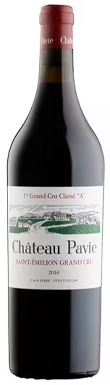

A monumental Pavie. Incredible aromatic intensity, depth and energy; alive, bright and beautifully poised. Packed with power, precision and tension, yet silky smooth, sharp and racy, with muscle and sinew in perfect balance. Not ready yet, but this is seamless and thrilling: a racehorse of a wine. Cherries, blackcurrants, plums and blueberries with a touch of liquorice and wet stone on the finish. A fantastic, flawless 2016 that shows the best of its terroir and winemaking.
2016
Château PavieSt-Émilion

Château Pavie, St-Émilion, 1er Grand Cru Classé B, Bordeaux, France, 2010
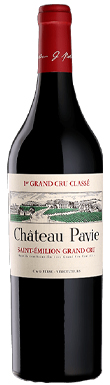
Bright rose petals and dark fruit with hints of liquorice and tobacco. Smooth, sumptuous and heady, this feels both romantic and powerful. Massy tannins are softened by layers of strawberry and cherry, with salty, wet-stone edges and chalky grip. Cinnamon and clove add spice and lift. Excellent freshness, razor-sharp definition, ripe and structured.
2010
Château PavieSt-Émilion
Château Pavie, St-Émilion, 1er Grand Cru Classé A, Bordeaux, France, 2022
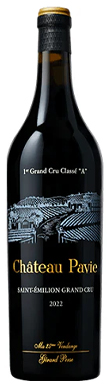
Rich and robust on the nose, so floral and alive with cumin, cinnamon and juicy red fruit. Delicious, moreish and full of life. Structured with sharp acidity that counters the fruit beautifully. Smooth, ripe tannins pulse with power and energy. Juicy and succulent yet precise, with raspberry, tobacco, liquorice and slate notes. An exuberant, singular style, mouthwatering. Still only beginning to show its potential.
2022
Château PavieSt-Émilion
Château Pavie, Aromes de Pavie, St-Émilion, Grand Cru, Bordeaux, France, 2020
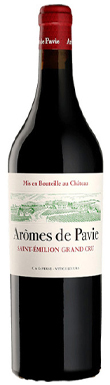
Leather, chocolate, toast and soft floral tones on the nose with hints of spice and blueberries. Ripe, round and powerful on the palate, with fleshy tannins that fill and cushion the mouth. Sharper acidity than 2018 or 2019 gives energy and drive. Racy and sophisticated, though still somewhat closed. Blackcurrant, cherry, plum, liquorice and tobacco linger with cinnamon warmth. Textured, vibrant and built for at least 10 more years.
2020
Château PavieSt-Émilion
Château Pavie, St-Émilion, 1er Grand Cru Classé B, Bordeaux, France, 2005
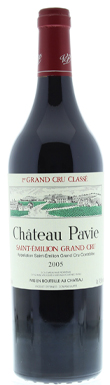
Dark chocolate, tobacco and heady perfume lead this rich yet refined wine. Deep and expressive, with delicate aromas and soft touches of wood and toast. The upfront tannins are mighty but not overpowering. Still tight on the finish, but freshness and limestone minerality drive it forward. Chiselled and long, with juicy, salty liquorice notes and a stony, slate-edged energy that keeps it mouthwatering and alive.
2005
Château PavieSt-Émilion
Château Pavie, Aromes de Pavie, St-Émilion, Grand Cru, Bordeaux, France, 2019
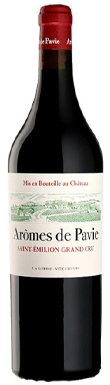
Cool blue fruit and violets on the nose with milk chocolate, iodine and a hint of leather. Smooth, balanced and utterly delicious palate, streamlined and floral with a fresh, lifted core. Beautifully delineated, structured yet elegant, with crunchy freshness, fine tannins and that signature liquorice and stony finish. Classy, refined and irresistibly moreish.
2019
Château PavieSt-Émilion