
Burgundy investment: Focus on blue-chip wines
As the Burgundy market pauses (briefly?) to draw breath, at the very top it’s still all in the name.


Burgundy isn’t storming the market like it was 12 months ago, but don’t underestimate the ongoing scarcity and global demand for a hardcore group of blue-chip producers, according to some merchants.
‘At some point, the market had to pause for breath,’ said Nick Martin, founder and CEO of Wine Owners exchange in the new Knight Frank Wealth Report 2023, referencing strong price gains for top Burgundy over a five-year period and a recent slowdown.
Ruairi O’Hara, of UK merchant Goedhuis & Co’s investment and private client sales teams, said ‘prices have come down on the top end a little’, following strong gains. But he said he expected the market to ‘find stability’. Customers were still buying for consumption as well as investment, he said. ‘We’re seeing people buying young and old Domaine de la Romanée-Conti (DRC) for delivery to their homes, to be consumed.’
Jamie Ritchie, worldwide chairman of Sotheby’s Wine & Spirits, said top-tier Burgundy appeared more solid in early 2023 than was perhaps anticipated in late 2022. ‘We’re not really seeing any more price appreciation in that area, but we’re seeing continued demand.’
Other auction houses have also reported ongoing good demand (see ‘Monitor’, below).
Bordeaux Index said earlier this year that buyers remained ‘razor focused on a clutch of big-name producers’, led by Leroy, DRC, Georges Roumier, Sylvain Cathiard and Armand Rousseau.
Matthew O’Connell, CEO of Bordeaux Index’s LiveTrade trading platform, said blue-chip prices have been pretty static recently, and trading has been a bit muted, but it’s too early to say whether prices have hit a plateau this year. ‘I think there’s a good chance of further price rises,’ he added.
Looking further ahead, O’Connell’s ongoing thesis is that the expectation of continued scarcity, along with current and untapped future demand among wealthy collectors, will continue to drive blue-chip Burgundy producers forward on the secondary market. ‘The penetration of Burgundy in Asia is really not as high as people might think,’ he said, adding that the US also has further to go.
Liv-ex, a global marketplace for the trade, offered a more cautious view of Burgundy in general, at least in the near term. Some of its trade members predicted some form of price correction in Burgundy in 2023. The Liv-ex Burgundy 150 index dropped by 2.1% in February, although it was still up by 13% over one year and by almost 94% in five years.
A recent Liv-ex report also highlighted questions around the sustainability of pricing in Burgundy in general. Its data suggested Burgundy had overall become ‘riskier to buy and harder to sell’ on the secondary market. The bid-to-offer ratio for Burgundy wines on Liv-ex was 0.26 in January 2023, versus 1.1 a year earlier.
At the top end, though, O’Connell said price elasticity [how demand reacts to a change in price] is key. In other words, some wealthy collectors just want to drink and own certain top-tier producers’ wines. He added: ‘People were looking at six-packs of DRC Romanée-Conti in 2018, saying “no one will ever pay more than £100,000 for a six-pack of Romanée-Conti, these things have a ceiling” – they never have ceilings.’
Demand for top producers’ wines can transcend Burgundy’s vineyard hierarchy, O’Connell said. He added Roumier Bourgogne Rouge was recently trading at about £500 a bottle. ‘It’s not about classification of vineyards, it’s simply about producers,’ he said. ‘Jean-Yves Bizot’s Bourgogne Rouge in the secondary market is significantly more than £1,000 a bottle.’
Monitor: latest sales activity
Data supplied by Bordeaux Index (below) offers insight into the average price performance of Burgundy over the past six, 12 and 18 months, based on the merchant’s executed transaction data.
While it clearly shows how price momentum has slowed more recently, it also shows wines from 10 ‘blue-chip’ producers outperforming a group of 10 producers outside this segment.
Elsewhere, there has been more evidence of ongoing collector thirst for Burgundy. Geneva-based auction house Baghera Wines said an online auction of Jean-Yves Bizot wines in Singapore saw all 87 lots find buyers, with total sales of SG$817,705 (£503,105, US$603,729). It added 85% of lots went to local buyers, underlining interest in rare Burgundy among Asia-based collectors.
Top lot was 12 bottles of Bizot’s Vosne-Romanée 2019, which fetched SG$36,600 (pre-sale estimate: SG$26,000 -$46,000), including buyer’s premium. Three bottles of Echézaux 2005 fetched SG$21,350 (e: SG$17,500-$27,500).
Auction house Zachys also reported strong demand for top Burgundy at a two-day sale in early March. It said a three-litre jeroboam of DRC La Tâche 1971 fetched US$93,375 (£76,752), versus an estimate of US$65,000-$95,000. Meanwhile, France-based iDealwine auctioned Méo-Camuzet wines direct from the estate’s cellars and said all 53 lots found buyers.

Tasted & rated for Decanter Premium
Domaine de la Romanée-Conti, Romanée-Conti Grand Cru, Burgundy 2020
This famous wine’s 2020 vintage is a particular triumph, said Decanter Burgundy correspondent Charles Curtis MW, who awarded the full 100 points after tasting it alongside other DRC 2020 releases. ‘The texture is suitably firm and substantial, but there is astonishing elegance and freshness for such a torrid vintage,’ Curtis said. ‘This is everything you want Romanée-Conti to be.’ He said 6,003 bottles were made, also praising the ‘dizzying success’ of DRC’s Montrachet Grand Cru 2020 (98pts). DRC releases are strictly allocated, according to the winery’s exclusive UK agent Corney & Barrow.
Burgundy investment: The Bordeaux Index View
Fine wine & spirits specialist Bordeaux Index kindly sponsors this section of Decanter, and provides its view on the market here every issue. It can be found at bordeauxindex.com
The last 12-18 months have proved another breakout period for blue-chip Burgundy prices (see chart above). We see this as largely driven by wealthy collectors and consumers within a broader trend of global growth in luxury consumption. Burgundy supply is limited and potentially becoming more so, as the 2021 vintage suggests; price performance is therefore a classic case of supply-demand dynamics. There is investment interest in Burgundy given price performance across the last five years, but we see this as very much secondary to collector activity.
These positive dynamics – likely to persist, albeit with natural periods of price growth and price consolidation – really only apply to the blue-chip space, however: our market analysis shows a markedly different story for producers outside the top category of the biggest-name domaines. It’s food for thought for both collectors and investors: we firmly believe that the ‘gap’ between the top and the rest of the Burgundy market will widen over time.

Related articles
- Investment: will 2023 see a resurgence for Bordeaux?
- Investment: fine wine sales outlook for 2023
- Want to sell your wine cellar? Here’s how
Domaine de la Romanée-Conti, Romanée-Conti Grand Cru Monopole, Burgundy, France, 2020
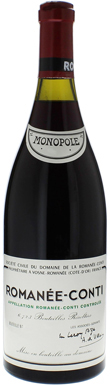

Young Romanée-Conti is sometimes enigmatic, with its greatness obscured. If this bottle was any indication, however, the potential of the 2020 vintage is already...
2020
Domaine de la Romanée-ContiRomanée-Conti Grand Cru Monopole

