Castello Banfi: producer profile plus 14 wines tasted
Stemming from a successful import business based in New York, Castello Banfi has become Montalcino's largest - and one of its most innovative - producers.
Get our daily fine wine reviews, latest wine ratings, news and travel guides delivered straight to your inbox.
You are now subscribed
Your newsletter sign-up was successful
Castello Banfi is Montalcino’s largest wine estate by far, occupying 2,870 hectares on the slopes a few kilometres to the south and southwest of the town, located in the province of Siena in Tuscany.
Banfi claims the largest contiguous vineyard in Europe: approximately 950ha of vines form a sprawling web of adjoined vineyards. The remaining two-thirds of the estate are made up of olive groves, wheat fields, plum trees, truffle stands, woodland and scrub.
See the tasting notes and scores for 14 top Banfi wines
At the heart of it all, at 280 metres, lies the ancient castle of Poggio Alle Mura. Ravaged by time – and particularly World War II – the castle was in need of repair and so, when the prestigious Poggio Alle Mura estate vineyards and castle were acquired by Banfi in 1983, the Mariani family immediately set about restoring it to its former glory.
Nowadays, the castle itself houses a glass museum and balsameria, while in its shadow you will find a hotel, two restaurants (including the one-Michelin-starred La Sala dei Grappoli) and an enoteca.
Banfi factbox:
Founded: 1978
Production: approximately 10 million bottles annually
Key wines: Poggio Alle Mura Brunello di Montalcino Riserva; Brunello di Montalcino; Cuvée Aurora Alta Langa; Summus Toscana
Get our daily fine wine reviews, latest wine ratings, news and travel guides delivered straight to your inbox.
Banfi Vintners was founded by Giovanni F. Mariani Sr in New York in 1919, naming it after his mother’s family name. Prohibition came into effect the following year but the company survived by importing Italian delicacies and producing medicinal bitters. As soon as the repeal was announced, Mariani began seeking out new agencies, and Banfi Vintners soon became a successful wine importer specialising in Italian, German and French wines.
In 1963 Mariani handed the company over to his two sons, John Jr. and Harry, who had joined the company several years earlier. His daughter Joan had also worked for the company in the 1950s, until she married.
Banfi Vintners shot to success in 1969 thanks to the popularity of Riunite Lambrusco, which the company introduced to the USA.
The company was pivotal in introducing American consumers to ‘new’ Italian wines. It already imported Castello Poggio Alle Mura’s wines (the estate it would later acquire in 1983), one of the very few in Montalcino that produced enough volume to export, and in 1978 John Jr. and Harry founded the Castello Banfi estate in Montalcino. A year later, they also acquired the 50ha Bruzzone estate in Strevi, Piedmont.
Banfi is now headed by cousins Cristina Mariani-May (John’s daughter) and James Mariani (Harry’s son), the third generation of the family.
The company today has holdings not only in Montalcino and Piedmont, but also in Bolgheri, Maremma and Chianti Classico, enabling it to produce a representative slice of Tuscan – and Piedmontese – oeno culture. Its wines are now exported to over 90 countries around the world.
The Banfi projects
Castello Banfi’s success brought opportunities to experiment, and so it began a series of groundbreaking studies and projects. The first, initiated in the 1980s, was to research the 650 or so Sangiovese clones found in the surrounding area, with the aim of identifying the best clones to be used for future replanting. This proved to be a laborious but rewarding project which continued through the 1990s and into the 2000s.
Banfi also turned its attention to the vessels used for ageing its wines. Timbers from the forests of Allier, Nevers, Fontainebleau and Tronçais in France were identified as the ideal oak for Banfi’s barriques, while Slavonian oak would continue to be used for larger barrels.
Cut into staves, the wood is stacked outside for three years (rather than the traditional two years) in a heptagonal structure to allow for even weathering, before undergoing a slow, light toasting process. Banfi specifies a custom size for its barriques of 350l rather than the typical 225l, constraining the influence of the wood by reducing the percentage of wine in contact with its surface area.
‘After carefully studying the soils of our estate, researching the best local clones of Sangiovese to match with those soils, and then studying different woods and barrel types, we are able to highlight the optimal expression of Sangiovese. What we needed was to find a fermentation process that could further build on these strengths,’ said Mariani-May in a previous interview with Decanter.
This fermentation process was an initiative instigated by Mariani-May, dubbed Horizon – a vinification centre within the winery to handle some of Banfi’s finest wines.
The hand-picked grapes are sorted both in the vineyard and then on sorting tables in the winery, before being placed into unique composite fermenting vessels. A combination of stainless steel base and head, and a central band of replaceable oak staves, these vessels enable the best of both worlds for Banfi: the temperature control and fresh flavours of stainless steel, and the aeration and rounded character of oak.
This is intended to produce softer, less astringent wines, ensuring they are more accessible early in their lifespan – perfect for appealing to Banfi’s export markets. Twenty-four of these vessels came on-stream in 2007 after seven years of trials, and are used for fermenting several of the estate’s wines, including its Brunellos.
Innovation
In 1995, Banfi introduced the first SuperTuscan from Montalcino, Summus, a blend of Sangiovese, Cabernet Sauvignon and Syrah.
In 2001 Banfi took part in a project to resurrect the ‘forgotten’ grape, Alberossa, and along with three other wineries succeeded in getting it added it to the list of permitted varieties under the Monferrato DOC regulations. This resulted in the rare varietal Alberossa, La Lus, released in 2006, which has proven a surprising hit with consumers.
Banfi has been innovating since its earliest days. It’s testament to its continual drive for quality that, despite its size, it is willing to undergo such projects.
Tasting notes and scores for the range of Banfi wines:
You may also like:
Brunello di Montalcino 2004: a retrospective
Rosso di Montalcino: Brunello’s charming little brother
Chianti Classico: a glowing future plus 12 must-try wines
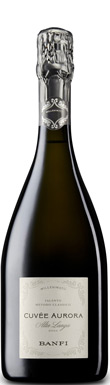
Castello Banfi, Cuvée Aurora, Alta Langa, Piedmont, Italy, 2016

Since 1990, Banfi have been at the cutting-edge of metodo classico wines in the region, taking part in a project with six other wineries to produce high quality sparkling wines. The Alta Langa DOCG was finally awarded in 2008, specifically for metodo classico wines. Aurora ('new dawn') is a blend of at least 70% Pinot Noir, with Chardonnay making up the remainder. Lees-aged and hand-riddled for at least 30 months, it has a gentle scent of bright lemon, apple and buttered bread. In the mouth a sherbet character makes way for pretty flavours of green apple, satsuma, lemon, white flowers, and a very fresh, saline finish featuring the slightest touches of wood, cream, nougat and brioche. Still youthful, this will mature nicely. 4g/L residual sugar.
2016
PiedmontItaly
Castello BanfiAlta Langa
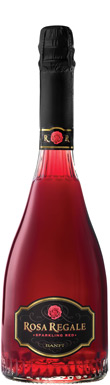
Castello Banfi, Rosa Regale, Brachetto d’Acqui, Tuscany, Italy, 2020

This single-vineyard Brachetto from near Acqui Terme, in the heart of the DOCG, has an eye-catching cherry red colour with scents of ripe autumn berries, vanilla, icing sugar and herbs. Rich cherry and strawberry fruit flavours are joined by darker, plummy depths. Soft, juicy and sweet, this sparkling wine has plenty of freshness to keep it balanced, and the herbal bitters character on the finish emphasises this. At just 7%, this is a fantastic lunchtime treat to pair with cured meats and fresh bread.
2020
TuscanyItaly
Castello BanfiBrachetto d’Acqui
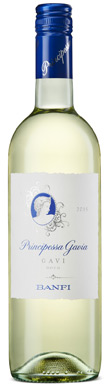
Castello Banfi, Principessa Gavia, Gavi, Piedmont, Italy, 2019

From a single vineyard in Novi Ligure, this Gavi has a fresh, nutty, herbal and floral character leading to a honeyed palate dripping in apricot, baked apple, herbs and spice. It's zesty and well balanced, and the long finish is packed with lemon and pear flavours.
2019
PiedmontItaly
Castello BanfiGavi
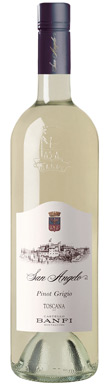
Castello Banfi, San Angelo Pinot Grigio, Toscana, Tuscany, Italy, 2019

This Pinot Grigio, from Banfi's Montalcino vineyards surrounding the castle, is a characterful take on the variety. Herb, apple and peach aromas are followed by a good intensity of lip-smacking lemon and lime flavours along with white flowers, then hints of soft peach and herbs on the finish.
2019
TuscanyItaly
Castello BanfiToscana
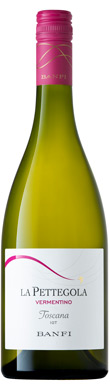
Castello Banfi, La Pettegola Vermentino, Toscana, Tuscany, Italy, 2019

The Vermentino grapes for La Pettegola are grown in the coastal Maremma region of Tuscany. The result is a fresh wine with floral apple scents followed in the mouth by a nice intensity of green apple, pear, elderflower, and citrus zest, with a sliver of honeycomb on the mid-palate. There's a lovely dry steeliness on the finish, along with some Maremma salinity. Delicious!
2019
TuscanyItaly
Castello BanfiToscana
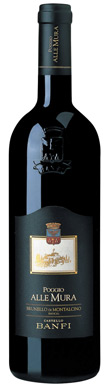
Castello Banfi, Poggio Alle Mura, Brunello di Montalcino, Tuscany, Italy, 2015

Sourced solely from prime Sangiovese clones identified during Banfi's years of clonal research and planted here in 1992, grown on the slopes below the castle on reddish soils with clay sediments. It'a a more herbal, dark-fruited rendition compared to the standard Brunello, with an intense palate displaying bold tannins and ripe blackberry, blackcurrant and black cherry. It's richness of dark fruits arguably makes this a Brunello ideally suited to the estate's international markets - particularly the USA. Matured for two years in 40% French oak casks and 60% 350L French oak barriques.
2015
TuscanyItaly
Castello BanfiBrunello di Montalcino
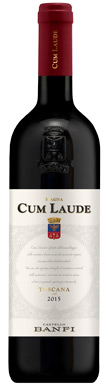
Castello Banfi, Magna Cum Laude, Toscana, Tuscany, Italy, 2016

A SuperTuscan-style blend of 30% Cabernet, 30% Merlot, 25% Sangiovese and 15% Syrah from estate vines to the south of Montalcino town, fermented individually in hybrid Horizon tanks. Afterwards, the Sangiovese is matured in large barrels, and the other varieties in 35hL barriques for six to eight months before blending and further ageing for up to eight months. Barrel notes of cedar, sweet spices and black pepper are joined by spicy cherry, juicy blackberry, coffee and violet. In the mouth it is concentrated and full, with bright raspberry and strawberry streaks breaking through darker notes of plum, blackberry, black cherry and tobacco. Black and white pepper combine with some sweet spices and a juicy vein of blackcurrant and violet on the long finish.
2016
TuscanyItaly
Castello BanfiToscana
Castello Banfi, Aska, Bolgheri, Tuscany, Italy, 2017
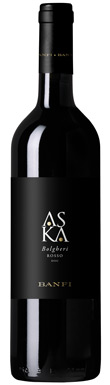
Fermented in steel then matured for 10 months in 225L and 350L French oak barriques for around 10 months, this Cabernet Sauvignon with a small amount of Cabernet Franc has a minty, herbal aroma backed by rich, dark berries. It's richer, juicier and more intense than the Belnero which hails from Montalcino, with a chocolate shade to the blackberries and blackcurrants, joined by some herbal accents. The acidity is delightfully fresh, and leads the palate to a long, mint-chocolate conclusion.
2017
TuscanyItaly
Castello BanfiBolgheri
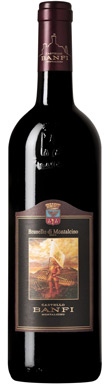
Castello Banfi, Brunello di Montalcino, Tuscany, Italy, 2015

Banfi's Brunello needs little introduction - it is one of the most widely exported examples from the DOCG and is a very reliable style. Vinified in Banfi's unique hybrid tanks since the 2007 vintage, then matured for 24 months in 80% French oak casks and 20% 350L French oak barriques, it gains a soft and silky palate with gentle aromas of cherry fruits and a fresh, bright character. Red cherry and vanilla are supported by ripe, chocolatey tannins and lead to a long finish. A delicious, accessible Sangiovese from Montalcino, but lacks some complexity.
2015
TuscanyItaly
Castello BanfiBrunello di Montalcino
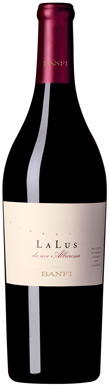
Castello Banfi, La Lus Albarossa, Monferrato, Piedmont, Italy, 2017

The Albarossa crossing was created in 1938 by Professor Giovanni Dalmasso, originally thought to be a crossing of Barbera and Nebbiolo, but much later shown to actually be a crossing of Barbera and Chatus (AKA Nebbiolo di Dronero). After decades languishing in the shadows, in 2001 four Piedmontese wineries - including Banfi - decided to invest in its future and the variety was recognised under the Monferrato DOC. The first Albarossa wines were released in 2006. The grape remains scarce to say the least, however, with around 10ha planted in the whole of Italy, making this 100% Albarossa extremely rare indeed. Chocolate, violet and sweet strawberry scents dominate, with a hint of mint. In the mouth it has good freshness balancing good intensity of heady red and black fruits, followed on the mid-palate by chocolate and raspberry coulis. There are some wood and black pepper notes on the long, minty-fresh finish, with just a slight touch of alcohol warmth. Aged in French oak barriques for 12 months. An interesting and delicious study in rare varietals.
2017
PiedmontItaly
Castello BanfiMonferrato
Castello Banfi, Rosso di Montalcino, Tuscany, Italy, 2018
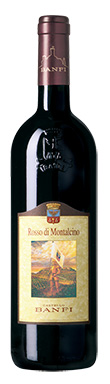
Vinified in Banfi's hybrid tanks, the wine is then matured for 12 months in barrique and large oak barrels. A fresh cherry scent precedes a juicy palate full of cherry and strawberry flavours, with a brush of herbs and subtle texture. The finish is soft and features a drop of chocolate and mint alongside some wood and cream. An easy-drinking Rosso.
2018
TuscanyItaly
Castello BanfiRosso di Montalcino
Castello Banfi, Belnero, Toscana, Tuscany, Italy, 2016
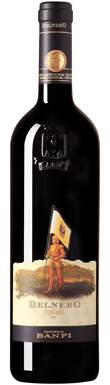
From vineyards in the southern hills of Montalcino, this red is a blend built around Sangiovese, with Cabernet Sauvignon and Merlot too. The wine is fermented in Banfi's hybrid steel and oak tanks, then aged in 350L French oak barriques and large casks for around 14 months. It is bottled unfiltered under nitrogen to minimise the use of sulphites. The nose is fresh and laden with berries, followed by a mouthful of fresh, ripe red and black berries with hints of chocolate, wood and tobacco. Fine, grainy tannins give it structure, but it's ultimately missing some complexity and interest.
2016
TuscanyItaly
Castello BanfiToscana
Castello Banfi, Summus, Toscana, Tuscany, Italy, 2016
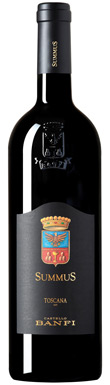
From grapes grown around the castle in Montalcino, this blend of Sangiovese, Cabernet and Syrah has a plummy, herbal scent with dark berries and some peppery spice. In the mouth it displays rich, concentrated red and black berries on a textured palate, with subtle tannins providing structure, then a finish of sweet spices, liquorice and a touch of herb and violet. Vinified in Banfi's hybrid tanks and aged for up to 24 months in 350L French oak barriques and large casks.
2016
TuscanyItaly
Castello BanfiToscana
Castello Banfi, Centine, Toscana, Tuscany, Italy, 2018
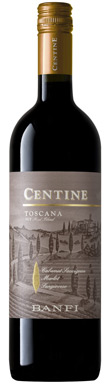
From hillside sites in southern Tuscany, this entry-level blend of Sangiovese, Cabernet and Merlot has a typical nose of bright red fruits, joined in the mouth by some darker notes of black cherry, blackberry, and hints of herbs and cassis. A straightforward but identifiably Tuscan red that provides a good introduction to Banfi's range of red wines.
2018
TuscanyItaly
Castello BanfiToscana

James Button is Decanter’s regional editor for Italy, responsible for all of Decanter's Italian content in print and online.
Like many others, he started his wine career at Majestic Wine, giving him a strong grounding in the subject before successfully completing the WSET Level 4 Diploma in 2010. From 2014 to 2016 he managed the fine wine department of a startup wine company in London, before joining Decanter as digital sub-editor.
Outside of wine, James enjoys cooking, skiing, playing guitar and cycling.