
Burgundy: a complete guide to Corton
Burgundy expert Charles Curtis MW takes you on a tour of Corton in this in-depth report, and picks out 27 top-rated wines from this 'outlier' of the Côte d'Or.

Corton stands alone. So much so that one client of the Hospices de Beaune, a great lover of Corton, proposed a revision of the Côte d’Or: in addition to the Côte de Beaune and the Côte de Nuits, he felt that there should be a Côte de Corton since the wines are so distinctive.
In geological terms, the hill of Corton is an outlier—a freestanding hill, separated from the rest of the Côte by erosion.
Scroll down to see Charles Curtis MW’s Corton tasting notes and scores
It is also located in a transitional area in the Côte d’Or. Right at the hill’s northern side, tectonic forces pushed down the older layers of Bathonian and Bajocian limestone and elevated the younger Oxfordian limestone.
The bedrock here is softer and mixed with more clay and marl, producing reds that are more supple and approachable in their youth than those from grapes grown in the Côte de Nuits.
The appellation itself is also a bit of an outlier.
In former times, it was highly esteemed. In his seminal 1855 work, Dr. Jules Lavalle remarks, ‘the wines of Corton are closer to the wines of Chambertin than to any other wine of the Côte d’Or’. High praise indeed, and far from universally shared today.
Still, an investigation is warranted if an authority as eminent as Dr. Lavalle was convinced of its merit. Aubert de Villaine is convinced as well. In 2008, Domaine de la Romanée-Conti leased 2.28 hectares of vineyards in Corton from the estate of the Prince de Mérode, and in 2018 it leased a further 2.91 hectares of Corton Charlemagne from Bonneau du Martray.
A savvy collector might well decide to follow in their footsteps, even if it means bucking current trends. Prices for many Cortons remain surprisingly reasonable (for the time being), but if recent Burgundy price trends are any indication, now is the time to stock up.
How it all began
To understand the wines of the hill of Corton, it might be easiest to start at the beginning.
Among the hill’s original vines were those donated in 775 AD by Charlemagne to the Abbot of Saulieu. The Basilica in Saulieu dates originally to the second century AD, where it was founded on the site of martyrdoms during the reign of Marcus Aurelius.
In the eighth century, the Basilica was destroyed by Saracens shortly after the foundation of the abbey. The monastery and its church were rebuilt by Charlemagne, who made it his ‘royal church’ and donated vines located on the hill of Corton to the abbey.
The original location of these vines is in dispute, but the vines included in this donation (along with others) remained under the church’s ownership for just over a millennium.
Camille Rodier, writing in the early 20th century, informs us that the vines originally donated by Charlemagne corresponded almost precisely to the holdings of the Bonneau du Martray family, which straddle the line between Pernand-Vergelesses and Aloxe-Corton.
Their ancestors purchased this 24-hectare vineyard shortly after the French Revolution. This family, descendants of 14th-century powerbroker Nicolas Rolin, retained ownership until American billionaire Stan Kroenke purchased the property in 2017. Emmanuel Hautus currently leads the winery team with Fabien Esthor in the vineyard.
White wines
One thing is sure: these vines were in white wine territory.
This part of the hill faces south-west, and it is not as sunny and warm as the east-facing slopes. The cooler location is a disadvantage for red wine, but it works well for white wines—especially in these times of global warming.
The vines that face most directly to the west are those in the commune of Pernand-Vergelesses in the climat ‘En Charlemagne’.
Today it can produce either red Corton or white, and both have grand cru status. The whites are normally called Corton-Charlemagne, although they may also be called simply ‘Charlemagne’. En Charlemagne was ranked in the first class (Première Cuvée) for white by Dr. Lavalle, writing in 1855, but in his view, the red wines merited only third class (Troisième Cuvée).
En Charlemagne is contiguous with a climat called Le Charlemagne in neighboring Aloxe-Corton. Le Charlemagne was also highly esteemed by Dr. Lavalle, who ranked it above the first category (‘Hors Ligne’) in his work.
Today, this vineyard produces both red and white, although here, too, it seems that the whites generally have the edge. More top-quality whites are produced along the very top of the hill, where the slightly cooler temperatures and white marl soils are well suited to Chardonnay production.
The climat called Le Corton is at the top of the hill along the northern limit of the village of Aloxe-Corton. Just to the south is Les Languettes, followed by Les Pougets. Each of these can today produce either Corton-Charlemagne, Charlemagne, or red Corton.
The largest landowner on the hill of Corton is Maison Louis Latour, with nearly 24 hectares in total, including almost 10 hectares of Chardonnay.
The firm began to amass holdings in Corton in 1890 when it acquired the château and vineyards of the Count de Mandat-Grancey upon his death. As Latour’s director, Christophe Deola, explains, the vineyards near the top are steep with a 25% slope that faces south-south-west in moderately deep, lime-rich Oxfordian marl soils.
They also own plots further downslope in Corton Pougets and Languettes, exposed to the south with a lesser slope. ‘These give a broader wine, and the regular access to the water slows the maturation and brings more flesh to the wines,’ says Deola.
‘The steep upper portion of Le Charlemagne gives more minerality and tension, and Languettes is often picked first because of the poor soils and the exposition, but the acidity is always good.’
Another notable producer in these lower slopes is the legendary Domaine Coche-Dury, directed today by Raphaël Coche.
Raphaël’s father, Jean-François, rented a parcel of 0.33 hectares in Le Charlemagne in 1985 and began to bottle the wine the following year. The wine has achieved legendary status over the years, with vintages routinely selling for more than £3.600/US$5,000 per bottle.
In 2012 the domaine purchased the plot they had been leasing and acquired three more, increasing their total holding to 0.88 hectares. One of the plots is near the bottom of the slope where the soils are deepest; the other three are together at mid-slope.
This profile contributes to the highly luxurious nature of the wine, particularly when combined with Coche’s perfectionist technique in the cellar.

Top Potential
Among the climats producing predominately or exclusively red wine, Lavalle singled out Corton-Renardes and Clos du Roi above the rest, with Chaumes rated slightly lower.
Today Les Renardes and Le Clos du Roi can produce spectacular wine. Among the most engaging producers of wine from Les Renardes is Michel Mallard.
Mallard oversees his family domaine in Pernand-Vergelesses with his sons, in addition to shouldering the winemaking at the Domaine d’Eugenie, owned by French billionaire François Pinault.
The Mallard family owns a parcel of 0.65 hectares that stretches from Le Corton at the top of the slope down to the road, planted to vines that average at least 50 years. The soil here is thin, with clay broken up by pebbles of oolitic and bioclastic limestone, a soil type is typical of Ladoix.
Christine Gruère-Dubreuil of Dubreuil-Fontaine notes that the thinner topsoil here delivers an elegant, balanced wine that is not as forward as Bressandes further down the slope but has substantial tannins and the ability to age.
Just to the south of Renardes is Clos du Roi. As the name suggested, this parcel formerly belonged to the King of France. One domaine to watch here is Chandon de Briailles, which has been family-owned since 1832. It is managed today by Claude de Nicolay and her brother François. Claude is a trained oenologist who is married to Frédéric Drouhin. The pair use biodynamic methods—certified by Demeter—to produce a massive but hugely elegant wine from their 0.45 hectares of vines in Clos du Roi.
Ludavine Griveau, the regisseur of the Hospices de Beaune, notes that Clos du Roi often ripens a bit later. The soil has many pebbles and even higher limestone content. It often ripens after Bressandes and gives wines in between those of Renardes and Bressandes.
‘There is a quintessence of the hill of Corton expressed here that has the subtle nature of Bressandes and the structure of Renardes,’ says Griveau. ‘It is a complete expression of Corton. The grapes are always perfectly healthy since the site is well exposed and very agreeable to the vine.’
The Hospices cuvée Baronne du Baÿ is 100% Corton Clos du Roi.
Mid-slope marvels
Bressandes is the large swath of vineyard down the slope from the Clos du Roi and Les Renardes. It is flatter here, and the vines have an east-south-east exposition. The soils are rich in iron and loamy clay and are leavened with plenty of gravel and sit over Bathonian and Comblanchien limestone.
South of Bressandes lies Les Grèves and Les Perrières as the hill begins to face due south. The village of Aloxe-Corton is located here, nestled into the smaller climats of Les Fiètres and Les Meix.
The Clos des Meix is the monopole of the Domaine du Comte Senard, run today by Lorraine Senard. Senard’s holdings are not limited to the Clos des Meix. They produce no fewer than seven different grand cru Corton bottlings, including Perrières, Paulands, Clos du Roi, Bressandes, Corton-Charlemagne, and Corton Blanc. The wines are models of elegance and finesse.
Beyond the Clos des Meix lies the La Vigne au Saint surrounded by Corton Les Chaumes. These climats provide similar growing conditions as those on the other side of the village at the same elevation.
Christophe Deola of Latour explains, ‘For the reds, soils that are richer in clay, such as La Vigne au Saint, and to a lesser extent Chaumes, Clos des Chaumes, and Bressandes, give fleshier wines. Because there is a bit more water here, the wines are rounder, more supple, and overall richer on the palate and need a longer maturation.
‘Poor soils such as those in Perrières and Grèves give more serious wine because of the water stress. These conditions increase the tannins and give a certain austerity to the wines but also more minerality. The Clos du Roi and the wines around the Château offer a synthesis of this style, between the serious, the classic, and the more sensual aspect tied to the clay soils.’
Lonely Ladoix
Corton doesn’t stop at the commune border of Aloxe but extends to the north into the commune of Ladoix-Serrigny.
For many years, the vines of Ladoix-Serrigny were underappreciated. In his work on the region, Lavalle glosses over them entirely and includes none in his assessment.
This judgment, however, seems a bit harsh. They tend to be ignored because they are east/north-east facing, but some are essentially extensions of highly regarded sites in Aloxe.
The Clos des Cortons Faiveley is a perfect example. This 3.02-hectare monopole owned by Faiveley is essentially a continuation of Les Renardes just over the border in Ladoix. There is also Corton Vergennes, a 3.45-hectare parcel.
Part of this is a continuation of Bressandes, and part of it is the extension of Maréchaudes, which lies down-slope from Bressandes. Both red and white wines are produced here.
Famed négoçiant Paul Chanson willed a site in Vergennes to the Hospices that was planted to white grapes. He claimed they were ‘More Pinot Blanc than Chardonnay’. The modern-day vineyards director for Chanson quickly dispelled the notion, although the wine remains intriguing.
Finally, there is an interesting slice of oddly-shaped vineyard, Le Rognet et Corton. At 8.58 hectares, it is relatively large, but the contours are irregular.
The southern portion of the climat reaches down to touch Renardes and Bressandes, while the rest spreads to the north of Vergennes. Just over two hectares is classified for Pinot Noir only, but the balance can be red or white.
In this section, Domaine Méo-Camuzet owns a tremendous old vine parcel which it bottles as Clos Rognet.
There are still more vines classified as grand cru in Ladoix, but most of these were promoted to grand cru status fairly recently, and few produce wines of great distinction.
Even without these late additions, the vineyards of Corton have more than enough to command any wine lover’s attention.
Charles Curtis MW’s Corton tasting notes and scores
You may also like
Join Charles Curtis MW for a superb Burgundy masterclass at DFWE London
Decanter’s London Fine Wine Encounter 2023: Priority booking now open
Burgundy 2019 en primeur: Full report plus top-scoring wines
Domaine de la Romanée-Conti, Corton Grand Cru, Burgundy, France, 2010
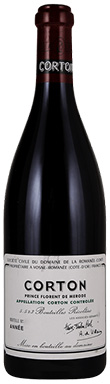

The Corton from Domaine de la Romanée-Conti is produced from vines leased from the Domaine Prince Florent de Merode, and is blended from Clos du...
2010
Domaine de la Romanée-ContiCorton Grand Cru

Domaine Faiveley, Clos des Cortons Faiveley Grand Cru Monopole, Burgundy, France, 1978
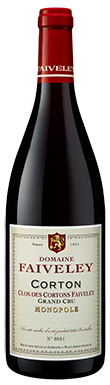
This was a superb bottle, recently consumed from a private collection. The bouquet showed a truly lovely evolution, yet it is holding quite well. There...
1978
Domaine FaiveleyClos des Cortons Faiveley Grand Cru Monopole
Domaine Faiveley, Clos des Cortons Faiveley Grand Cru Monopole, Burgundy, France, 2018
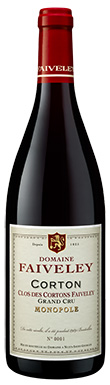
The Clos des Cortons Faiveley near the top of the Corton et Rognet slope has been in the family since 1874. This site, just over...
2018
Domaine FaiveleyClos des Cortons Faiveley Grand Cru Monopole
Domaine Michel Mallard, Corton Les Renardes Grand Cru, Burgundy, France, 2018
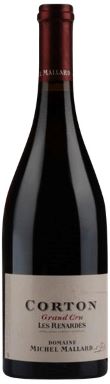
A massive wine that has all the components but needs time to show its best. Mallard owns a 0.65 hectare parcel in Les Renardes that...
2018
Domaine Michel MallardCorton Les Renardes Grand Cru
Domaine Comte Senard, Corton Clos des Meix Monopole Grand Cru, Burgundy, France, 2018
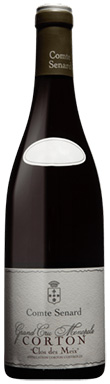
This 1.64-hectare monopole of Comte Senard is nestled into the hill near the village facing due south. The 2018 vintage is concentrated and ripe; half...
2018
Domaine Comte SenardCorton Clos des Meix Monopole Grand Cru
Domaine Méo-Camuzet, Corton Clos Rognet Grand Cru, Burgundy, France, 2010
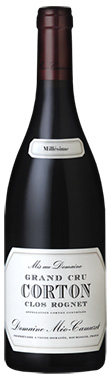
Mysterious Corton: this 0.45-hectare clos is located at the bottom of the grand cru slope in Ladoix between Les Vergennes and Les Grandes Lolières and...
2010
Domaine Méo-CamuzetCorton Clos Rognet Grand Cru
Domaine Chandon de Briailles, Corton Clos du Roi Grand Cru, Burgundy, France, 2017
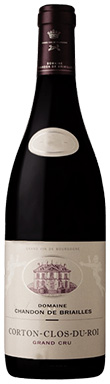
The domaine owns 0.45 hectares of Corton Clos du Roi, planted to 60-year-old vines. In 2019, these delivered a massive wine that was the least...
2017
Domaine Chandon de BriaillesCorton Clos du Roi Grand Cru
Domaine Michel Mallard, Corton Le Rognet Grand Cru, Burgundy, France, 2018
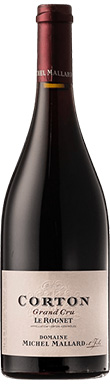
Produced from two parcels in Ladoix totaling 1.27 hectares. The larger parcel is at the base of Le Rognet across from Les Grandes Lolières; the...
2018
Domaine Michel MallardCorton Le Rognet Grand Cru
Dubreuil-Fontaine, Corton Clos du Roi Grand Cru, Burgundy, France, 2015
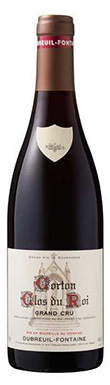
Two mid-slope parcels of Clos du Roi deliver a classic Corton with ripe black plum fruit and a stony, almost saline minerality. The wine shows...
2015
Dubreuil-FontaineCorton Clos du Roi Grand Cru
Hospices de Beaune, Cuvée Charlotte Dumay, Corton Grand Cru, Burgundy, France, 2002
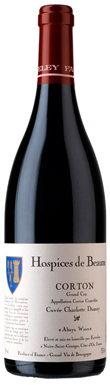
The Hospices is a significant owner of vines in several Corton climats. This wine is their largest cuvée, assembled from Bressandes (one-third) and Renardes (two-thirds),...
2002
Hospices de BeauneCorton Grand Cru
Domaine Faiveley, Clos des Cortons Faiveley Grand Cru Monopole, Burgundy, France, 2017
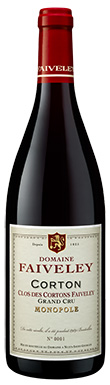
This was a superb showing in 2017 for this classic wine from Faiveley. Thin soils and east-facing exposure ripen fruit well, and the harvest in...
2017
Domaine FaiveleyClos des Cortons Faiveley Grand Cru Monopole
Domaine Michel Mallard, Corton Maréchaudes Grand Cru, Burgundy, France, 2018
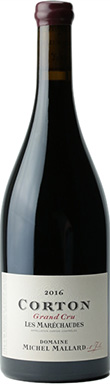
Remarkably dense and lush for a Maréchaudes. The climat lies near the bottom of the slope on the border with Aloxe in land that was...
2018
Domaine Michel MallardCorton Maréchaudes Grand Cru
Domaine Chandon de Briailles, Corton Les Bressandes Grand Cru, Burgundy, France, 2017
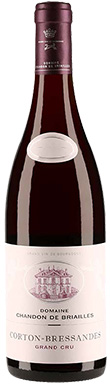
Produced from a 1.45 hectare holding in Bressandes, this gives a wine with bright, high-toned cherry fruit and pleasant floral aromas. The wine is less...
2017
Domaine Chandon de BriaillesCorton Les Bressandes Grand Cru
Domaine Marius Delarche, Corton Les Renardes Grand Cru, Burgundy, France, 2018
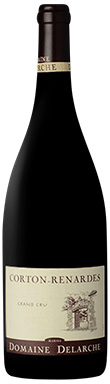
There are two parcels in Renardes that Etienne Delarche used to demonstrate how successful 2018 could be for those who avoid exaggeration in this torrid...
2018
Domaine Marius DelarcheCorton Les Renardes Grand Cru
Bouchard Père & Fils, Corton Le Corton Grand Cru, Burgundy, France, 2018
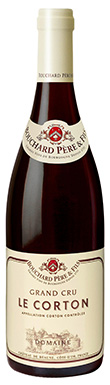
In 2018 the picking began on 5th September and yielded a rich, ripe red and black berry fruit character, yet there was no sense of...
2018
Bouchard Père & FilsCorton Le Corton Grand Cru
Dubreuil-Fontaine, Corton Les Bressandes Grand Cru, Burgundy, France, 2016
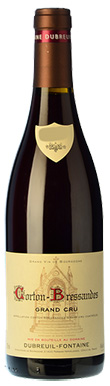
The wine shows classic red berry fruit coloured with savoury, earthy notes and a slightly herbaceous cast. The texture is lively and fresh, and the...
2016
Dubreuil-FontaineCorton Les Bressandes Grand Cru
Bouchard Père & Fils, Corton Le Corton Grand Cru, Burgundy, France, 2017
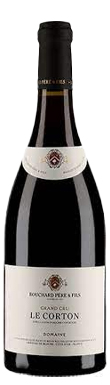
The red Corton from Bouchard is bright and fresh, with aromas of currant, pomegranate and kirsch. The wine is noticeably more tannic, and there is...
2017
Bouchard Père & FilsCorton Le Corton Grand Cru
Louis Latour, Corton Clos du Roi Grand Cru, Burgundy, France, 2016
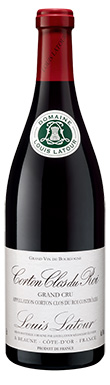
Aromas of candied plums accented with a suggestion of wild herbs and a savoury note give the nose of Latour's Clos du Roi a pleasant...
2016
Louis LatourCorton Clos du Roi Grand Cru
Louis Latour, Corton Clos de la Vigne au Saint Grand Cru, Burgundy, France, 2018
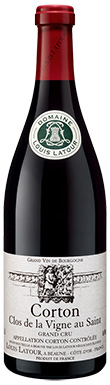
Latour owns the majority of Corton La Vigne au Saint in Aloxe, located down the slope from Chaumes just as the hill begins to shift...
2018
Louis LatourCorton Clos de la Vigne au Saint Grand Cru
Domaine Coche-Dury, Corton-Charlemagne Grand Cru, Burgundy, France, 1986
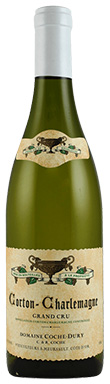
A celestial bottle, shared at the winery a few years ago with Jean-François and Raphaël Coche. The wine was mature, with notes of sous-bois and...
1986
Domaine Coche-DuryCorton-Charlemagne Grand Cru
Bonneau du Martray, Corton-Charlemagne Grand Cru, Burgundy, France, 2005
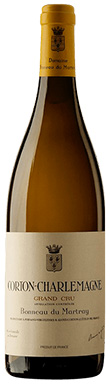
The 2005 vintage is a triumph, even 15 years after the harvest. The wine is superbly elegant and still light in colour. Today, there is...
2005
Bonneau du MartrayCorton-Charlemagne Grand Cru
Bouchard Père & Fils, Corton-Charlemagne Grand Cru, Burgundy, France, 2000
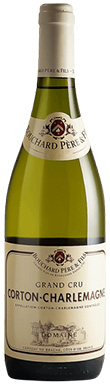
More than 20 years after the harvest, this wine is now at a beautiful point between fresh ripe apple and more developed notes, on the...
2000
Bouchard Père & FilsCorton-Charlemagne Grand Cru
Domaine Faiveley, Corton-Charlemagne Grand Cru, Burgundy, France, 2018
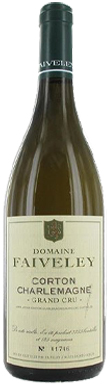
Here the richness of the 2018 vintage truly comes out. The Faiveley team began to pick on August 27th; here, the assemblage of the young...
2018
Domaine FaiveleyCorton-Charlemagne Grand Cru
Domaine Faiveley, Corton-Charlemagne Grand Cru, Burgundy, France, 2017
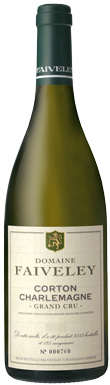
Young vines from the Clos des Cortons are assembled with vines from elsewhere on the hill to produce this fresh and citrusy wine that is...
2017
Domaine FaiveleyCorton-Charlemagne Grand Cru
Louis Latour, Corton-Charlemagne Grand Cru, Burgundy, France, 2018
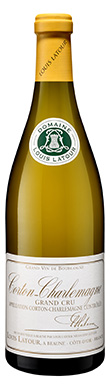
Despite the heat of the vintage and serious ripeness (14.5% alcohol), this is surprisingly elegant and nuanced. There is a pleasant lemony accent to the...
2018
Louis LatourCorton-Charlemagne Grand Cru
Louis Latour, Corton-Charlemagne Grand Cru, Burgundy, France, 2016
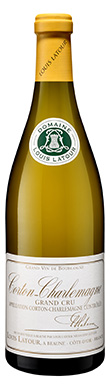
Latour owns 9.6 hectares in Corton Charlemagne, mostly in Le Charlemagne and En Charlemagne, but also in Languettes and Renardes. The Latour style of Corton...
2016
Louis LatourCorton-Charlemagne Grand Cru
Domaine Marius Delarche, Corton-Charlemagne Grand Cru, Burgundy, France, 2018
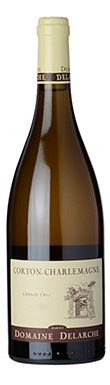
An unexpected delight. This Pernand-based domaine owns several parcels of old vine Corton Charlemagne, all from the west-facing En Charlemagne climat. Lovely fresh and crisp...
2018
Domaine Marius DelarcheCorton-Charlemagne Grand Cru