
First taste: Louis Roederer Collection 242
Simon Field introduces the new wine that replaces Roederer's Brut Premier.

Jean-Baptiste Lecaillon has long been regarded as the most gifted chef de caves of his generation; it is now increasingly clear that he is also the Champagne region’s most eloquent ambassador.
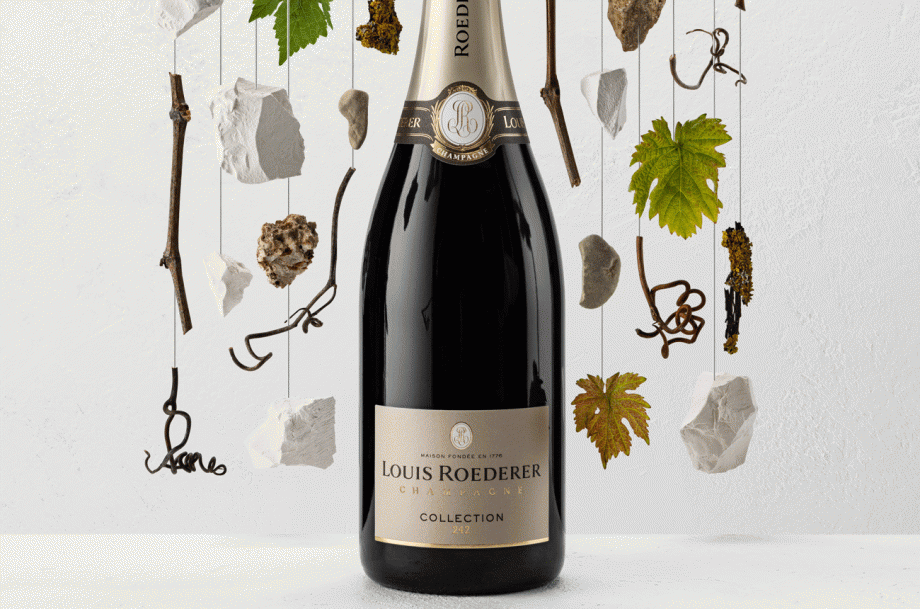
2021 marks a striking double for Roederer: the release of a superlative Cristal 2013 and – even more notable – the launch of Collection 242, which replaces the Brut Premier.
Scroll down for Simon Field MW’s Louis Roederer Collection 242 tasting note and score
A multi-vintage cuvée, the 242 is built on the same philosophy as the Jacquesson 7 series and Krug’s Edition.
The ‘242’ refers to the fact that the youngest vintage in the blend, 2017, is the 242nd harvest chez Roederer (Krug are only up to Edition 169!) Jean-Baptiste is quite specific; ‘this marks the end of the era of Brut Sans Année Champagne’. Quite a claim!
Louis Roederer Collection 242 – a new approach
Is it justified? Lecaillon reminds us that when Brut Premier was introduced in 1986, the aim was to achieve consistency in a landscape still dominated by fertilisers, high yields and the legacy of some dreadful harvests in the 1970s.
Late picking, oxidative treatment of reserve wines and generous levels of dosage were all used as a means to achieve – or to give the impression of achieving – ripeness. The house style was born of negation and necessity.
2002 is cited as the year when all this changed. Suddenly, with climate change no doubt playing its part, the struggle for ripeness was over. Now there was emphasis on site, soil and the key word changed from ‘ripeness’ to ‘freshness’.
No longer the philosophy which Lecaillon describes as the ‘corrective mechanic’; on the contrary the impulse was towards creativity and ‘constant adaptation in the face of the year in question’.
The non-vintage cuvée was henceforth to be described as multi-vintage and, what is more, ‘to be treated like Cristal’, with emphasis on and control over individual sites and a long-standing commitment to “renaissance viticulture, with adherence to a greater or lesser degree to both organic and biodynamic principles’.
Introducing Perpetual Reserve
The Brut Premier was a terrific wine and, of course, always contained a significant proportion of reserve wine.
Where the Collection is different is that the reserve wine’s 44% is now shared between oak-aged individual vintages (10% made up of 2009, 2011, 2013, 2014 and 2016) but also, most significantly, of 34% from a Perpetual Reserve, which was started in 2012 and is now making its debut.
The Perpetual reserve is aged in a reductive fashion and thus is key to the inculcation of that most beguiling combination, freshness and maturity at the same time, the holy grail of the Champenois.
The fact that 2017 was a tricky vintage (frost early on and then mildew problems) is of scant concern to Lecaillon; the husbandry in the vineyard and meticulous selectivity thereafter has, in fact, provided the perfect raw materials for this launch.
Freedom in blending
It is hard not to share his enthusiasm, an enthusiasm fully supported by the Rouzaud family who own Champagne Louis Roederer.
Chardonnay was recognised as being a little more successful than the Pinot Noir in 2017, and makes up 42% of the blend, a little higher than ‘usual’; otherwise the assemblage has not changed per se. The wine has a dosage of 8g/L and was disgorged in March 2021.
All in all, a terrific achievement.
Let’s leave the last word to Lecaillon: ‘We now have more freedom in the blending… this wine is very alive, very fresh, very Roederer’. Very Roederer indeed, and for all the discussion of the ‘sacrifice’ of a house style, this fundamental identity persists, built as it is on long-standing traditions and respect for nature and her grapes. This is, nonetheless, a most impressive development.
See Simon Field MW’s Roederer Collection 242 tasting note and score
Related content
First taste: Louis Roederer Cristal 2013
First taste: Krug new releases
Roederer reveals new still wines from the Champagne region
Louis Roederer, Collection 242, Champagne, France

<p>Fresh, vibrant nose displaying aromas of orange, lime peel, almond, honey and brioche with ripe quince and sweet pear undertones. Great focus and length on...
Louis Roederer

