Get our daily fine wine reviews, latest wine ratings, news and travel guides delivered straight to your inbox.
You are now subscribed
Your newsletter sign-up was successful
An account already exists for this email address, please log in.
Producer profile: Champagne Jacquesson plus latest wines tasted
Boutique Champagne house Jacquesson is recognised around the world for its stylish and decidedly distinctive Champagnes – an identity that has been forged over more than 200 years. Yohan Castaing explores its history and tastes a range of their single-vineyard cuvées...
Founded in Châlons-sur-Marne by Memmie Jacquesson in 1798, the house was for a long time one of the most important in the region. It enjoyed an international reputation as a quality leader and innovative trendsetter.
Indeed, Adolphe Jacquesson, son of Memmie, took out a patent for his invention of the muselet, or bottle muzzle. He was equally a master of the art of blending and had a major influence on Johann Joseph Krug who, after working for Jacquesson, went on to found his own house in 1843.
Scroll down for Yohan Castaing’s Champagne Jacquesson tasting notes and scores
Jacquesson was also an early champion of the innovations of Jean-Baptiste François, pharmacist and inventor of the so-called ‘François reduction’ method. This revolutionised the production of sparkling wine by enabling winemakers to gauge more accurately the right amount of sugar to add in order to set off the second fermentation without creating more pressure than the bottle could withstand. The amount of bottles exploding in cellars was thus reduced from as high as 50% to just 4%.
The house of Jacquesson fell on hard times and suffered financial hardship in the latter part of the 19th century. In 1920, a family of wine brokers named de Tassigny purchased it with ambitious plans to restore its former glory.
However, that did not really come about until its acquisition in 1974 by the Chiquet family, they themselves wine brokers but also Champagne producers. The contemporary era for this once again stellar house began when operations were moved to Dizy, located in the heart of the Vallée de la Marne, just a few kilometres north of Epernay.
A different path
Things really took off for Jacquesson after 1988 under the leadership of the two Chiquet brothers, with Jean-Hervé in charge of sales and marketing, and Laurent focused on winemaking. Both are passionate wine connoisseurs who appreciate international wines as much as French ones.
Just as Adolph Jacquesson had been in his time, they proved to be radical innovators, notably by turning their backs on the accepted practice of seeking a consistent house style year in, year out, to which the traditional houses were so bound, a practice they found to be a hindrance for making the best Champagne possible in a given year.
Decanter newsletter
Get our daily fine wine reviews, latest wine ratings, news and travel guides delivered straight to your inbox.
Chiquet brothers, Jean-Hervé and Laurent
(Image credit: Credit Unknown)
They chose instead to highlight terroir and vineyard expression, as well as vintage character, in their Champagnes.
To accomplish their audacious vision, they restructured their vineyards and instigated major renovations in the cellar. A form of haute couture and herbicide-free viticulture became the norm. Yields were reduced, as was the dosage for the Champagnes vinified in wooden casks and aged in large 500-litre tuns or the 600-litre format known as the demi-muid. The use of sulphur was also reduced drastically in order to augment terroir expression.
In 2000, Jacquesson inaugurated the series of ‘numbered cuvées’ of a Champagne crafted in a way to express the innate character of the main vintage in the blend. It is a Champagne completely denuded of artifice, composed of a few reserve wines blended with a base wine from a recent vintage and a minimum dosage.
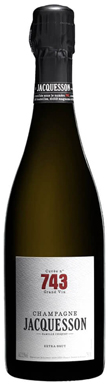
The house of Jacquesson had already started numbering its cuvées in 1898, and in 2000, this was the 728th, and so it was released as Cuvée 728, and so on, with rolling numbers for the following ones, culminating so far today with Cuvée N° 743.
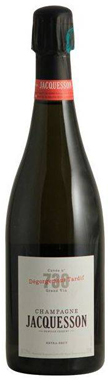
In addition to the now well-known numbered cuvée, Jacquesson also produces its DT cuvée, for Tardif Disgorgement, meaning late disgorgement. The current release is the Cuvée N° 738, benefiting from a prolonged period of ageing on the lees.
Single-vineyard range
Jacquesson owns nearly 29 hectares of vines, which provide nearly 80% of its grapes. Of this 29ha, 18ha are found in the sector of the Vallée de la Marne (including the grand cru village of Aÿ as well as Hautvilliers and the house’s home base in Dizy) and 11ha in the Côte des Blancs district (Avize and Oiry). Its portfolio also extends to four mono-cru, or single-vineyard, Champagnes.
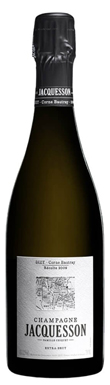
The first, located in Dizy, is called Corne Bautray. It is a plot of just 1ha, planted to 9,000 old Chardonnay vines dating back to 1920. It is a steep, southwest-facing slope composed of clay and chalk soils and lying close to a wooded area. It tends to produce fine and delicate Champagnes with a texture that is both chalky and crystalline.
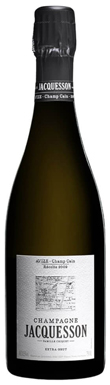
Champ Caïn, the second, is from a site in the heart of the Côte des Blancs near the village of Avize. 12,000 vines of Chardonnay planted in 1962 occupy 1.5ha on a south-facing lower slope of a hillside composed of clay, sand and silty soils. The Champagnes produced here are invariably wines of dense, structured substance balanced by a racy, mineral-driven elegance.
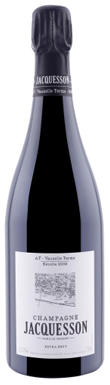
Next up is Vauzelle Terme, located near the village of Aÿ at mid-slope of a very steep, south-facing hillside with alluvial soils on a base of limestone and chalk. Some 2,500 Pinot Noir vines were planted in 1980 on this small 0.30ha plot. It produces full-bodied but finesse-driven Champagnes of remarkable precision that have a beguiling lightness of touch on the long finish.
Lastly, the very rare Terres Rouges cuvée, so named for the richness of its soil, and one could say as much for the deep hue of this rosé Champagne produced using the skin contact method.
The current releases of these mono-cru Champagnes are from the 2009 vintage. The growing season was marked by a cold and dry winter, a mild but quite rainy spring that led to outbreaks of mildew, followed by a hot and dry summer. Then came a magnificent period leading up to the harvest that saved the vintage, which is undoubtedly a great one.
As for the Cuvée N° 743, the base vintage is 2015, which experienced a mild but rather wet winter and spring, and then a hot and dry August, leading to an early harvest that began on 10 September, and lasted until the end of the month. It is a vintage marked by good acidity and excellent ageing potential.
See Yohan Castaing’s Champagne Jacquesson tasting notes and scores
Based on 2010 vintage, this possesses a stunning, yet complex bouquet of liquorice, apricot, smoke with menthol and fresh notes. With 96 months on lees,...
A textbook wine for the 2009 vintage. With pear, white peach, flowers and touches of honey, the bouquet is complex, but what is especially captivating...
This tiny parcel is planted with only Pinot Noir, on a south-facing slope. A delicate, elegant, racy and pure bouquet here that interplays nicely with...
Bordeaux native Yohan Castaing is a freelance journalist, based in France. He reviews wines from the Loire, Languedoc, Roussillon, Provence, southwest France and Champagne houses for The Wine Advocate. He founded Anthocyanes, a French wine guide, and Velvety Tannins, a guide to the wines of the Rhône Valley. He also writes for wine publications including Gault&Millau and Jancis Robinson. Castaing has held a variety of positions in the wine industry such as wine buyer and marketing director. He was a wine marketing consultant and the author of several books about wine marketing and wine tourism before, in 2011, he became a full-time freelance wine journalist focusing on the industry and wine reviews.