
First taste: Rare Champagne 2008
The latest release of this Pinot Noir-dominated prestige cuvée, tasted and rated.

Get our daily fine wine reviews, latest wine ratings, news and travel guides delivered straight to your inbox.
You are now subscribed
Your newsletter sign-up was successful
Rare indeed is the new release of a jewel among the Champagne offerings of the EPI group, which, in addition to owning both Piper-Heidsieck and Charles Heidsieck, also possesses Biondi-Santi, the prestigious Brunello di Montalcino estate in Italy.
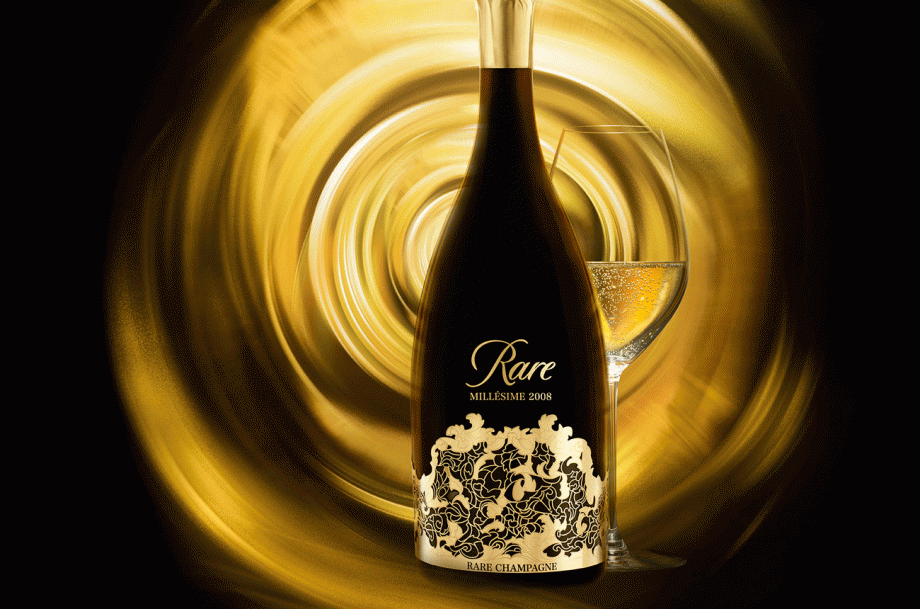
Cellar master Régis Camus chose this summer to put on the market the 2008 vintage of the prestige cuvée known as Rare Champagne, once a special tête de cuvée bottling produced only in exceptional years under the Piper-Heidsieck label before splitting off to become a brand in its own right in 2018.
Scroll down see the Rare Champagne 2008 tasting note and score
Ode to time
This is a Champagne described by the rather intimidating Camus – a major figure in the Champagne world, former cellar master of Piper-Heidsieck until 2018 but now involved exclusively with the production of Rare Champagne – as ‘an ode to time’.
He explains: ‘Rare Champagne is above all a matter of superlative vintages,’ hence the short roll call of vintage releases: 1976, 1979, 1985, 1988, 1990, 1998, 1999, 2002, 2006 and now 2008.
For the record, there also exists a cuvée of Rare Rosé Champagne released by Piper-Heidsieck for the 2007 and 2008 vintages.
Made to age
‘Rare Champagne has a strong and distinct stamp of identity,’ continues Camus. ‘It is a blend that is just about always the same: 70% Chardonnay and 30% Pinot Noir. It also has a style made for the long haul, with attributes that range from freshness and minerality to exotic fruit aromas that evolve toward a complex bouquet reminiscent of the West Indies.’
It is true that time is the ally of this exceptional Champagne. ‘Time is the fourth grape variety of the Champagne region,’ Camus says with amusement. The 2008 vintage, aged for almost 13 years before its release, is a superb example.
Get our daily fine wine reviews, latest wine ratings, news and travel guides delivered straight to your inbox.
Vintage conditions
Here is how Camus describes the growing season of 2008: ‘We had a very rainy winter with only a few spells of frost. The spring was also mild but rainy, and the flowering took place under low temperatures. July was also cool. Then came what is called the Champagne miracle. In August, the weather turned warm and sunny, which allowed the grapes to ripen perfectly, and the harvest took place in wonderful weather.’
This miraculous change in the weather accounts for the strong impression left by this tasting. Such a slow ripening of the berries meant that the acidities were quite high, so it took time for the wine to gain in elegance and evolve toward the inimitable creamy style of Rare Champagne at its best. This 2008 vintage impresses as much by its crystalline character as its vivacity and airy finish.
As for the vinification, the wine was not aged in barrels, only in stainless steel tanks, and went through full malolactic fermentation. The dosage was a perfectly balanced 9g/L.
Although as said, this 2008 Rare Champagne is very much in its usual creamy style, it has an added edge of an underlying nervy tension that provides striking structure to the wine. It evolves in the glass towards smoky notes, flint and a little vanilla, and that compelling benchmark autolytic character of aged Champagne. A hugely successful vintage.
Tasted & rated: Rare Champagne 2008
Related content
A taste of Rare Champagne with Régis Camus
First taste: Krug new releases
Guide to Pinot Meunier Champagne

Bordeaux native Yohan Castaing is a freelance journalist, based in France. He reviews wines from the Loire, Languedoc, Roussillon, Provence, southwest France and Champagne houses for The Wine Advocate. He founded Anthocyanes, a French wine guide, and Velvety Tannins, a guide to the wines of the Rhône Valley. He also writes for wine publications including Gault&Millau and Jancis Robinson. Castaing has held a variety of positions in the wine industry such as wine buyer and marketing director. He was a wine marketing consultant and the author of several books about wine marketing and wine tourism before, in 2011, he became a full-time freelance wine journalist focusing on the industry and wine reviews.