
In the cellars of Tedeschi: Tasting back in time
James Button tastes Amarone spanning the 1970s to the current era, from the family-run Tedeschi winery, to see how this super-charged Valpolicella ages.


Amarone is one of those wines which evokes different feelings in different people. Some may recall enjoying the rich, curranty fruit and warming alcohol in their favourite chair on a winter’s night. A vino da meditazione which needs no accompaniment.
Others may find that it’s a food-friendly wine perfect for drinking with roast lamb or seasonal game, and some enjoy the prestige of pouring Amarone for treasured guests.
But, equally, there’s another group of wine drinkers which is turned off by Amarone’s high alcohol and boisterous reputation.
And while an increasing number of winemakers are today dialling down Amarone’s excesses to make a more drinkable – dare I say elegant – red to appeal to modern sensibilities, debates in wine circles continue to rage about whether Amarone can stand up to long ageing, or whether it should in fact be drunk in its youth.
Scroll down to see notes and scores from an exploration of Tedeschi
At the beginning of the year, I travelled to Pedemonte, in the heart of the Valpolicella Classica zone, to visit family-run Tedeschi and taste some historical vintages of their Amarone.
And for me, these absolutely demonstrated that quality Amarone can age very gracefully indeed.
Origins in Valpolicella
The Tedeschi family has been in Valpolicella since 1630, and making wine since 1824. They have just opened their archive of old vintages to the public – some 27,000 bottles in total – of which the tasting room beneath the winery houses 6,800.
Lorenzo Tedeschi began producing a dry Amarone in the 1960s, at a time when it was little known and the sweet Recioto was still the typical wine of the region produced from semi-dried grapes.
In fact, it was only in 1990 that Amarone della Valpolicella DOC was allowed to be put on the label – previously, wines were labelled as Recioto della Valpolicella DOC Amarone (as seen in the image of the 1979 vintage, below).
Today, under management by Lorenzo’s children, Antonietta, Sabrina and Riccardo, Tedeschi makes several Valpolicella and Amarone from a variety of locations.
The wines
It’s not often you get the opportunity to compare not only older vintages of Amarone, but also different bottlings from the same producer, so this occassion was a fascinating insight into how these wines can evolve, and how differences in micro-climate and soils (and winemaking, of course) can play a role in a wine’s characteristics.
Over the years, changes have been made to enhance the quality of the wines. Winemaker Riccardo Tedeschi has shortened maceration times, and works with horizontal rather than vertical tanks, which he says preserve more structure in the wines.
He also uses three 25hl French oak casks and some old (up to 50 years-old…) Slavonian oak casks, as well as cement vats and ceramic eggs which impart gentle oxygenation without the tannins that wood imparts.

Marne 180
35% Corvina, 35% Corvinone, 20% Rondinella, 10% Rossignola, Oseleta, Negrara, Dindarella.
‘Marne 180’ refers to the marl (‘marne’ in Italian) soils of the Maternigo estate – situated in the hills on the east side of the Valpolicella zone at 250-480 metres above sea level. The name also refers to the 180° exposure of the vineyards there.
Made from a selection of favourable plots, Marne 180 is Tedeschi’s new ‘entry level’ Amarone (first vintage, 2015), aged in Slavonian oak barrels for around 30 months. Clay-rich soils with limestone, iron and manganese provide balance, energy and spice to the wines.
The estate now also provides the fruit for a single-vineyard Amarone Riserva, ‘Maternigo’ (not included in this tasting). So far, just two vintages have been released: 2016 and 2019, but the results are exceptional.
La Fabriseria
40% Corvina, 40% Corvinone, 15% Rondinella, 5% Oseleta.
La Fabriseria is sourced from vines grown on terraces on the hills of Valpolicella Classica on the west side of the denomination, between Fumane and Sant’Ambrogio di Valpolicella.
First produced in the 1983 vintage, just 10 vintages of this 2,500-bottle production have been released to date. These days, a portion of the bunches are left uncrushed, and it’s aged in Slavonian oak barrels for 48 months followed by a further 12 months in bottle.
Calcareous soils with iron oxide and some sandy elements over schist and clay are complemented by a dry and windy micro-climate, with large temperature swings between daytime and nighttime which preserve freshness and ensure optimal ripening.
Monte Olmi
30% Corvina, 30% Corvinone, 30% Rondinella, 10% Oseleta, Negrara, Dindarella, Croatina, Forselina.
The prestigious 2.5-hectare Monte Olmi vineyard, located close to the winery in Pedemonte di Valpolicella, in Valpolicella Classica, has been owned by the family since 1918.
Since 1964, Tedeschi has produced a single-vineyard Amarone – one of the first in Valpolicella – from this southwest-facing, dry-stone terraced vineyard.
It’s a traditional blend of pergola-trained Corvina, Corvinone, Rondinella, Oseleta, Negrara, Dindarella, Croatina and Forselina, grown on red clay and limestone soils with some accumulations of gravel.
The wine spends 48 months in Slavonian oak barrels before bottling, where it spends another six months.

Amarone through the decades
Related articles
- Expert’s Choice: Valpolicella
- Amarone for Christmas: 30 great bottles to try
- The elegance of Bertani: From ‘cru’ Valpolicella to legendary Amarone
Tedeschi, Capitel Monte Olmi, Recioto della Valpolicella Amarone, Classico, Veneto, Italy, 1974

At 50 years old, this wine still has plenty to say. It's more evolved than the 1979 Recioto della Valpolicella Amarone Classico, with notes of...
1974
TedeschiRecioto della Valpolicella Amarone

Tedeschi, Recioto della Valpolicella Amarone, Classico, Veneto, Italy, 1979
The 1979 is impressively youthful in colour and delightfully vibrant and complex in execution. A core of sweet, ripe dark cherry and black fruits is...
1979
TedeschiRecioto della Valpolicella Amarone
Tedeschi, La Fabriseria, Recioto della Valpolicella Amarone, Classico, Veneto, Italy, 1983
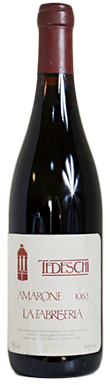
The first vintage of La Fabriseria and it's a great start, even after all these years. Intense and salty, with subtle aromatics and savoury, truffley...
1983
TedeschiRecioto della Valpolicella Amarone
Tedeschi, Recioto della Valpolicella Amarone, Classico, Veneto, Italy, 1985
Fragrant, intense and well balanced, this 1985 is full of macerated red and black berries, sous bois, and a distinct mint and sage character. Good...
1985
TedeschiRecioto della Valpolicella Amarone
Tedeschi, La Fabriseria, Recioto della Valpolicella Amarone, Classico, Veneto, Italy, 1988
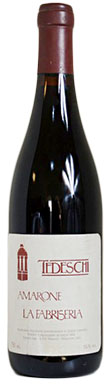
Savoury, silky and intense, it's a balanced and vertical wine with bright acidity and hints of ripe cherry, however it's also showing some signs of...
1988
TedeschiRecioto della Valpolicella Amarone
Tedeschi, Capitel Monte Olmi, Amarone della Valpolicella, Classico, Veneto, Italy, 1990
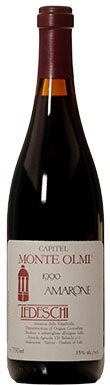
This 1990 Capitel Monte Olmi is full of complexity, beginning with a savoury nose of dried red berries, spice, truffle, menthol, damp earth and a...
1990
TedeschiAmarone della Valpolicella
Tedeschi, La Fabriseria, Amarone della Valpolicella, Classico, Veneto, Italy, 1995
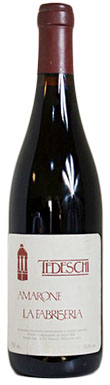
Balsamic herb, truffle, earth, lavender and violet scents lead, with some lovely fresh and dried cherry notes. Fleshy and vibrant, with a sweet core of...
1995
TedeschiAmarone della Valpolicella
Tedeschi, Amarone della Valpolicella, Classico, Veneto, Italy, 1997
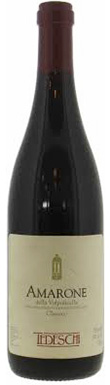
Meaty and floral, there's a sweetness in the mouth of soft strawberry, blackberry and raspberry, accompanied by spice, leather and tobacco, and with overtones of...
1997
TedeschiAmarone della Valpolicella
Tedeschi, Capitel Monte Olmi, Amarone della Valpolicella, Classico, Veneto, Italy, 1998
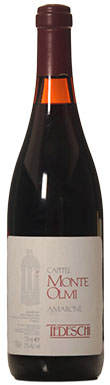
Fragrant dried fruit aromas with graphite and spice are touched by tertiary hints of wood polish and sous bois. In the mouth there's a macerated...
1998
TedeschiAmarone della Valpolicella
Tedeschi, Capitel Monte Olmi, Amarone della Valpolicella, Classico, Veneto, Italy, 2000
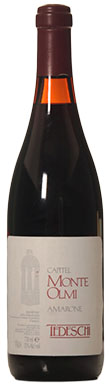
More textural than the 2005, and also less spicy, soft red and black berries are accompanied by leathery and earthy development. Long and fresh but...
2000
TedeschiAmarone della Valpolicella
Tedeschi, Capitel Monte Olmi, Amarone della Valpolicella, Classico, Veneto, Italy, 2005
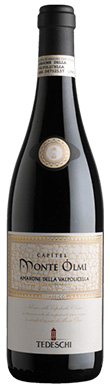
Vibrant and herbaceous, crushed red and black berry aromas lead to a compact palate of dark fruits and spice framed by wood, earth and herbal...
2005
TedeschiAmarone della Valpolicella
Tedeschi, Amarone della Valpolicella, Classico, Veneto, Italy, 2007
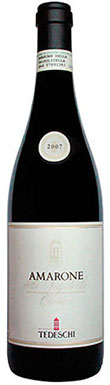
This Amarone Classico is relatively delicate after the heft of Capitel Monte Olmi, with red and black berry aromas accompanied by sous bois, leather and...
2007
TedeschiAmarone della Valpolicella
Tedeschi, La Fabriseria Riserva, Amarone della Valpolicella, Classico, Veneto, Italy, 2011
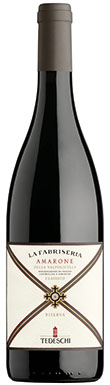
There's a slight vegetal/herbaceous note lurking among the dark berry aromas. A wine of great depth and breadth, it showcases vibrant, intense and soft blackcurrant...
2011
TedeschiAmarone della Valpolicella
Tedeschi, Capitel Monte Olmi Riserva, Amarone della Valpolicella, Classico, Veneto, Italy, 2011
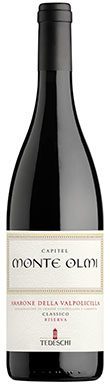
This Capitel Monte Olmi is very intense and concentrated but also with impressive freshness, ensuring great balance despite 17% abv. Silky dark fruits are supported...
2011
TedeschiAmarone della Valpolicella
Tedeschi, Marne 180, Amarone della Valpolicella, Veneto, Italy, 2017
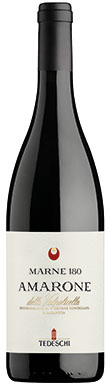
This selection from the Maternigo estate, situated on calcareous marls, is wonderfully energetic, with primary fruit and a refreshing wave of acidity accompanied by aromatic...
2017
TedeschiAmarone della Valpolicella
