
Ornellaia Bianco: A link to the past
The first presentation of a full vertical of Ornellaia Bianco, now spanning seven vintages, was recently organised by this famous Tuscan estate in Milan and also in London, where James Button tasted the wines and discovered more about their story.


A Sauvignon Blanc-driven blend since its first commercial release with the 2013 vintage, Ornellaia Bianco is produced in tiny quantities by this highly regarded Bolgheri-based estate – from three small vineyards that enjoy cooling sea breezes during the hot summer months.
Scroll down to see tasting notes and scores for an Ornellaia Bianco vertical: 2013-2019
The Bolgheri region is today dominated by world-class red wines based largely on Bordeaux grape varieties. Yet red wines weren’t permitted under the Bolgheri DOC when it was established in 1983; this only came following a regulation change in 1994.
Since then, white wines have been largely overshadowed. It’s somewhat of a rarity, then, to be able to taste a vertical of white wine from the region.
A vertical of Ornellaia Bianco, which is bottled as a Toscana IGT wine, is particularly rare, given the winery has only completed seven vintages and produces no more than 10,000 bottles (around 800 cases) each year.
The reason for the tasting was to celebrate Ornellaia Bianco’s 10th harvest, although we will need to wait a few more years to taste the 2022 vintage.
With plenty of tidbits of vintage information from the ever-eloquent Axel Heinz, estate director at Ornellaia, the wines were lined up and poured in pairs and threes to avoid any getting too warm.
Tasting all seven wines together tells the story of the search for Ornellaia Bianco’s identity. ‘The objective is to make a wine that reflects the sense of place of Ornellaia…but also of Bolgheri,’ said Heinz, admitting that the team has yet to settle on a particular style for the wine.
There’s very little in the way of a common thread between any two vintages, other than the use of Sauvignon Blanc as the base with which to blend (or occasionally not blend) other varietals.
‘There is a link to the past through the use of Sauvignon Blanc,’ commented Heinz, perhaps referring to the white wines made by Bordeaux estates, as well as the use of the variety in the estate’s Poggio alle Gazze, first produced in the 1980s.

Ornellaia Bianco: Year by year
Scroll down to see full tasting notes and scores for all seven wines
2013
‘By vintage 2013 we were ready to make a white Ornellaia that spoke of the place and the name,’ said Heinz.
Ornellaia Bianco 2013 was the first commercial release, with a blend of 70% Sauvignon Blanc and 30% Viognier producing just 4,000 bottles.
The individual base wines were fermented in barriques (30% new) with no malolactic fermentation, then aged on the lees for up to 18 months with occasional batonnage. A final three months on steel was completed before blending and bottling.
The large proportion of Viognier gives this warm yet fresh vintage superb aromatics with exotic flashes, but it’s by no means voluptuous.
Heinz described 2013 as, ‘a vintage I would love to see in a few years when we have more accumulated experience with the whites.’
2014
The 2014 vintage was a notoriously wet year, with average temperatures in July and a cool August. ‘There was no ripening going on in August,’ said Heinz. While this affected the red wines of Tuscany, it was good news for white varieties as the grapes were able to preserve aromatic compounds.
For this second vintage of Ornellaia Bianco, the Viognier was reduced to 13%, with 13% Petit Manseng also introduced to the base of Sauvignon Blanc. ‘Because it was a cooler year, it gave us a wider choice of grape variety,’ noted Heinz.
The wine was made in the same way as with 2013 but, thanks to the grape and vintage differences, the finished blend emerges as a more focused, structured, saline and fresh expression.
2015
In 2015, the estate pressed ahead with a wine made from 100% Sauvignon Blanc. A very hot July threatened to shut down the ripening process but rain in August cooled things down and gave the grapes a chance to retain freshness.
This has developed a delicious waxy and grilled pineapple character; it’s leesy and rich, yet fresh. Bolder than 2014, it’s perhaps less finessed but carries excellent balance through to the very long, juicy finish.
2016
Conditions in 2016 were cooler but drier than 2015, making an interesting comparison between Ornellaia Bianco’s only two 100% Sauvignon Blanc vintages. For me, the 2016 is the better wine by a small margin, although it trades at a hefty premium to the 2015.
The 2016 is corseted and refined, demonstrating a push-pull between juicy concentration and mineral restraint, suggesting there is much more to come from this wine.
2017
Winemakers up and down Italy know 2017 as the ‘drought year’, although a very warm March was also followed by much cooler weather at the end of April that led to frost in some other parts of Tuscany.
‘2017 was as challenging as one might think for the whites, because of the early harvest,’ said Heinz, explaining that he was still away on holiday when the decision was made to start harvest on 7 August.
Although its reputation precedes it, the vintage was perhaps saved by a drop in temperature during harvest, which Heinz said was actually cooler than during harvest in 2018 and 2019.
The wine lacks the acidity found in the other vintages of Ornellaia Bianco, but this is offset by a focus and richness to the fruit (aided by 9% Viognier), as well as some lovely tangy minerality.
Perhaps as a result of the vintage conditions, ageing time was reduced to no more than 12 months (previously up to 18 months) in order to produce a more aromatic profile. This shorter ageing regime has remained in subsequent vintages.
2018
After a scorching 2017, there was no water stress for the vines in 2018: spring saw three-times the average rainfall. This delayed budbreak, although flowering was actually a week earlier than anticipated due to the higher-than-average spring temperatures.
The season remained wet through to July, which was warm and dry. August was as hot as in 2017 but, crucially, there was a little bit of rain.
The long ripening caused by the wet season led to an extremely protracted harvest, which commenced on 16 August but was not completed until mid-September. ‘We felt comfortable letting the grapes hang,’ noted Heinz, although he confessed that he may have pushed it too far and so ‘inversed the trend’ with the 2019.
As with 2015 and 2016, the comparison between equivalent blends in 2017 and 2018 is interesting: 2018, again a blend of 91% Sauvignon Blanc and 9% Viognier, is bolder and more concentrated, allied to plenty of freshness (yet more suppressed aromas) and with a more three-dimensional quality than 2017.
2019
A cold and wet spring was followed by a very hot and dry summer with just two days of rain at the end of June, which helped to drop the temperature to normal levels, giving ideal conditions for ripening.
Herbal and stony with cut grass, green fruits, and plenty of passion fruit and papaya, this 2019 is a dramatic departure from preceding years but also seems to hark back to the earliest vintages of Ornellaia Bianco – while seeking out a fresher, lighter, more aromatic character.
Heinz and his team certainly worked hard to bring back aromatic finesse following 2018’s subdued aromatic character, picking earlier and introducing a selection of larger barrel sizes.
The Viognier in 2019 was increased to 19% of the blend, the biggest proportion since the first vintage in 2013. Sauvignon Blanc makes up the other 81% of the the 2019 wine.
‘In certain vintages,’ said Heinz, ‘all it takes is a few days and you’ve missed that golden window of opportunity. Viognier is as frustrating as it is magnificent.’ This decision to increase the Viognier component was therefore likely due, at least in part, to ideal weather during harvest.
It will be interesting to see how the winemaking team approach the next few vintages, especially given the tricky growing conditions in 2022.
One interesting development that may inform the future direction towards a more ‘typical’ Bordeaux-style white to match the Bordeaux-inspired Ornellaia rosso is that this year the first small parcel of Sémillon was harvested.
If experimental vinifications go to plan, we could well see this variety joining Sauvignon Blanc in a few years.
Ornellaia Bianco: 2013-2019
Related articles
- Bolgheri 2019: Vintage report plus 50 top wines
- September releases on the Place de Bordeaux 2022
- Sicily report 2022: spotlight on Europe’s hottest region plus 65 wines tasted
Ornellaia, Bianco, Toscana, Tuscany, Italy, 2013
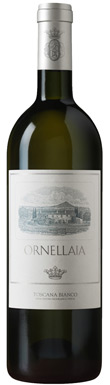

A mild spring delayed flowering by around two weeks in 2013, but it was followed by a dry and sunny summer until mid-August cooled things...
2013
OrnellaiaToscana

Ornellaia, Bianco, Toscana, Tuscany, Italy, 2014
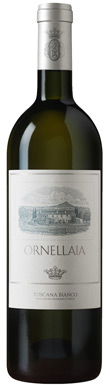
A blend of 74% Sauvignon Blanc, 13% Viognier and 13% Petit Manseng, this 2014 has aroma of beeswax, passionfruit and candied lemons. The oily, textured...
2014
OrnellaiaToscana
Ornellaia, Bianco, Toscana, Tuscany, Italy, 2015
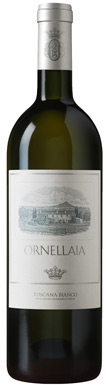
A very hot July threatened to shut down the ripening process in 2015 but rain in August cooled things down and gave the grapes a...
2015
OrnellaiaToscana
Ornellaia, Bianco, Toscana, Tuscany, Italy, 2016
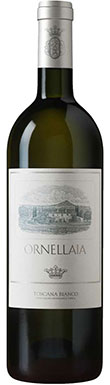
A cooler but drier year than 2015, making an interesting comparison between Ornellaia Bianco’s only two 100% Sauvignon Blanc vintages. Smoky lanolin notes lead to...
2016
OrnellaiaToscana
Ornellaia, Bianco, Toscana, Tuscany, Italy, 2017
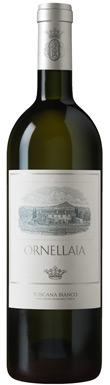
Although its reputation precedes it, the drought vintage of 2017 was perhaps saved by a drop in temperature during harvest, which Ornellaia's estate director, Axel...
2017
OrnellaiaToscana
Ornellaia, Bianco, Toscana, Tuscany, Italy, 2018
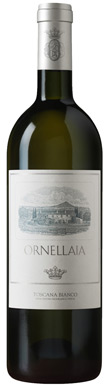
After a scorching 2017, there was no water stress for the vines in 2018: spring saw three-times the average rainfall, which delayed budbreak although flowering...
2018
OrnellaiaToscana
Ornellaia, Bianco, Toscana, Tuscany, Italy, 2019
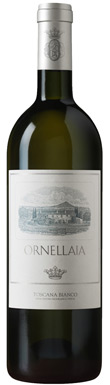
2019 experienced a cold and wet spring followed by a very hot and dry summer with just two days of rain at the end of...
2019
OrnellaiaToscana
