
The Chappellet family and the forging of Napa’s Cabernet identity
Among Napa Valley's pioneers, the Chappellet family was instrumental in putting the region on the map thanks to its now-legendary Cabernet Sauvignons.
In the mid-1960s, American businessman Donn Chappellet began doing some soul searching and started to imagine life as a winemaker. He had co-founded Interstate United Corporation, a food services business that, at its apex, employed 8,000 workers and was listed on the New York Stock Exchange.
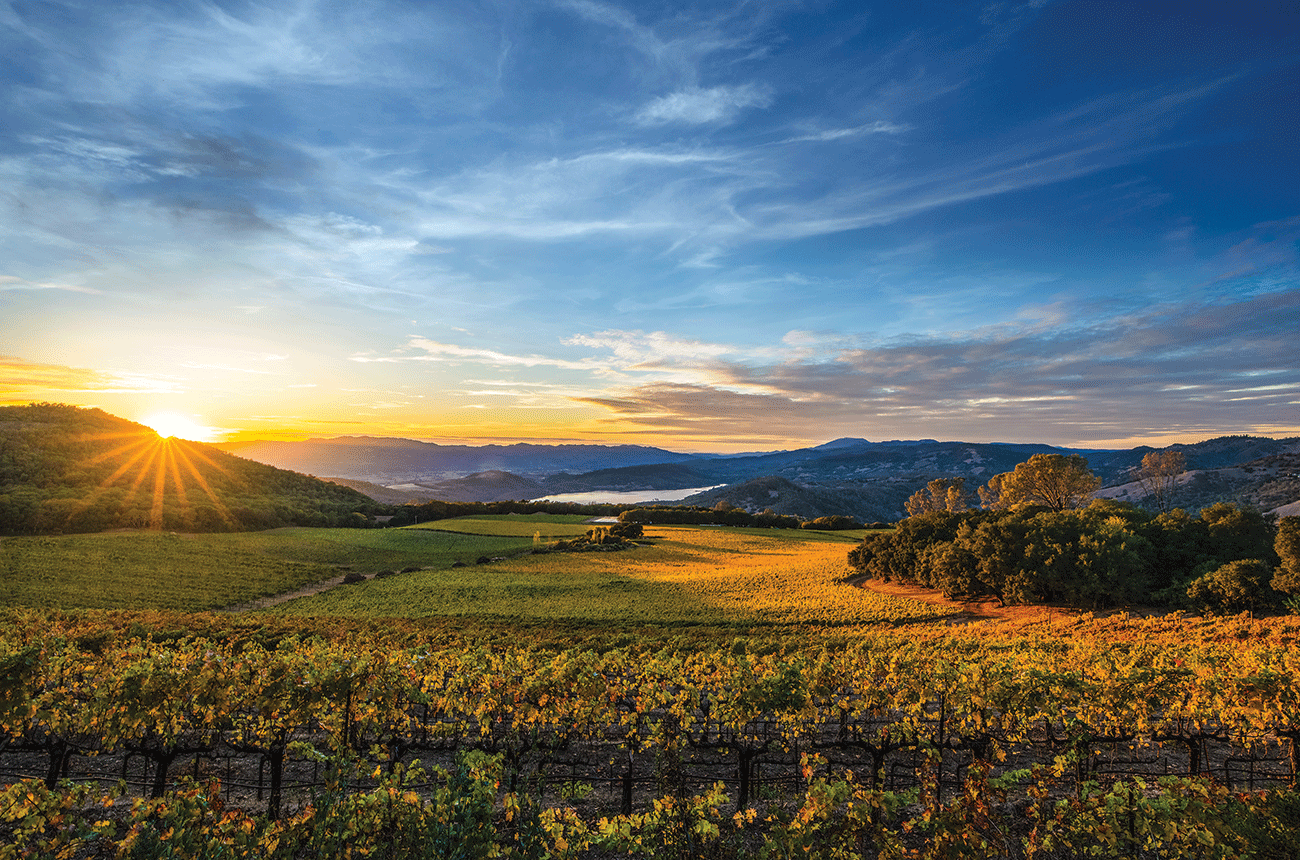
Then, in 1966, at the age of 34, he sold his shares and moved his family from Los Angeles to a remote part of Napa Valley called Pritchard Hill, which is now home to a bevy of Napa giants, including Bryant Family, Colgin, David Arthur, Continuum, Realm, Ovid and, of course, Chappellet.
Today, Chappellet is regarded as one of Napa Valley’s greatest assets, known for its powerful, structured, mineral-driven and ageworthy Cabernet Sauvignons. Beginning in September 2023, Chappellet has offered stocks of its 2019 Pritchard Hill Cabernet Sauvignon and 2019 Signature Cabernet Sauvignon wines on La Place de Bordeaux through Les Vins d’Ailleurs, a branch of courtier (broker) Bureau Barre & Touton.
Scroll down for tasting notes and scores for 10 Chappellet wines
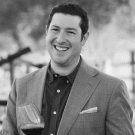
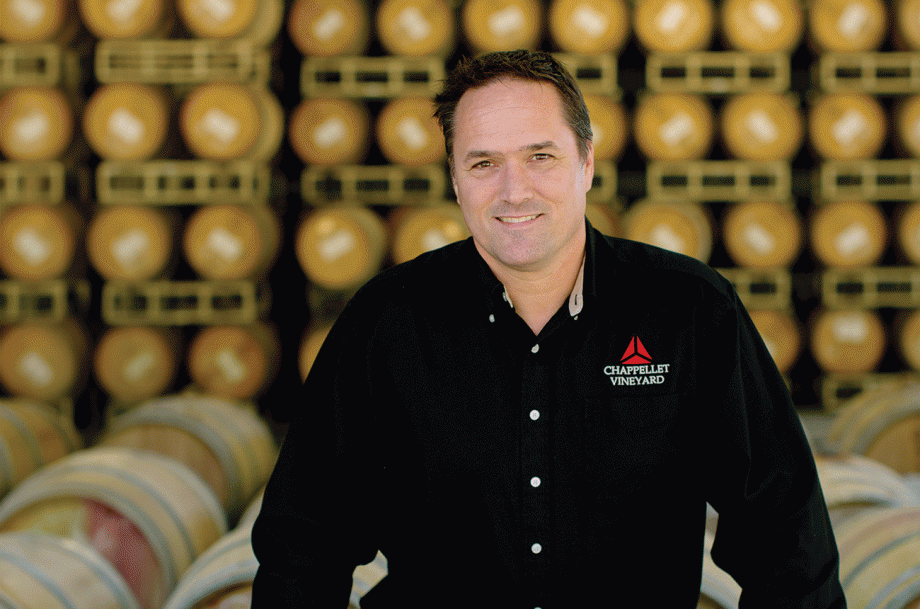
Donn passed away in 2016 aged 84, but the winery is still family-owned and operated. Co-founder Molly Chappellet, Donn’s widow, a renowned landscape artist and James Beard Award-winning author, still lives in a house on the property. She currently serves as chairman emeritus and director of aesthetics. Donn and Molly’s eldest son Cyril is the CEO and chairman. His brother Dominic is a co-owner and chief operating officer, and their sisters Lygia, Carissa and Alexa are board members.
How it all began
Cyril Chappellet recounted to me that André Tchelistcheff, widely considered the most influential winemaker in Napa Valley history, once told Donn that he believed that better wines could be made from hillside vineyards in Napa. ‘So that led us to this place,’ he says, motioning toward the estate’s summit – the famous protruding hill, with a name originating from homesteader Charles Pritchard, who planted vines there from the 1870s.
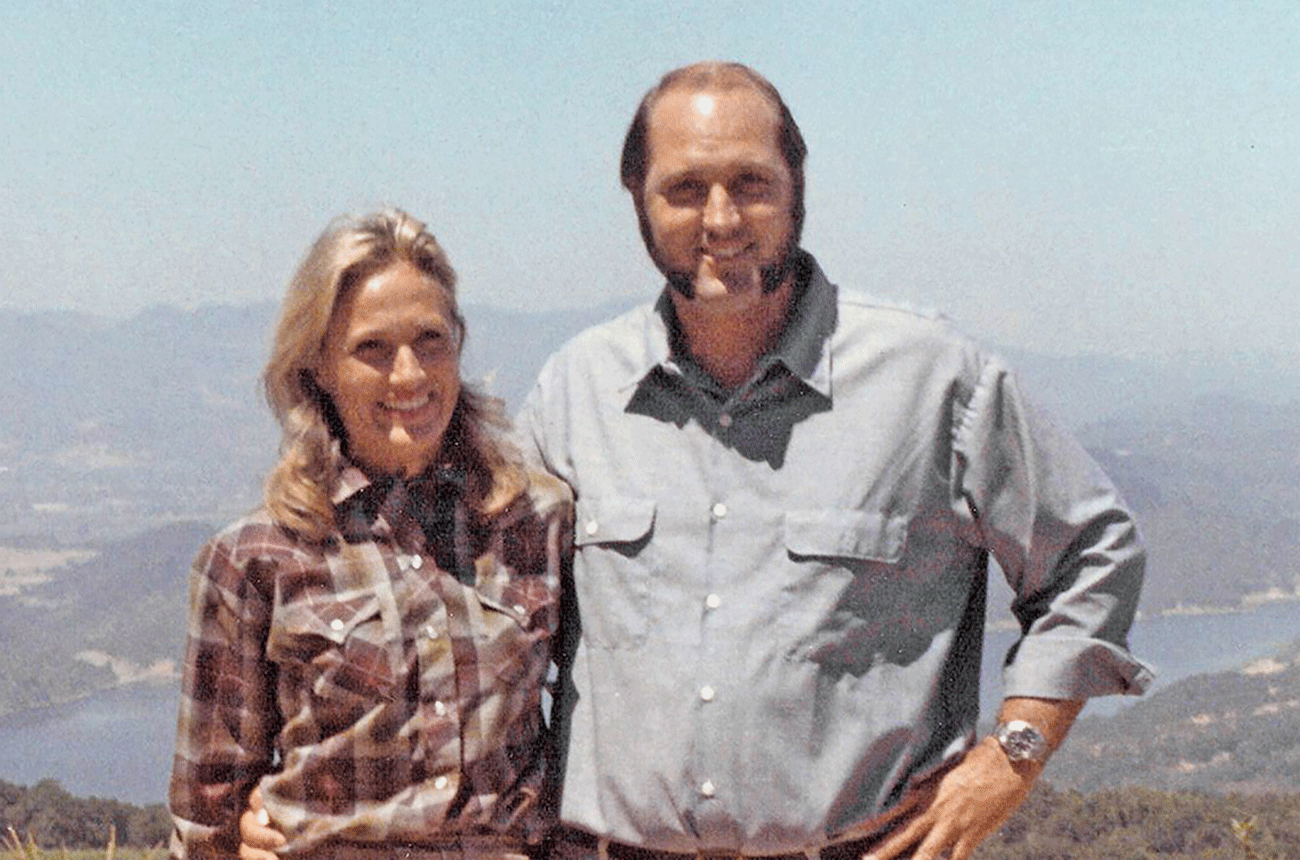
Donn bought 129ha of craggy woodland with an existing vineyard and then an adjoining 129ha plot, with the aim of making wine as good as the top Bordeaux producers he loved to collect. Donn and Molly cleared the unforgiving landscape, planted more vines and began designing a winery. Philip Togni was hired as winemaker and vineyard manager and tasked with refining the vineyards. The 1968 Cabernet – made at Robert Mondavi Winery – was blended with wine from the 1969 vintage prior to bottling and release that year, and the label bears no vintage date.
Famed LA artist Ed Moses designed the pyramid-shaped winery, which was completed in time for the 1969 harvest – its first commercial release was the 1969 vintage Chappellet Cabernet Sauvignon. Over the ensuing decades, Chappellet would establish a reputation for producing some of Napa’s most celebrated wines – earning high praise from top critics. Author and Decanter columnist Hugh Johnson recently acknowledged Donn’s desire to create his own Château Latour and wrote that Chappellet Cabernet from a great year ‘could justify his aspiration’.
Conversion to organic farming
In the early 1980s, phylloxera reappeared in Napa Valley. Chappellet’s vines were planted on AXR rootstocks, which aren’t resistant to the root louse, but this didn’t spell disaster, thanks to a hippie consultant named Amigo Bob Cantisano. Dominic recalls Amigo Bob, who sported a t-shirt and shorts in winter, telling his parents in the mid-1990s: ‘I don’t think I can get rid of phylloxera, but I can make your vines so healthy they won’t care it’s there.’
Amigo Bob introduced new cover crops, composting, compost teas and organic soil amendments, which led to such healthy vine growth that within a year, the phylloxera louse ceased to have much of an effect on the vines’ roots. Chappellet vineyard manager Dave Pirio ‘was cautious about changing farming methods but ultimately became convinced that we could farm organically and produce even higher quality fruit’, says Dominic. By 2012, the estate had earned CCOF (California Certified Organic Farmers) certification.
The original vines have now all been replaced; the property’s oldest vines date from the early 1990s. The lack of plentiful water led them to replant on 110R and 3309 rootstocks. ‘We want drought resistance but not much vigour,’ explains Phillip Corallo-Titus, who has been in charge of winemaking since 1990.
In 2012, the Chappellet family invested in a new 1,400m2 barrel chai, built adjacent to the original winery. ‘We make Viognier, Chenin Blanc and Chardonnay,’ says Corallo-Titus, ‘and we needed cold rooms for this. We use cold more as a preservative than sulphur – SO2 is more stable at a lower level such as 53°F (11°C). It also results in less evaporation, and brettanomyces or any yeast or bacteria really doesn’t grow at this temperature.’
Unpredictable weather and drought years have also led Chappellet to innovate its water and power usage for irrigation and winery production. ‘We don’t have an aquifer, so we rely on rain and surface water flowing from creeks to fill our reservoirs,’ says Dominic. To maximise water use, all of the water used in wine production, amounting to about 3.8 million litres a year, is now recycled for re-use and irrigation across the estate. And to combat power outages, which are frequent on the remote hilltop, the winery has installed a 1,860m2 solar photovoltaic system, enabling Chappellet to power itself.
A Pritchard Hill AVA?
‘You can easily make big wines on this mountain,’ says Corallo-Titus, ‘with the volcanic soils and sun. So it’s all about tannin management. The key is to get the tannins perfectly ripe and soft enough but still with excellent structure so that the wines are approachable in their youth but [are also] ageworthy.’
Although for many years Chappellet had aged its Cabernets in Hungarian oak, as of 2021, only French oak is used in the cellar. The Signature Series wines are currently aged in 60% new oak, he says, up from 40%-50% during the early 2000s. The flagship Pritchard Hill Cabernet has been aged in 100% new French oak ever since its inception with the 1997 vintage.
All of the vineyards planted in the territory known as Pritchard Hill, with its highly regarded mixture of hills and plateaus rich in volcanic soils, fall within the Napa Valley AVA. Given that Donn Chappellet fully registered the name as a trademark in 1997 (its ‘first use’ being noted in 1971), it would ultimately be up to the Chappellet family to apply for AVA status for Pritchard Hill. ‘We would have no problem having Pritchard Hill be an AVA,’ explains Dominic, ‘if we could control the boundary lines of what that AVA is. It’s about protecting something that we think is special, not about excluding anybody.’
Dominic says that neighbours are urged to tout the fact that they make great wine ‘from the area that we call Pritchard Hill’, but is resolute that unless the family has complete control of the setting of the boundary, an AVA of that name will never exist. There are currently a number of restrictions on how ‘Pritchard Hill’ can be used by other wineries on their bottles: it can be used as a descriptor of place but it can’t be used on the front label, and if it’s used on the back label, it can’t be in all capitals.
There has been some talk of establishing an AVA that doesn’t involve the Pritchard Hill name. ‘I don’t see the need for it,’ says Dominic firmly. ‘I don’t really understand why you would seek to achieve more cachet using a name other than the one the area already has.’
Chappellet at a glance
Founded: 1967
Owned by: The Chappellet family
Key wines: Hideaway Cabernet Sauvignon, Pritchard Hill Cabernet Sauvignon and Signature Cabernet Sauvignon
Additional wines: Calesa Chardonnay, El Novillero Chardonnay, Sangiacomo Chardonnay, Apple Lane Pinot Noir, Dutton Ranch Pinot Noir, Fedrick Ranch Pinot Noir and Cold Creek Viognier
Winemaker history: Philip Togni (1967-74); Joe Cafaro (1975-76); Tony Soter (1977-80); Cathy Corison (1981-89); Phillip Corallo-Titus (1990 to present).
Cellar alumni: David Graves, Mia Klein, David Arthur Long, Robert Pepi, Helen Turley
On La Place de Bordeaux
‘We want the right people to be able to buy our wine, even if they are in the Maldives, and La Place can get us there,’ says David Francke, president of Chappellet. Many importers don’t have connections in the global markets Chappellet desires to reach, and this played a big part in Chappellet’s decision to seek a partner on La Place – the complex network of courtiers and négociants that acts as a marketplace and distribution system, primarily for wine from Bordeaux but increasingly for other fine wines from around the world.
‘The coverage and market expertise they bring was very important to us,’ Francke continues.
Francke recalls Barre & Touton’s first visit to Chappellet in October 2022 – to see the estate and taste its wines. To everyone’s surprise, they announced that they wanted to ‘talk business strategy’. Both sides expressed the idea that the partnership is about a ‘long play, to go from the US market to expand internationally’.
For now, less than 1% of production will go to Barre & Touton. ‘We didn’t make a 2020 [due to fires],’ explains Francke. ‘They recommended that we start with the 2019 vintage, and that’s what they launched on La Place in September 2023. We also released some older wine to showcase the ageability, some going back into the 1970s.’
He notes that Laurent Dufau, Nina Treny and Cyril de Labarre of Barre & Touton ‘were shocked’ by the quality of the older Chappellet wines. ‘We held blind tastings with old Bordeaux and old Napa, and no one could tell the difference.
Cristaldi’s pick: a taste of the Chappellet range
Related articles
- The rich history of California’s Louis M. Martini including a vertical tasting
- St Helena 2020: The top Cabernets from this Napa AVA
- Producer profile: Hundred Acre plus 18 great wines to try
Chappellet, Signature Chenin Blanc, Napa Valley, California, USA, 2022
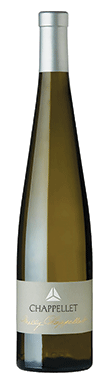

Bright, long, lean, fresh, and nuanced. Terrifically inviting aromas of sea spray, lemon cream, apricot, white peach and a hint of seagrass. It is so...
2022
ChappelletNapa Valley

Chappellet, Pritchard Hill Cabernet Sauvignon, Napa Valley, California, USA, 2021
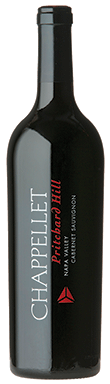
Such an attractive and alluring bouquet of violet florals, blue fruit aromatics, sagebrush, bay laurel, and toasty cedarwood. Medium to full-bodied with a wonderfully rich...
2021
ChappelletNapa Valley
Chappellet, Pritchard Hill Cabernet Sauvignon, Napa Valley, California, USA, 2019
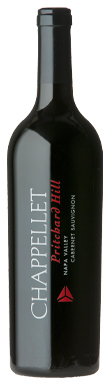
Chappellet's longtime winemaker Phil Titus turns out yet another power-packed Cabernet, which leads with aromas of candied violets, blueberry preserves and brandy-soaked blackberries, followed by...
2019
ChappelletNapa Valley
Chappellet, Signature Cabernet Sauvignon, Napa Valley, California, USA, 2021
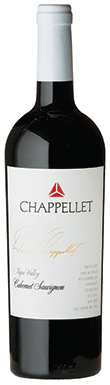
It is a marvellously compact and coiled-up wine with a towering structure. Very beautifully fragrant dried purple flowers and herbs. Full-bodied with loads of succulent...
2021
ChappelletNapa Valley
Chappellet, Signature Cabernet Sauvignon, Napa Valley, California, USA, 2019
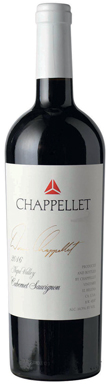
Heady and ripe, floral and open on the nose with aromas of cedar, sweet strawberries, spiced plum and herbal-edged raspberries. Crisp and juicy, tight and...
2019
ChappelletNapa Valley
Chappellet, Pritchard Hill Cabernet Sauvignon, Napa Valley, California, USA, 2018
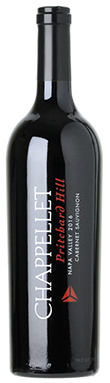
Fabulous nose on this wine, rich, ripe, full-throttle Cabernet cassis with added complexity from graphite and leaf. Despite being so expressive, you get the impression...
2018
ChappelletNapa Valley
Chappellet, Pritchard Hill Cabernet Sauvignon, Napa Valley, California, USA, 2008
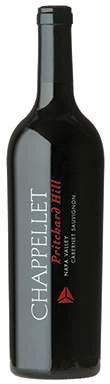
The first whiff draws you in with savoury iron-stone minerality, complemented by fragrant wild herbs, liquorice, and perfumed kirsch nuanced by spearmint and rich, loamy...
2008
ChappelletNapa Valley
Chappellet, Signature Cabernet Sauvignon, Napa Valley, California, USA, 2009
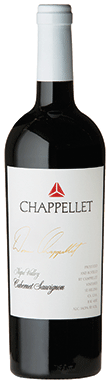
At 15 years of age, the 2009 Signature is at the stage where secondary and tertiary notes are just starting to come into play. Tasting...
2009
ChappelletNapa Valley
Chappellet, Pritchard Hill Cabernet Sauvignon, Napa Valley, California, USA, 2013
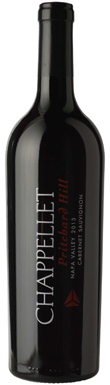
A darker, more brooding wine than its sibling bottling, aroamas of cassis, burning embers and creamy barrel spice are followed by a wine which seems...
2013
ChappelletNapa Valley
Chappellet, Signature Cabernet Sauvignon, Napa Valley, California, USA, 2014
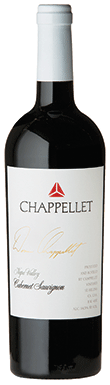
A complex bouquet of wild berries, dried flowers, subtle cigar box and a framing of new wood introduces a powerful, concentrated and sapid palate with...
2014
ChappelletNapa Valley
