Walls: Why Syrah is the most adaptable grape in the world
Matt Walls explores the global reach of the famous Rhône grape variety, finding truly outstanding examples from around the globe in South Africa, the USA, Lebanon and New Zealand. Here he discusses Syrah's many guises and selects six wines worth seeking out.

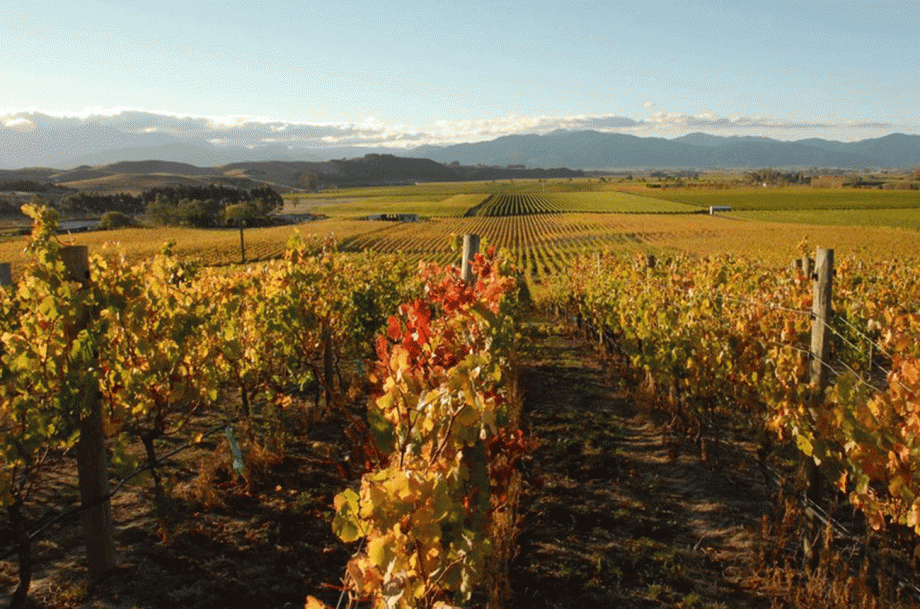
Some grapes are homebodies. They don’t like to travel, preferring to stay close to their place of birth. Others are happy to explore far-flung lands, even to settle and establish new colonies.
Syrah, however, is a peerlessly adept traveller, a free-spirited polyglot happy to set down roots in countless wine regions around the world. It is the most adaptable of all great red grapes – a vital quality in a changing world.
Scroll down for Matt Walls’ tasting notes and scores of six Syrahs from around the world
Expanding horizons
Grape varieties tend to reach their heights of expression in their home region, heights that are rarely surpassed elsewhere. This is certainly true with Syrah. The very best are still to be found in the Northern Rhône.
But, truly outstanding examples are now made in the United States, South Africa, New Zealand, Australia, Chile… even Germany. And in multiple regions within all of these countries.
In 1990, Syrah was the 36th most planted grape in the world. By 2016, it had shot up the rankings to sixth. The only red grapes that have more area under vine globally are Tempranillo, Merlot and Cabernet Sauvignon.
Unrivalled success
And what of these other red grapes? Tempranillo covers more land than Syrah, but it doesn’t travel well – significant plantings are only found in Spain and Portugal.
The same can be said of Italian grapes; outside Italy we might be able to name one or two interesting wines made from Nebbiolo, Sangiovese or Nero d’Avola, but they are the exceptions that prove the rule.
Merlot and Cabernet Sauvignon are more adaptable than Tempranillo, but these tend to work better as a team than alone. Both are planted in more countries than Syrah, but their reach has contracted since 2010, whereas Syrah’s reach is expanding.
I’d also suggest that Syrah has more success across a greater range of climates than these two varieties. And, for that matter, the notoriously capricious Pinot Noir.
Ability to reflect terroir
The fact that Syrah can do so well in both hot and cooler climates is evidenced by its dual title – Syrah and Shiraz. That there’s no single name for this grape variety can make it awkward and clumsy to talk about, however, it is also useful because it helps us differentiate between its multiple guises.
Few grapes rival Syrah’s ability to reflect terroir, particularly when grown in more temperate climates. Just as the climats of Gevrey-Chambertin in Burgundy assert themselves through Pinot Noir year on year, so do the lieux-dits of Côte-Rôtie through the lens of Syrah.
Hotter climates add a little heat-haze to the final style, but when expressed as Shiraz it can still display a strong sense of place.
The difference between a Syrah and a Shiraz is not simply a question of climate, though. Châteauneuf-du-Pape is nearly 200km south of Côte-Rôtie, and correspondingly hotter and sunnier; it’s a different animal here, but it’s still unmistakably Syrah, not Shiraz.
The pressing issue: climate change
As our global climate heats up, the adaptability of any given grape variety is taking on greater salience. Can it produce balanced wines that express terroir as the mercury rises? Is it happy on different terrains if plantings need to move to cooler latitudes or higher ground?
Syrah is now on the march in France, migrating north from Côte-Rôtie. There are plantings in Beaujolais, and Mark Haisma has even planted some in the Mâconnais. If Pinot can’t take the heat, it will have to exit la cuisine. Will the climats of Gevrey eventually have to be expressed by Syrah instead? I can think of few better options.
See tasting notes and scores of six Syrahs from around the world worth seeking out
You might also be interested in…
California Syrah: Matthew Luczy’s report
Barossa Shiraz: St Hallett Wines producer profile
South African Syrah: 30 great buys
South American Syrah: panel tasting
Rhône Syrah: Delas’ Hermitage Ligne de Crète
Reynvaan, Foothills Reserve, Columbia Valley, Walla Walla Valley, Washington, USA, 2017
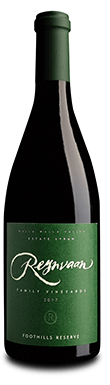

Stemmy in style, with oregano and marjoram over sappy fruits and notes of incense too. It’s medium-bodied so very fresh, with good intensity and the stems rise again on the palate. With time, rose and cedar come through on the nose and palate, alongside a little fruit sweetness and chocolate. Parsley stem bitterness is subtle and controlled. With its long finish this is a wine that really bowls you over. Complex, drinkable, distinctive. On the border with Oregon, the Reynvaan 'Foothills in the Sun' vineyard is one of the highest vineyards in Washington at around 500m. This is predominantly Syrah, with a little Viognier and Cabernet Sauvignon, all grown on deep loam soils giving very low yields. Matured in barriques, of which very few are new, this sees no fining, filtration or use of commercial yeasts.
2017
ReynvaanColumbia Valley

Dewaldt Heyns, Weathered Hands Shiraz, Swartland, South Africa, 2015
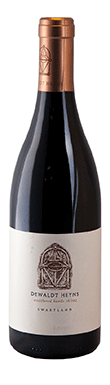
Unmistakably Shiraz rather than Syrah, and so interesting on the nose with its great depth of aroma and an enveloping spiciness. A mix of incense, star anise and sappy black fruit. It's intensely concentrated but not too full-bodied, not fat or over extracted. Lashings of oak - fermented in new French oak for 20 months - are lovingly applied to good effect. It's almost gratuitous, but it works. So concentrated and juicy you can almost feel the pulp being squeezed through your fingers. Mature, but will improve with time.
2015
Dewaldt Heyns
Ixsir, El Ixsir, Batroun, Lebanon, 2014
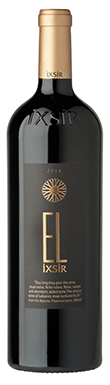
Having been matured for 26 months in 400L barrels, 50% of which were new, the 2014 still shows some oak spice through the fruit coulis, black cherries and dark plums. But it is seamless on the palate, very fresh, and the oak is well-integrated. Rounded, pure and well-balanced, this is clearly a very elegant wine, in a Bordelais, vin-de-garde style. The blend works well and shows great elegance; a unique style that is traditionally composed. It’s mature and ready to drink now, but there’s no hurry. Established in 1999, the vineyards of Ixsir are spread across the mountains of Lebanon, the highest up to 1800m, some of the highest in the Northern Hemisphere.
2014
Ixsir
Domaine de Fondrèche, Divergente, Ventoux, Rhône, France, 2018
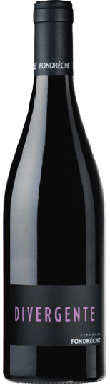
Plenty of intensity and forward motion, with good acidity and bite. There is a subtle smoky char on the nose which combines with the reductive spicy element and understated clove-like oak to make for a complex flavour profile. It's fleet of foot, not heavy or thick, with concentrated black fruit. Finishing with upright tannins and bright acidity, it’s fresh and lively. From Syrah planted in 1955, which is very early for this part of the Rhône, at the foot of Mont Ventoux.
2018
Domaine de FondrècheVentoux
Fromm, Fromm Vineyard Syrah, Marlborough, New Zealand, 2016
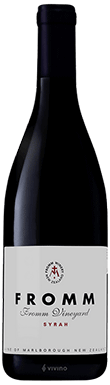
Super fresh nose with notes of white pepper and pounded raspberries. Not as light in body as you might expect, but spicy and bright with good acidity and gently chalky tannins. Cranberries emerge on the palate with an almost minty fruit character. From a region more commonly associated with Sauvignon Blanc, this vineyard was planted in 1992. The fruit was all destemmed, wild fermented, and aged in oak for 18 months. Only six barrels were made.
2016
Fromm
M Chapoutier, Sicamor, Crozes-Hermitage, Rhône, France, 2018
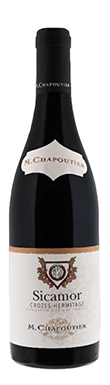
A vibrant and intense style of Crozes-Hermitage, with characteristic blackberry and smoky bacon hints and notes of blackcurrant and iodine. Marked acidity lends freshness and acts as a counterpoint to the well-integrated oak. Compact and thirst-quenching. The Northern Rhône is the birthplace of Syrah, a natural crossing of Dureza and Mondeuse Blanche. From here it has spread far and wide. Sicamor is a new cuvée by Chapoutier, from a blend of different terroirs. One is coarse-grained granite from the western side of the hill of Hermitage, another is stony soils on the eastern side, and the last is a parcel from Les Chassis on the flat terraces of Crozes-Hermitage. The grapes for this cuvée are all destemmed and it is then fermented in concrete and aged for 12 months in recently used 600L barrels, with no filtration and no fining before bottling.
2018
M ChapoutierCrozes-Hermitage
