Anson: How the 1990 Bordeaux first growths taste now
Jane Anson tastes Lafite, Mouton, Latour, Margaux and Haut-Brion side-by-side, plus Yquem, to see how these greats of the celebrated Bordeaux 1990 vintage have aged over the past three decades.


The Bordeaux first growths could have been forgiven for feeling relaxed as the 1990 grapes were brought into the cellar.
This was the third successful vintage in a row, and a time where money was flowing back into the region in a serious way after a decade that had more hits than misses.
Scroll down for Jane Anson’s tasting notes and scores for the 1990 Bordeaux first growths
Beginning a new decade
Cellar upgrades were now routine, and confident winemaking choices were being introduced, such as the third wine Pauillac de Latour at Château Latour.
It was also a time of change, with new owners at Latour, and a new generation at Mouton Rothschild.
There were many owners, however, who initially reserved their enthusiasm for the wines. Although it was clear that 1990 shared with 1989 the fact that it was an early vintage, with great concentration of tannins and sugars, it had also been so hot and dry in July and August that the tannins were initially hard and unforgiving.
Vintage conditions
Cumulative temperatures from June to October in 1990 were higher than both 1989 and 1982. There was also significantly less rain in 1990; 31mm across both July and August, compared to 94mm the year before.
Blockages meant a drawn-out colour change in the berries, which led to a later harvest, and most estates had a good yield of small, thick-skinned berries (saved by two short bursts of rain on 14-15 September and on 22-23 September).
Alcohol levels were seen as high at the time, but read today as extremely reasonable. Of the six wines that we tried here, none go above 13% abv.
Most estates dropped their prices by around 20% at the moment of en primeur, but the 1990 vintage has more than proved its quality over the years.
They might not have been so quick to do so if they had known this vintage would be followed by the seriously underwhelming 1991, 1992, 1993 and 1994. Bordeaux would have to wait five years before being rewarded with another year that even approached the 1990 wines in quality.
And as is invariably the case in well-built, slow burn years such as this, the interest in the first growths is intense.
Prices today
Finding them is not easy today, and this particular tasting, if you were buying a full case of each (in bond), would mean spending somewhere close to £40,000 in the UK market.
Now 31 years old, Lafite comes in at close to £8,000 (per 12-bottle case in bond), Latour £7,500, Haut-Brion £8,500 and Margaux heading up the pack at £11,000.
And in proof of the draw of a first growth, even the less successful Mouton is priced at £4,250.
For value, relatively speaking, you might want to look at the Yquem, which is drop dead gorgeous and a ‘mere’ £2,700 for a case of 12 in bond right now.
There is no question that these are wines that have retained their power to delight, although Mouton 1990 is an excellent reminder that it is not just the vintage or even the quality of the estate that always comes out on top.
Drinking older wines is like heading into a time capsule and sometimes they point to disruption.
At this point at Mouton, Baron Philippe de Rothschild had died in 1988, bringing to an end a monumental career that had begun when he first arrived in Pauillac in 1922.
His longtime winemaker Raoul Blondin retired a year later in 1989, and so the estate was finding its feet under a new team in 1990.
It was also three years before the introduction of Petit Mouton, brought in by Baroness Philippine. From the start, Mouton was seen to have had a more problematic 1990 vintage than its fellow firsts.
Based on this tasting, this has remained true, with Mouton’s two Pauillac first growth siblings outshining it – yet with neither of those coming up to the level of Margaux and Haut-Brion.
And the success of Yquem alongside them clearly showed that 1990 managed that rare trick of being successful for both red and sweet Bordeaux – and one that has decades ahead of it.
See Jane Anson’s tasting notes and scores for the 1990 Bordeaux first growths
You may also like
Bordeaux: The five first growthsAnson: How the 1985 Bordeaux first growths taste nowAnson: The brilliance of 1996 Pauillac winesAnson: How is Brexit affecting Bordeaux wine?
Château Margaux, Margaux, 1er Cru Classé, Bordeaux, France, 1990
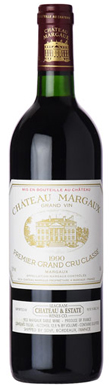

This is a great wine and, like all the greats, it is always changing. In some recent showings it has been effusively plump and energetic, here it was more restrained and mineral than I had remembered. It is still profound, however, and with a bit of time in the glass it opens up to show extraordinary depth. There are some first hints of maturity and a subtle iodine note on the finish, but it is exquisite throughout and should continue to improve for years to come.
1990
Château MargauxMargaux

Château d'Yquem, Sauternes, 1er Cru Classé Superieur, Bordeaux, France, 1990
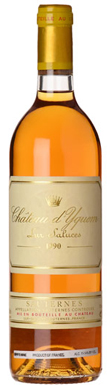
Hard to contain this wine within the contours of the glass - this is exuberant, concentrated and luscious. Full of blood orange, nectarine, saffron, touches of caramelised ginger, truffle and crème brûlée. A see-saw of zesty acidity and luscious sweetness, this is a beautiful wine that still has decades ahead of it. Owned by the Lur Saluces family at the time, clearly showing why Yquem stands in its own category in the appellation.
1990
Château d'YquemSauternes
Château Haut-Brion, Pessac-Léognan, 1er Cru Classé, Bordeaux, France, 1990
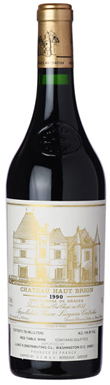
Very close to Margaux in terms of its level of success, although with a more exuberant feel, touches of cinnamon, smoke, truffles and meat. Overall it is more opulent and rounded in the mouth than the other four firsts at this point and a seriously impressive glass of wine. This was an early harvest, and is clearly ready to drink with an exotic charm, but there is still a softly brushed tannic frame, and plenty of life ahead. A great period at Haut-Brion, with Jean Bernard Delmas at the helm of the winemaking.
1990
Château Haut-BrionPessac-Léognan
Château Lafite Rothschild, Pauillac, 1er Cru Classé, Bordeaux, France, 1990
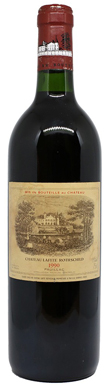
A smoky, slightly baked character to the fruit and an undercurrent of dark chocolate and ground coffee. The texture is soft, sunny, and supple, with agreeable plumpness on the finish. 1990 was another sunny year that produced a lush, ripe result for Lafite that is immediately approachable. Although it should continue to show well, it lacks the incisive character of cooler years. The growing season was easy, with warm weather throughout and a successful flowering that set a large crop. There was sufficient sun to ripen all the fruit, however, and the final result was 57% Cabernet Sauvignon, 30% Merlot, and 13% Cabernet Franc.
1990
Château Lafite RothschildPauillac
Château Latour, Pauillac, 1er Cru Classé, Bordeaux, France, 1990
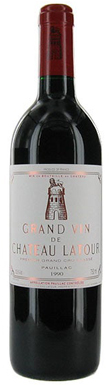
A superb wine, aging well, the 1990 Latour still seems deceptively youthful, with plenty of ripe mulberry and blackcurrant fruit aromas and a graceful evolution, with truffle, earth, and smoke notes. The texture is supple and warm, but it avoids the softness of some of the clarets from 1990. The tannins are still reasonably firm. Although the wine should continue to improve in the cellar for at least another 20 years, it is already at a nearly perfect point between youth and maturity. Drunk with friends in Atlanta.
1990
Château LatourPauillac
Château Mouton Rothschild, Pauillac, 1er Cru Classé, Bordeaux, France, 1990
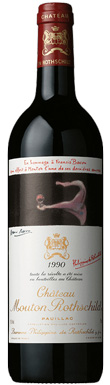
A time of serious changes at Mouton, with Baron Philippe de Rothschild passing away in 1988 after having overseen seven decades worth of harvests, and his longtime winemaker Raoul Blondin retiring in 1989. It was also three years before the introduction of Petit Mouton under Baroness Philippine (even Aile d'Argent the white wine didn't arrive until 1991). Does all of this explain why the 1990 has suffered with its reputation from the beginning? Certainly it is far more mature at this 31-year-checkin than the others in the tasting, with strawberry and raspberry notes rather than the darker fruits that you more usually find in great Pauillac, with clear tertiary notes of tobacco, rust and woodsmoke. I had a better bottle of this in December 2020, and also in October 2018, so do expect bottle variation and you just might get lucky, but this was not the wine of the night. Label artist Francis Bacon, with one of his last works. Harvest 18 September to 3 October.
1990
Château Mouton RothschildPauillac
