
Joh. Jos. Prüm: Producer profile & 10 wines tasted
Both traditionalist and trailblazer, Joh. Jos. Prüm and its Mosel Rieslings have set the standard and been a touchstone for generations of winemakers and wine lovers alike


The Mosel Valley is seemingly rife with winemakers named Prüm. Indeed, members of the Prüm family have inhabited the village of Wehlen, a wine-growing epicentre of the Mosel, as far back as the 12th century.
The bedrock for generations of wine-growing at Prüm’s was the original estate of S. A. Prüm, the winery established in the early 1800s by Sebastian Alois Prüm. It was Sebastian’s brother, Jodocus Prüm, who installed a sundial on a rocky outcrop of the Wehlener vineyards in 1842, lending the word Sonnenuhr, or sundial, to the vineyard’s name.
Scroll down to see tasting notes and scores for 10 Rieslings from Joh. Jos. Prüm
In 1911, S. A. Prüm was split among Sebastian’s seven grandchildren, the oldest being Johann Josef Prüm. S. A. Prüm and its descendant wineries still thrive in the Mosel, among them, Weins-Prüm and Studert-Prüm, but also Jos Christoffel Jun, Dr Loosen and Dr Pauly-Bergweiler. In the Rheingau, even Robert Weil is a Prüm descendant.
Of all the Prüms, however, no winery has become more iconic for its singular, even stalwart, expression of the Mosel than Joh. Jos. Prüm. The wines of J. J. Prüm are a celebration of the German wine classification system, Prädikatsweine – luminous, ethereal expressions of kabinett, spätlese and auslese, along with the rare (and astronomically pricey) beerenauslese, eiswein and trockenbeerenauslese.
The estate produces only Riesling, and although dry wines increasingly dominate both production and sales in Germany, J. J. Prüm produces virtually no dry wines.
Since 2003, the estate has been helmed by Dr. Katharina Prüm and her father Dr. Manfred Prüm, who succeeded his own father at the estate in 1969. For twenty years, they have served as co-owners and co-winemakers of the estate.
‘There was never any deliberate division of labour or duties,’ says Katharina. ‘At first, I was functioning more as an observer. I took on responsibilities step by step and now, as my father turns 90 [in 2024], maybe things have flipped,’ she says.

Jewels of the Middle Mosel
J. J. Prüm is anchored in Wehlen, a picturesque village of the Mittelmosel, or Middle Mosel. Compared to the cooler Saar and Ruwer valleys, the narrow, snaking valley of the Middle Mosel produces Riesling that is distinctly ripe, often brimming with fruit, yet racy, filigreed and electric too.
The estate’s holdings span 22ha in the heart of the Middle Mosel and include celebrated vineyards in Bernkasteler Badstube and Zeltinger Sonnenuhr. But the crown jewels of J. J. Prüm’s estate are its sites in the Wehlener Sonnenuhr and Graacher Himmelreich – two adjacent vineyards known to produce many of the world’s most ageworthy wines.
The Wehlener Sonnenuhr and Graacher Himmelreich rise out from the Mosel River in direct view of the winery – majestic, dangerously steep slopes covered with shards of blue-grey Devonian slate. The vineyards are a familiar backdrop to anyone lucky enough to be invited into the estate’s parlour for a tasting (very few outsiders have stepped into the cellars or production areas of J. J. Prüm).
Joh. Jos. Prüm at a glance
Founded 1911 by Johann Josef Prüm following a division of the original S. A. Prüm estate
Co-owners and winemakers Dr. Manfred Prüm (third generation owner) and Dr. Katharina Prüm (fourth generation owner)
Location Village of Wehlen in the Mittelmosel (Middle Mosel)
Production 140,000 bottles
Grape variety Riesling
Area under vine 22ha
Key vineyards Wehlener Sonnenuhr, Graacher Himmelreich, Zeltinger Sonnenuhr, Bernkasteler Badstube
Soil Devonian shale
Of the two sites, Wehlener Sonnenuhr has a slightly more southern exposition and a higher concentration of pure, weathered Devonian slate. Graacher Himmelreich, which borders the southern edge of Wehlenher Sonnenuhr, is slightly less steep in gradient. It’s distinguished from Wehlener Sonnenuhr by pockets of blue slate and a deeper, water-retaining soil structure.
‘Standing in front of the two vineyards, it’s impossible to understand why they taste so different,’ says Katharina. But regardless of vintage or climate variations, distinctions between the two vineyards always shine through.
The wines of Wehlener Sonnenuhr tend towards richness, structure and complexity. ‘Wehlener Sonnenuhr offers more intensity, more stone fruits like white peach,’ says Katharina. Graacher Himmelreich tends towards clarity and focus. ‘The wines are a bit more racy in style,’ she says. ‘They have slightly higher acidity’ and fruit flavours that are brisk and cutting – more green apple or ripe pink grapefruits,’ Katharina suggests.
Wines from Wehlener Sonnenuhr also tend to develop at a more relaxed pace. ‘Graacher Himmelreich jumps at you a bit more quickly,’ says Katharina. ‘It’s charming earlier whereas Wehlener Sonnenuhr starts more slowly. Once it gets going, however, it runs and runs forever. Wehlener Sonnenuhr is the marathon runner of the two.’

An ageless approach to winemaking
In the two decades since Katharina joined her father, much of the estate’s production remains unchanged.
Because phylloxera is deterred by slate soils, roughly 90% of the estate’s vines are ungrafted. Yields are low and weather and climate permitting, the winery harvests late, allowing grapes to ripen over an extended growing period, intensifying in aroma, complexity and expressiveness.
Workers harvest grapes with no mechanical assistance, clinging to ropes as they manoeuvre rocky cliffsides with buckets in hand – one for healthy grapes and one for botrytised grapes. The wines are fermented spontaneously and matured on their lees for extended periods in stainless steel.
Tasted young, they can be nervous and tightly wound with a distinctly reductive sponti (short for spontaneous fermentation) stink. Katharina calls it a ‘wildness’ – a smoky, pungent odour reminiscent of struck matches and slate. It’s a signature of the J. J. Prüm style, a veil of youth that fades with bottle maturation to reveal thrilling complexity and freshness. To the Prüms, it’s an accepted part of an intentionally long evolutionary process.
A goldkapsel or gold capsule, with a single white stripe on the neck of a J. J. Prüm bottle, represents some of the estate’s best auslese bottlings, typically richer, more concentrated wines boosted with botrytised grapes. An auslese with a lange goldkapsel, or long gold capsule, has two white stripes at the bottom to indicate a much higher percentage of botrytis, closer in style to a beerenauslese. Beerenauslese, trockenbeerenauslese and eiswein are always adorned with the lange goldkapsel.
While approachable young, even a basic kabinett from J. J. Prüm can benefit from three to five years of cellar time. Spätlase and auslese may not approach their peak for 20-30 years, and a well-kept beerenauslese or eiswein can be shockingly vibrant for decades longer. Whether young or mature, decanting the wines is often recommended.

Embracing tradition, but always seeking improvement
A large part of J. J. Prüm’s allure is its timelessness. Regardless of vintage variations, their wines are remarkably faithful to a benchmark form that’s immune to fads.
Katharina, however, is emphatic that she’s neither immune to nor resistant to change. ‘For me, tradition means only to keep things that make sense,’ she says. ‘In producing great wines, you constantly have to ask what you can do better, and that was a continual process that my father carried out too.’
Change in climate, for example, has driven an increasing number of adaptations for the winery. Consistently warmer growing seasons prompt grapes to ripen much faster than in the past, shortening the long ripening periods the estate is known for. When Katharina started at the estate, harvest never began before October, she says. Today, the winery often harvests by mid-September.
‘Weather patterns today are much less predictable too,’ she says. Amid extremely dry vintages like 2022, the winery undertakes more green harvesting than ever before, cutting away higher percentages of grape clusters to help drought-afflicted vines restore their balance. It’s a difficult adaptation, Katharina suggests, that further compounds yields that have shifted lower and lower in contemporary vintages.
Subtle shifts in wine style over the last two decades also reflect Katharina’s philosophy when it comes to Prädikatsweine: that each level of ripeness must have a clear and distinct identity.
Today, J. J. Prüm’s kabinetts are most often just a shade off-dry – not legally dry, but much drier than you’ll find with most Mosel estates. Its spätlese is a bit more fruity but never sweet on the finish. And for Katharina, even an auslese is a food wine, she says: ‘Sweetness should never be the main impression for these wines.’ Her oft-repeated message is that at J. J. Prüm, kabinett, spätlese and auslese are all drier than they are sweet in style.
In educating consumers, Katharina steers clear of measurements of residual sugar. In fact, the winery does not publicise any of its analytical data. ‘The key is to find the right balance of sweetness and acidity in the context of every vintage,’ she says, ‘and that’s something we define by tasting, not just analytical data.’

Forever sweet, or rather, not dry
Katharina’s career at the winery began amid a growing shift in German consumer preferences towards dry wines – a Trockenwelle, or dry wave – that catapulted the weight of German wine production from sweet to dry.
It’s a shift that’s also been championed by the Verband Deutscher Prädikatsweingüter (VDP), the powerful association of Germany’s most prominent estates as they focus efforts on the exclusively dry, super-premium Grosses Gewächs, or GG bottlings.
Despite being a founding member of the VDP, J. J. Prüm produces virtually no dry wines. Its off-dry and sweet Prädikatsweine wear the VDP Grosse Lage designation, reflecting the grand cru status of the vineyards, but the winery produces no GGs.
If a dry wine is made, ‘it’s usually by coincidence – we’ll have a little tank that just fermented super-fast and if it wants to be dry, we just let it,’ says Katharina. The last time she remembers producing dry wine was in 2011, most likely bottled as a kabinett trocken or spätlese trocken.
It’s not that Katharina doesn’t believe the Mosel can produce exceptional dry wines. In fact, she thinks the Mosel’s ability to produce dry wines has only improved as the climate gets warmer. But so many regions in Germany and even more around the world produce fantastic dry wines, she explains.
‘Here in the Mosel, we produce something so rare and unique, something only a few people can produce in the world,’ Katharina says; ‘that’s what our focus is.’
See notes and scores for 10 exquisite Joh. Jos. Prüm Rieslings
Related articles
- German dry Riesling: Panel tasting results
- German Grosses Gewächs 2023 releases: the top wines
- New Zealand aromatic whites: 20 top wines to discover
Weingut Joh. Jos. Prüm, Goldkapsel, Graacher Himmelreich Riesling Auslese, Mosel, Germany, 2020
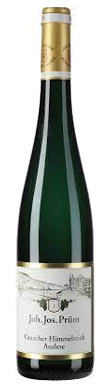

Seaspray and brine lend savoury nuances to penetrating flavours of sun-drenched white peach and honeydew. Augmented with small proportions of botrytised grapes, it's a steely,...
2020
Weingut Joh. Jos. Prüm

Weingut Joh. Jos. Prüm, Wehlener Sonnenuhr Riesling Auslese, Mosel, Germany, 2022
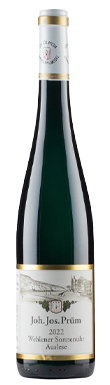
While tightly wound in youth and too nervous to express itself fully, there's a core of sun-drenched peach and yellow cherry lusciousness that pulsates from...
2022
Weingut Joh. Jos. Prüm
Weingut Joh. Jos. Prüm, Graacher Himmelreich Riesling Spätlese, Mosel, Germany, 2022
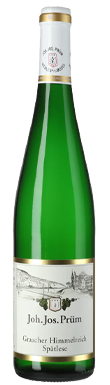
This powerfully concentrated yet fresh-fruited sip is a touch more inviting young than the more nervous Wehlener Sonnenuhr this vintage. Flavours of white grapefruit and...
2022
Weingut Joh. Jos. Prüm
Weingut Joh. Jos. Prüm, Wehlener Sonnenuhr Riesling Auslese, Mosel, Germany, 2020
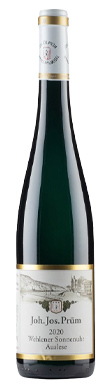
The wines of J.J. Prüm are famously tight and reductive in youth, but this profoundly ripe, perfumed auslese suggests an opulence and ease reflective of...
2020
Weingut Joh. Jos. Prüm
Weingut Joh. Jos. Prüm, Wehlener Sonnenuhr Riesling Kabinett, Mosel, Germany, 2022
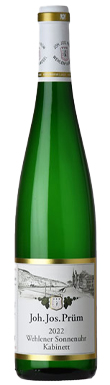
This vibrantly peachy, salt-licked kabinett requires just a few minutes of aeration to peel back the layers of smoke and slate that may obscure its...
2022
Weingut Joh. Jos. Prüm
Weingut Joh. Jos. Prüm, Wehlener Sonnenuhr Riesling Spätlese, Mosel, Germany, 2022
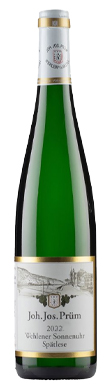
Tasted young, this sprightly spätlese announces itself with strikes of flint and an intensely smoky, earthen veil of reduction. With a bit of time and...
2022
Weingut Joh. Jos. Prüm
Weingut Joh. Jos. Prüm, Wehlener Sonnenuhr Riesling Spätlese, Mosel, Germany, 2020
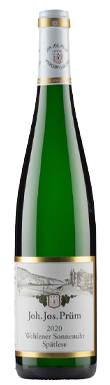
95
A racy, dazzling streak of sea salt and electricity, this finely etched spätlese offers up layers of bright, sun-kissed tangerine and yellow cherry flavours spiced with white peppercorns and ginger. It's remarkably open for such a young wine but anchored by a steely backbone of slate and stone. Balanced in sweetness and revitalising with each sip.
2020
Weingut Joh. Jos. Prüm
Weingut Joh. Jos. Prüm, Graacher Himmelreich Riesling Auslese, Mosel, Germany, 2022
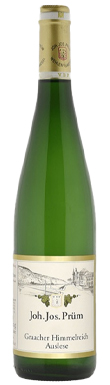
Tangs of cut stone and lime zest are peppered with gunpowder and smoke, but there's a powerful core of ripe lemon, lime and yellow cherry...
2022
Weingut Joh. Jos. Prüm
Weingut Joh. Jos. Prüm, Graacher Himmelreich Riesling Kabinett, Mosel, Germany, 2022
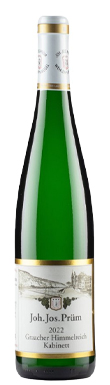
Cooler in tone than the more sun-kissed Wehlener Sonnenuhr, this delightfully stony, crystalline wine highlights the Mosel's mineral intensity. Light as a feather yet bracing...
2022
Weingut Joh. Jos. Prüm
Weingut Joh. Jos. Prüm, Zeltinger Sonnenuhr Riesling Auslese, Mosel, Germany, 2021
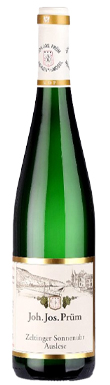
Lithe and intensely mineral, this filigreed expression of a uniquely rainy vintage is a flashback to the Mosel of the 1980s. Despite its delicate frame,...
2021
Weingut Joh. Jos. Prüm
