The Ca’Marcanda project in the sea-kissed region of coastal Tuscany began in 1996, led by the pioneering vision of Angelo Gaja.
It was a decision fuelled by curiosity – his daughter Gaia coyly jokes that her father could be accused of ‘cheating on Nebbiolo with Cabernet’.
Yet, what Bolgheri really represented was a great sense of freedom.
‘Stylistically there were no preconceptions; it’s the new world of Italy,’ she notes.
The Gaja name is perhaps best known as a leading light in Piedmont under Angelo Gaja, but today the family’s estates span three regions of Italy: Piedmont (Barbaresco, Barolo and Alta Langa), Tuscany (Ca’Marcanda in Bolgheri and Pieve Santa Restituta in Montalcino) and Sicily (Idda on Etna).
Settling in Bolgheri
As Gaia explains, ‘We arrived 10 years later’ – namely after the key names that led the historic Super Tuscan movement of the 1980s, from Grattamacco to Guado al Tasso and Ornellaia.
While Angelo Gaja remains involved in key viticultural decisions, since 2012 it has been the three siblings of the family’s fifth generation that tasted and decided each week with the winemaker.
Decanter newsletter
Get our daily fine wine reviews, latest wine ratings, news and travel guides delivered straight to your inbox.
‘Here I grew a lot thanks to the experiments at Ca’Marcanda… It is a philosophy of doing, of being hands-on,’ says Gaia.
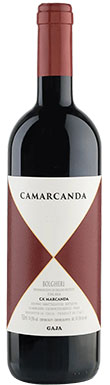
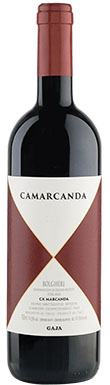
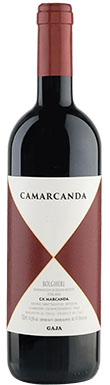
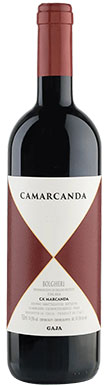
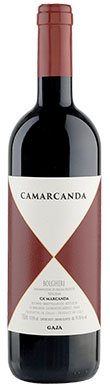
The flagship: Camarcanda
(Image credit: Gaja)
Gaja’s 120ha Ca'Marcanda estate focuses on four key labels: three reds (Promis, Magari and Camarcanda) and a white blend, Vistamare.
For the reds, key international varieties take centre stage, namely Cabernet Sauvignon, Cabernet Franc, Merlot, Petit Verdot and Syrah, in addition to Sangiovese.
The distinct Bolgheri landscape offers a range of soil types, from more sandy to clay-driven and mineral-rich.
This is in particular due to the influence of the Metalliferous Hills, which in the past was a key area for copper, iron, marble and limestone mines.
Recent zoning studies have evidenced around 27 different soil types; to which Gaia acknowledged, ‘the future of Bolgheri will still have a lot of surprises for us’.
Flagship wine Camarcanda represents the estate’s true calling card, produced from some of its best plots.
Today it is a Cabernet Sauvignon-driven blend with the remainder Cabernet Franc, while in the past Merlot also featured.
‘Italianity’ as a marker of identity
Gaia Gaja certainly knows how to command a room. Pulling listeners into her inner circle, she highlights the concept of ‘Italianity’ and the triumph of the ‘ingredient’ or ‘raw material’ in winemaking and gastronomic excellence in Italy.
For her, it's a sense that ‘complexity is not the same as complicated’ that is key, and what truly matters is purity of fruit and territory.
Looking ahead
The effects of climate change on winemaking were already front of mind in Angelo’s choices.
Forward-thinking and ambitious, from the outset he collaborated with university professors, entomologists, botanists and geologists.
Today, Ca’Marcanda remains a forerunner in its approach to the developments and adaptations required by the changing climate in both vineyard and winery.
Working with Professor Andrea Lucchi from the University of Pisa, the estate was involved in an extensive study of insect behaviour that culminated in the pioneering development of ‘smart bugs’, which are being trialled and used to tackle pests in the vineyard, beginning with Ca’Marcanda and now stretching to some 120 other producers.
A focus on the role of mixed agriculture (olives, cereals, woodland), composting practices, and cover crops (such as mustard, vetch and clover) are further strategies employed to encourage biodiversity and healthy soils.
More vigorous rootstocks are being chosen, along with a shift from cordon training to Guyot – in part to tackle vineyard diseases such as esca.
Planting orientations in the vineyard are changing too, with newer vines planted north to south rather than east to west in order to maximise freshness.
In the cellar, blending possibilities are being harnessed to make the most of difficult vintages.
Despite the unpredictability of an ever-changing climate, for Gaia these difficulties also constitute an exciting challenge.
She notes that it is these adverse vintages that provide the opportunity to showcase ‘excellence in consistency’, drawing on decades of experience and the ‘repetition of a craft that goes into the glass’.
26 years on, the warm character of the 2000 Bolgheri vintage is still apparent, yet with a welcome saline freshness. Tertiary notes dominate, with flavours...
Notes of sweet cherries and Mediterranean scrub; a joyous herbal framework of lavender and rosemary, pine and marine gorse. Chalky, moreish tannins and welcome tertiary...
Since the hot 2015 vintage, Merlot has been omitted from Carmarcanda. It's a stunning effort in 2021, with fragrant scents of dried cherry, sous bois...
Claire joined Decanter in 2024 with wide-ranging experience in the wine industry including auction, winemaking, communications and journalism. She holds the WSET Diploma in addition to the Italian Wine Scholar Guild and Vinitaly International Academy Wine Ambassador certifications. She enjoys hemisphere hopping: with two vintages under her belt in both Australia’s Yarra Valley and Vittoria in south-eastern Sicily. As Special Projects Editor at Decanter, Claire oversees all commercial content and bespoke projects. A qualified interpreter, she speaks fluent Italian and French and is working on her Spanish, Romanian and German.