
Ancient Australia: World’s oldest vines and 10 wines to try
The oldest surviving Shiraz, Grenache, Mourvèdre, Cabernet Sauvignon, Chardonnay and Semillon vines, now up to 180 years old, are not in France, or anywhere else in Europe, or even the ancient world. They're in Australia. David Sly charts the country's old-vine heritage, meets the winemakers tending these living relics and recommends wines still being made from them today.

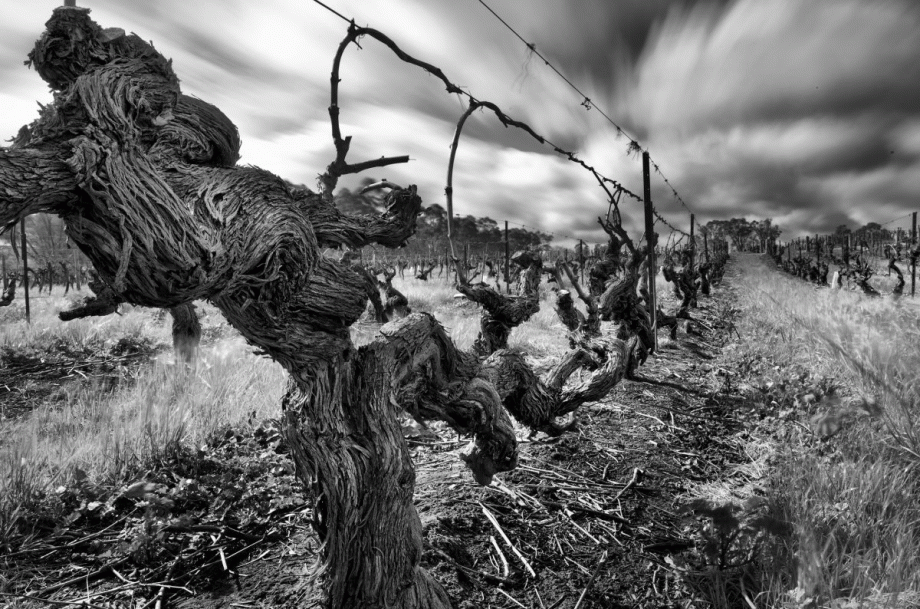
Marco Cirillo tends the world’s oldest surviving Grenache and Semillon vines. Planted in 1848 on their own rootstocks in the Light Pass parish of South Australia’s Barossa Valley and growing enough fruit to produce single-vineyard wines, these living relics hold far more than just historical value.
‘These vines aren’t good because they are old,’ says Cirillo. ‘They are old because they are so exceptionally good.’
Scroll down for tasting notes and scores of 10 wines showcasing Australia’s oldest vines
While it might be surprising to some, Australia has many of the world’s oldest wine grape vines – classic varieties sourced from France before the ravages of phylloxera in the 1880s. These ancient plantings now produce a raft of exclusive, distinctive wines, with a character quite separate to more youthful counterparts.
Australia’s ancient vine story mirrors the origins of its wine industry, when grapes planted by settlers from the 1840s as part of mixed farm plots, thrived and became a valuable trading commodity. These initial plantings formed the backbone of a robust fortified wine industry for more than 100 years, until a canny new generation of winemakers in the mid 1980s treated exceptional old-vine parcels separately to produce unique table wines.
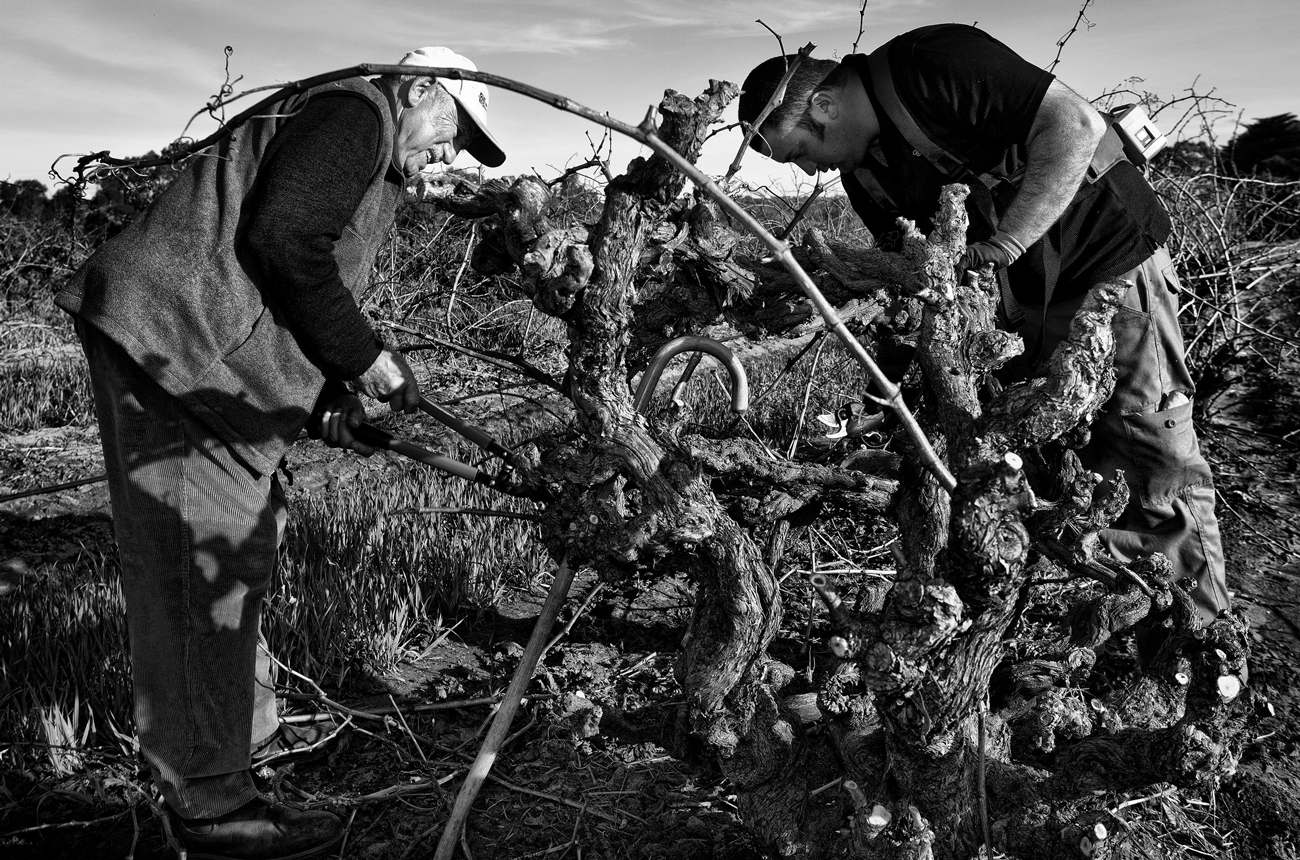
The shift was led by Robert O’Callaghan’s Rockford Basket Press Shiraz and Bob McLean promoting St Hallett Old Block Shiraz – both harvested from a collection of privately owned Barossa heritage vineyards. The acclaim and demand for these wines saved many plots from being grubbed up to make way for housing developments.
‘We were the first to acknowledge that these old Shiraz vineyards were a rare and valuable resource in the Barossa – something that we should protect,’ says O’Callaghan. ‘There was definitely a distinctiveness about the wines that came from them.’
Age, not terroir, is the magic ingredient
Richard Lindner, co-owner at Langmeil, discovered through the 1843 edition of the The Royal South Australian Almanac that a patch of gnarly vines within a derelict Tanunda vineyard Langmeil purchased in 1996 contained the world’s oldest surviving Shiraz, planted in 1843.
Winemaker Paul Lindner noticed that grapes from this 1.5ha section had unusual concentration and length. Since 1997, he has harvested one tonne of fruit annually to produce 250 dozen bottles of The Freedom 1843 Shiraz. ‘Taste it and you know immediately it has unique depth and complexity,’ he says. ‘The flavours have power, but it’s more the balance between the acidity, fruit and tannins that makes it so outstanding.’
The magic ingredient is vine age not terroir. He knows this, as less distinctive neighbouring vines lie in the same deep loam and red clay soils over a bedrock of limestone, ironstone and bluestone.
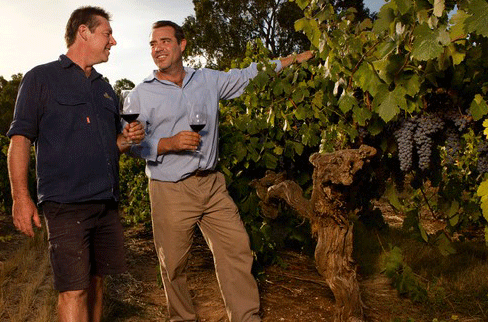
The Lindner family say they’re custodians of these ancient vines and take their role as cultural historians seriously. ‘We know the Freedom vines tell a story about Australian wine that is so much older than most of the world realises,’ says James Lindner, Langmeil’s sales and marketing director.
‘Caring for this vineyard is a continual restoration program. The vines are fragile, and we take great care, especially when pruning. We’re determined to preserve them for the future.’
The Freedom 1843 Shiraz now features a gold banner on its label announcing its more than 125-year vine age. Its success prompted Langmeil to release a Pure Eden Shiraz from 1890s vines in Eden Valley’s Wattle Brae Vineyard. This year Langmeil launched The Lineage, a AU$300 limited release from its two ancient vineyards at Tanunda and Eden Valley.
World’s oldest Cabernet Sauvignon
Cabernet Sauvignon vines planted in 1888 on four hectares of Block 42 at Kalimna in the Barossa Valley are a crowning glory of Penfolds’ vineyard assets. Penfolds purchased the vineyard in 1945, and winemaker Max Schubert noted the fruit’s intense flavours and rich mineral profile. He included some in early Grange vintages and now it is an important component of Bin 707.
Low yields mean Penfolds hasn’t produced many single-vineyard Block 42 wines, but the 2004 Kalimna Block 42 Cabernet Sauvignon Ampoule is among the winery’s most elite releases – 12 hand-blown glass vessels filled with the wine, each priced at AU$168,000.
‘To fill the ampoule with a great vintage from the world’s oldest Cabernet Sauvignon vines is something absolutely unique that only we could do,’ says Penfolds chief winemaker Peter Gago. ‘It makes a spectacular statement about Australian wine.’
Comparisons with South Africa
Promotion of Australia’s ancient vine treasures is piecemeal – far removed from the clear focus of South Africa’s Old Vine Project, spearheaded by Rosa Kruger, Decanter’s 2022 Hall of Fame recipient. The project has 130 members and works cohesively as a sector. It identifies Certified Heritage Vines, supports growers by linking vine age to grape prices, drives heritage vine tourism bookings and promotes the release of 250 certified heritage wines a year. Producers also share their knowledge through the Old Vine Academy, offering specialised pruning courses.
James Lindner is critical that more Australian wineries have not followed Langmeil’s lead to trumpet the virtues of ancient vines. ‘We’re too often defending what we do rather than asserting the best of what we have,’ he says
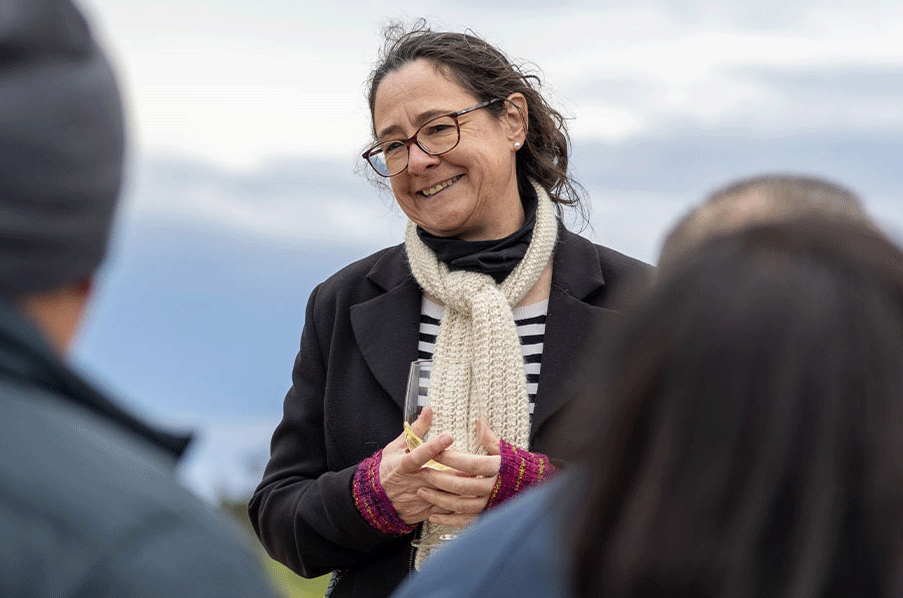
To improve the clarity and honesty of identifying mature vine sources on Australian wine labels, Yalumba drafted the Barossa Old Vine Charter in 2007. Working with grape and wine biodiversity experts Vine Health Australia, the charter classifies Old Vines as 35 years or older; Survivor Vines at least 70 years old; Centenarian Vines at least 100 years old; and Ancestor Vines at 125 years old or more.
Yalumba chief winemaker Louisa Rose says recognising ancestor vines is especially significant. They contain genetic material that helped populate the region with cuttings that underpin viticultural tradition.
‘As vines age, the fruit produces a deeper, richer colour and a different tannin profile. I can’t explain it but can certainly recognise it,’ Rose says. ‘These fully mature vines have a deep root structure that draws out greater diversity of flavour and character. They deserve special recognition.’
Bottling 150-year-old Sauvignon Blanc
Australia’s greatest ancient vine surprise is 1870s Sauvignon Blanc, planted on two blocks in McLaren Vale’s Tintara region, originally tended by pioneer winemaker Thomas Hardy and still owned by branches of the Hardy family. This Sauvignon Blanc has provided an unheralded component of Hardys fortified wines.
‘Because these grapes ripen early and have pronounced natural sweetness, they’re perfect for fortified,’ says retired fortified winemaker Bill Hardy. The fifth-generation descendent of founder Thomas Hardy adds that Hardys seemed to be ‘the only winery in Australia that worked with Sauvignon Blanc in the early years’. Today, this fruit remains a component of Hardys Rare Liqueur Sauvignon Blanc. ‘You can taste the heritage in every mouthful,’ says Hardy.
Old vine assets
The volume of Barossa Shiraz that sits within these classifications is significant. In 2017, Vinehealth Australia reported 12.54ha of Ancestor Vines, 100.62ha of Centenarian Vines, 88.48ha of Survivor Vines and 589.06ha of Old Vines, collectively representing almost 10% of the region’s Shiraz.
The charter was forwarded to the Barossa Grape & Wine Association in 2009, broadening industry-wide recognition of the four-tier classification, which helped shine a light on all rare vine assets.
A significant beneficiary is Dean Hewitson, whose Old Garden vineyard at Rowland Flat has the world’s oldest surviving Mourvèdre, planted in 1853. ‘Just calling these old vines doesn’t say enough,’ he says. ‘That’s a term bandied about too much, and these ancient vines need more distinctive explanation.’
Long used as a high-cropped blender, Mourvèdre deserves recognition as an elite stand-alone red wine variety, believes Hewitson. He also wants the value of these rare old-vine assets reflected in high wine prices. ‘Before I bought this vineyard in 1998, the fruit went into Orlando’s cheap sparkling wine, Carrington Blush,’ he says. Now his Old Garden Mourvèdre sells for $90 a bottle. His flagship is Hewitson Barrel 1853 ($450) – a blend of Monopole Shiraz and Old Garden Mourvèdre, both planted in 1853.
‘The great gift that these ancient vines give is absolute consistency,’ says Hewitson. ‘Regardless of vintage conditions, you know the flavour profile you’ll be getting from these sturdy survivors.’
Marketing quality
Cirillo is also assertively marketing its ancient vine resources. The family knew the Light Pass vineyard it purchased in 1969 had reliable and renowned old vines, and initially sold their Grenache fruit to Rockford and Torbreck wineries, and Semillon to Peter Lehmann Wines.
It was only after Marco Cirillo’s discovery that the vines dated from 1848 that he kept the fruit for himself. He made the first Cirillo 1850 Grenache in 2003. ‘Another wine company had already trademarked 1848 for its Shiraz, so we used the more general 1850 on our label to avoid complications,’ he explains. ‘But we knew we had to identify the vine age on the label to draw attention to its unquestionable quality.’
Old vines in Victoria and New South Wales
The Rutherglen appellation in northern Victoria has old vine history that echoes the Barossa’s. Vines arrived during the region’s gold rush during the 1850s, and wineries including All Saints, Morris, John Gehrig and Chambers Rosewood were operating by the time gold mining subsided, producing mostly fortified wines – a tradition that continues today. Notable ancient vines are also in Victoria’s central Nagambie Lakes district, where Tahbilk boasts Shiraz planted in 1860 and Marsanne planted in 1927, which is part of the world’s largest single Marsanne plot, at 40.5ha.
In New South Wales, the Hunter Valley has 11 vineyards with vines of 100 years or more on their own roots – and the Tyrrell family owns seven. Tyrrell’s Sacred Sites label highlights six century-old blocks across four vineyards: Shiraz from 1879 off the 4 Acres Vineyard; Semillon and Shiraz planted in 1908 from Johnno’s Vineyard; the world’s oldest Chardonnay vines planted in 1908 at the HVD Vineyard; and the 3.3ha Old Patch of Shiraz planted in 1867 within the Old Hillside vineyard – the region’s oldest producing vines.
Ancient Australia: oldest vines and 10 wines to try
Related articles
- Barossa and McLaren Vale Grenache: old vines, new passion
- South American old-vine reds: panel tasting results
- Rosa Kruger: Decanter Hall of Fame 2022
Château Tanunda, 150 Year Old Vines Semillon, Barossa Valley, South Australia, Australia, 2021
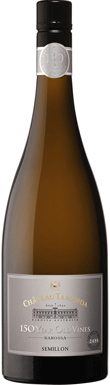

Rather than being confronted by the abrupt acidity of juvenile Semillon, this old-vine marvel adds the poise of mature flavours to a new-vintage release. It...
2021
Château TanundaBarossa Valley

Tahbilk, 1927 Vines Marsanne, Nagambie Lakes, Victoria, Australia, 2015
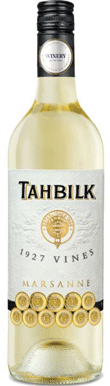
The joy of Marsanne from Tahbilk’s 1927 heritage vines is its depth of flavour. Yes, there’s lemon curd, grapefruit pith and pear, fresh ginger and...
2015
TahbilkNagambie Lakes
Langmeil, The Freedom 1843 Shiraz, Barossa Valley, South Australia, Australia, 2020
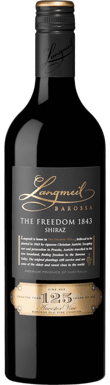
The hallmarks of outstanding, mature Shiraz are all on display in this new-release wine, such is the harmony of the extraordinary old vine fruit. Plush...
2020
LangmeilBarossa Valley
Best’s, Bin No1 Shiraz, Great Western, Victoria, Australia, 2019
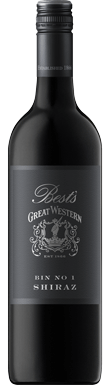
<p>Once spurned for lacking 'typical' Australian Shiraz power, Bin No1 Shiraz is now heralded as an elegant, cool-climate exemplar: svelte, rich in floral perfume and...
2019
Best’sGreat Western
Cirillo Estate, 1850 Ancestor Vine Grenache, Barossa Valley, South Australia, Australia, 2016
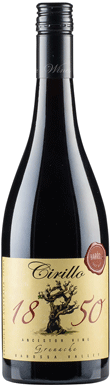
The complexity that comes with age is allowed to speak clearly in this large-framed Grenache. Dark berry, dried herb and spice notes at first, then...
2016
Cirillo EstateBarossa Valley
Hewitson, Old Garden Vineyard Mourvèdre, Barossa Valley, South Australia, Australia, 2019
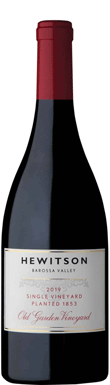
<p>If you expect the brute power of strident black-fruited muscle to come from 170-year-old Mourvèdre vines, you’ll be greatly surprised to instead find velvety opulence...
2019
HewitsonBarossa Valley
St Hallett, Old Block Shiraz, Barossa, South Australia, Australia, 2018
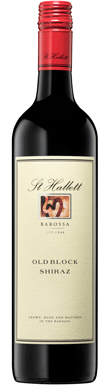
Since its inception in 1980, Old Block has been made from a mix of vines over 40 years old, although recent years has seen a...
2018
St HallettBarossa
Saltram, Metala Single Vineyard Shiraz-Cabernet Sauvignon, Langhorne Creek, South Australia, Australia, 2021
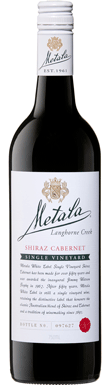
The Adams family, who own the historic Metala vineyard at Langhorne Creek, with surviving vines planted from 1891, has now regained full control of the...
2021
SaltramLanghorne Creek
Yalumba, The Tri-Centenary Grenache, Barossa Valley, South Australia, Australia, 2019
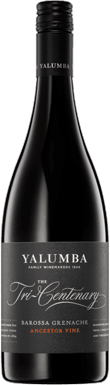
Handpicked from bush vines planted in 1889 on deep sandy loam over red-brown clay in the heart of the Barossa Valley, this mid-weight Grenache is...
2019
YalumbaBarossa Valley
Hardys, Rare Liqueur Sauvignon Blanc, McLaren Vale, South Australia, Australia
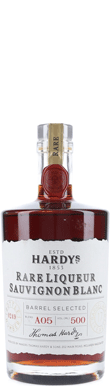
This intense solera blend has an average age of 17 years, but includes some 30-year-old components as well as 150-year-old vine material. Deep amber with...
HardysMcLaren Vale
