
Château Branaire-Ducru: producer profile
Its classic style makes it popular among claret lovers, and this understated St-Julien fourth growth is now embarking on its next chapter under the capable guidance of a new generation.

‘We thought it would be easy after 10 years,’ François-Xavier Maroteaux remarks with a soft smile while walking through Branaire-Ducru’s vines on a warm, sunny September morning, stopping every few metres to taste the concentrated Cabernet Sauvignon berries awaiting harvest after a long and very dry summer. ‘But the reality is that after 35 years we’re still learning and improving. It takes time.’
While Maroteaux is perhaps being a little too self-deprecating about what he and his late father Patrick have achieved since the fourth-growth classified estate was purchased in 1988 – giving Branaire a reputation for flawless regularity, good-value prices and as a ‘safe bet’ – it’s indeed only a small portion of Branaire’s history.
The estate includes ancient vineyards that once formed part of the Beychevelle holdings next door and a legacy that dates back to 1680, when Jean-Baptiste Braneyre bought vines from the Duc d’Epernon’s Beychevelle estate, which had been broken up after his death in 1642.
Scroll down for a selection of Château Branaire-Ducru wines to try
‘There are no short- or mid-term solutions when it comes to wine – it’s a marathon, a long one,’ Maroteaux says resolutely, shortly before affording me a first look at the château’s latest future- proofing installation – a brand new cellar with the capacity of 75 stainless steel vats (including 65 suspended vats). Both the cellar and new expanded wine-tourism facilities were designed by the famed Bordeaux architect Bernard Mazières.
Story of change
‘We have a long-term vision for the style and quality of the wines and we have the passion, so time is not a problem,’ he says. The committed philosophy of producing pure, fresh and charming wines expressive of terroir – ‘a mix of Margaux’s elegance and Pauillac’s structure’ – was enacted by, and continues from, his father’s pursuit.
Despite no formal wine experience, instead armed at the time with a successful career in finance and then as head of the Euro Sucre sugar business, Patrick Maroteaux took the reins at the estate after two years of searching for the perfect property. Immediately following the sale, he began the restoration of the vineyards and château, initially visiting once a week before moving to Bordeaux full time in 2000.
He quickly appointed a young Philippe Dhalluin as technical director to oversee a replanting programme (uprooting poor 1970s rootstocks and increasing Petit Verdot plantings) and drastic yield reduction to improve quality. Dhalluin later moved to Château Mouton Rothschild (Pauillac) and was replaced by the current, talented winemaker Jean-Dominique Videau, who in 2022 celebrated two decades at the helm.
A modernised cellar followed in 1991, bringing the first gravity-fed chais to Bordeaux, as well as specially designed thermoregulated vats, taking advantage of distillation knowledge acquired in the sugar factories. A second renovation was completed in 2010, increasing the number of tanks from 28 to 38. These supported an additional, and unlikely to be repeated, 10ha of vines that were purchased in the same year. An optical sorting table for harvest-time was added in 2017.
Patrick ended the sales exclusivity that the château previously had with wine merchant Nicolas, which had control over almost all the production through its stores. Ending the relationship meant the wines could now reach a far wider audience through the Place de Bordeaux marketplace but, with no library stock left at the château, he and François-Xavier had to buy back many older vintages. Going forward the château will retain a larger proportion of production.
France now accounts for 25% of the estate’s sales, with the main export markets being China and Hong Kong (22%), US (18%), UK (15%) and Switzerland (7%).
A second wine, Duluc de Branaire-Ducru, was added to the portfolio, mostly for grapes from replanted younger vines that would provide an enjoyable and eminently drinkable entry point to the estate’s grand vin. Duluc has never been sold through the Place and is instead released when ‘it’s ready – usually after four years is a good time to start drinking’.
The 2018 vintage is currently on the market (£35-£37 Adnams, Rodney Fletcher, Tanners, Waud Wines), although the wine can age – the 2011 is showing very well at the moment.
Continuing legacies

Patrick’s untimely passing in 2017, at just 67 years old, advanced a handover to François-Xavier, who moved in along with his wife and three children within weeks of a medical diagnosis in 2015 to spend as much time as possible learning the ropes. ‘I knew that one day I wanted to work with my father, but I was one of four [children] so it wasn’t guaranteed.’ Once given that chance, he found it ‘so nice to have the opportunity to work and travel a little with him, also with Jean-Dominique who I have known since the start – so it was very clear that we would keep the same style of wines’.
The style, according to the pair who work side-by-side and make 100% of the decision-making at the château, focuses on three key pillars: purity of fruit, freshness and elegance. ‘Our objective is to try to have the same signature each year. The difference is that in a great vintage the three elements will be pronounced, in more challenging vintages they will be more shy – but you should always be able to find them to some degree.’
Branaire-Ducru is considered characteristically complex, but also one of the more understated and shy-of-the-limelight wines in St-Julien. It has a modest pricing strategy to match – certainly when compared with more extravagant styles from across the appellation which also command much higher prices – it can be found at two to five times cheaper than its neighbours. This gives it one of the best quality-to-value ratios among the Médoc crus classés, thereby appealing to people who want to drink wine, rather than necessarily chasing investment value.
‘Branaire is one of the most unanimously respected and loved estates in Bordeaux,’ says Mathieu Chadronnier, president of Bordeaux négociant CVBG. ‘To me, it defines classicism. The pursuit of quality and expression at Branaire has always been a fine line between embracing the best that newly gained knowledge has to offer while staying true to its style and identity. As a result,’ he concludes, ‘the wines exude a sense of timelessness, and yet are very much of their time.’
In the vineyard

Branaire’s 60ha of vines are spread out across the St-Julien appellation, including a 3.5ha plot to the east and surrounding the château less than 1km from the moderating influence of the Garonne river, as well as plots to the west near Châteaux Lagrange and Talbot. ‘We have 15 different micro-terroirs, depending on the composition of soil and subsoil,’ Videau explains on a tour that counts no fewer than seven renowned estates within sight or short walking distance, including second growths Châteaux Ducru-Beaucaillou, Gruaud Larose and Léoville Barton, third growth Langoa Barton, fourth growths Beychevelle and Saint-Pierre, and Château Gloria.
It’s mostly quaternary silicious and gravel alluvium, one of the warmest terroirs in the region, with clay, limestone, sand and stone content (size and density) counting among the differentiating factors, as well as meso- and microclimates based on proximity to the river and forest borders. ‘More soil types help us stabilise the quality and the style of the wine,’ says Videau.
A 2% annual replantation programme is in place to maintain healthy yields, with the average vine age at about 40 years old. Vineyard plantings comprise 65% Cabernet Sauvignon, 28% Merlot, 3% Cabernet Franc and 4% Petit Verdot at 6,000-10,000 vines per hectare.
‘Balanced vigour’ is key, with a seemingly endless list of processes changed and adapted for each row, let alone for each variety – considerations whether to cover-crop, plough, de-leaf, plant, prune, fertilise and treat are taken almost on a vine-by-vine basis with no disparity of care, even for grapes destined for Duluc. ‘Economically it’s perhaps not the best strategy, but there are no compromises on quality,’ Maroteaux affirms.
Biodiversity is encouraged, as is a commitment to both CSR (corporate social responsibility) policies, as well as an environmentally conscious approach that combines organic and biocontrol treatments, primarily to best handle the severity and ongoing concern of mildew.
The estate has been certified HVE-3 (High Environment Value) since 2017 and has been working alongside other St-Julien estates to increase natural habitats across the appellation and to reduce the impact of the grapevine phytoplasma disease flavescence dorée. After 10 years ‘we’ve halved the number of treatments and planted more than 10km-worth of trees’.
Vital details
With about 70 individual plots, it was necessary to have ‘the complexity in the vineyards match the vat house’, thus prompting the new winery build – a ‘once-in-a-lifetime project’ for François-Xavier. At the time of my visit, while still not yet fully finished, the suspended gravity-fed tanks, ranging in size from 60hl to 90hl, are up and running enough to accommodate both the small crops of 2021 and 2022 with plot-by-plot vinification. Work is set to be completed by the end of 2023.
Fermentation generally lasts seven to eight days with pumping-over conducted at the beginning to gain extraction straight away. ‘We want wines with good richness and to have refined tannins – nothing harsh,’ Videau explains while walking round the new installation.
Work on the precise usage of press wine began in 2010. Press wine (following fermentation, this is the remaining liquid pressed out of the grape solids after the free-run juice has been collected) is regarded as ‘imperative for complexity’, with the château collecting samples that were pressed at different pressures, forming up to 180 barrels, of which 12%-14% is used in the final blend. In January following the vintage, consultant Eric Boissenot joins the team to decide on the blend, and the grand vin is then aged for 18 months in French oak, 60% new (having undergone long seasoning and low toasting to ‘respect the fruit’ and so as not to ‘ever taste the barrels’) and 40% second-fill, with a slightly shorter period (12 months) and less new oak (below 20%) being used for Duluc.
Looking to the future

Maroteaux rules out any further vineyard expansion, there being ‘no more land to buy in St-Julien’. Instead the objective is to ‘continue what the generation before did and ensure it lasts for the next one’.
With all but two of St-Julien’s 19 estates, including 11 classified, still family-owned, Maroteaux acknowledges that ‘this appellation is still a bit different’. St-Julien has ‘a nice reputation’, he says, adding: ‘We’re happy to have strong brands and families involved in the business. But we also have our own place. We want to continue meeting consumers and explaining what we do. It takes time.’
For Chadronnier, ‘François-Xavier does not follow in footsteps, but continues on a path started by his father. Along the way, while staying true to that direction, he is carving out his very own path, in the service of his estate, and with a very noble idea of “wine”.’
Maroteaux says: ‘Most important, when you taste a wine, is: would you like to share that bottle one night with someone or not? That’s the kind of wine we want to make. The best way is to taste, or come and visit.’ Château Branaire-Ducru has had a remarkably consistent run of charming and drinkable vintages since 2000 – younger wines showing excellent promise but needing time to open – and appealing prices to match. Add to that a shiny new tasting room set to open in spring 2024, and there’s plenty of reason to start your love affair with the wines of Branaire-Ducru.
Understated classic: Château Branaire-Ducru wines to try
Wines are listed in vintage order starting with the second wine then grand vin
Related articles
- Château Léoville Poyferré: producer profile
- Château Ducru-Beaucaillou vertical tasting: 1953-2018
- Château Pichon Baron: vertical tasting from 2000-2020
Château Branaire-Ducru, Duluc de Branaire-Ducru, St-Julien, Bordeaux, France, 2015
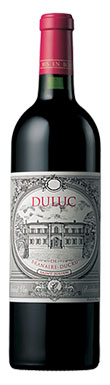

Gorgeous nose of cinnamon, floral-edged black fruits and chocolate. Supple and juicy with crushed velvet-textured tannins. Acidity is good giving this a round and mouthfulling...
2015
Château Branaire-DucruSt-Julien

Château Branaire-Ducru, Duluc de Branaire-Ducru, St-Julien, Bordeaux, France, 2016
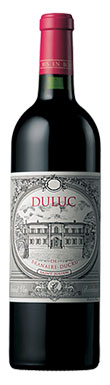
Mocha, cocoa powder, blackcurrants and black plums on the nose with some sage and thyme. Juicy and plump, this has a nice lifeforce to it...
2016
Château Branaire-DucruSt-Julien
Château Branaire-Ducru, Duluc de Branaire-Ducru, St-Julien, Bordeaux, France, 2017
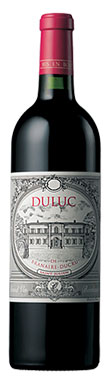
Rose and violets on the nose with some liquorice and a touch of medicinal herbs. Smooth and supple, the acidity here is at the fore,...
2017
Château Branaire-DucruSt-Julien
Château Branaire-Ducru, Duluc de Branaire-Ducru, St-Julien, Bordeaux, France, 2018
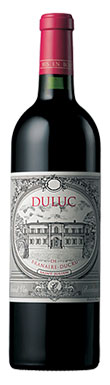
Gentle blackcurrant perfume on the nose, sweet and soft with a touch of medicinal herbs. Juicy and supple with lots of freshness and a nice...
2018
Château Branaire-DucruSt-Julien
Château Branaire-Ducru, St-Julien, 4ème Cru Classé, Bordeaux, France, 2009
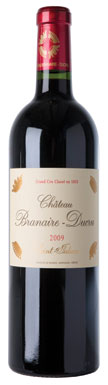
A nose of inviting chocolate powder and dark fruits - very specifically aromatic, after a few minutes the soft florals and medicinal herbs come into...
2009
Château Branaire-DucruSt-Julien
Château Branaire-Ducru, St-Julien, 4ème Cru Classé, Bordeaux, France, 2010
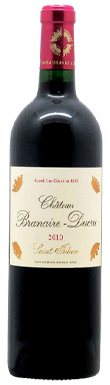
Herbal and dark-fruited, has body and movement with high acidity offsetting sleek tannins and mineral elements. Lovely focus and freshness, persistence and drive. Good combination...
2010
Château Branaire-DucruSt-Julien
Château Branaire-Ducru, St-Julien, 4ème Cru Classé, Bordeaux, France, 2012
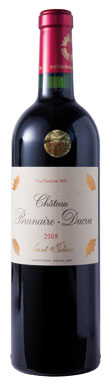
Lovely herb and flower scents on the nose, a signature of the estate with chocolate powder, toast, caramel, cinnamon alongside sour cherries and caramelised red...
2012
Château Branaire-DucruSt-Julien
Château Branaire-Ducru, St-Julien, 4ème Cru Classé, Bordeaux, France, 2013
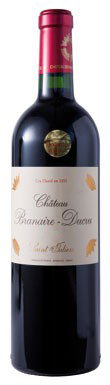
Soft and gentle, a little austere on the palate, the oak and spices sticking out above the graceful texture. Well handled, the tannins though a...
2013
Château Branaire-DucruSt-Julien
Château Branaire-Ducru, St-Julien, 4ème Cru Classé, Bordeaux, France, 2014
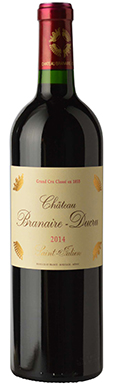
Herbal nose, violets, blackcurrants, chocolate and exotic sweet spices; clove and cinnamon. Plump and fruit forward, this is confident and shines brightly out the...
2014
Château Branaire-DucruSt-Julien
Château Branaire-Ducru, St-Julien, 4ème Cru Classé, Bordeaux, France, 2015
Juicy and alive, this shines out the glass, compelling and charming with a searing brightness and zestiness - just great acidity that lifts the initial...
2015
Château Branaire-DucruSt-Julien
Château Branaire-Ducru, St-Julien, 4ème Cru Classé, Bordeaux, France, 2016
Florality and black fruits on the nose, really very aromatic and expressive. Generous and giving, this is definitely more plush and supple than the 2015,...
2016
Château Branaire-DucruSt-Julien
Château Branaire-Ducru, St-Julien, 4ème Cru Classé, Bordeaux, France, 2017
Liquorice, cola, caramel, tobacco and black fruits, - some blue fruit hints too. Smooth and round, this has a lovely weight on the palate, supple...
2017
Château Branaire-DucruSt-Julien
Château Branaire-Ducru, St-Julien, 4ème Cru Classé, Bordeaux, France, 2018
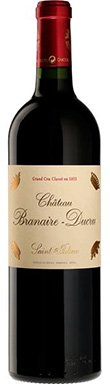
Really ripe, heady perfumed fruit on the nose, no longer just floral aromas but proper perfume, so expressive - wild and evocative, the first one...
2018
Château Branaire-DucruSt-Julien
Château Branaire-Ducru, St-Julien, 4ème Cru Classé, Bordeaux, France, 2019
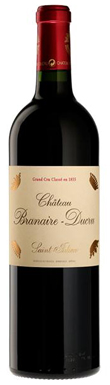
Lifted floral notes are combined with dark currant fruit flavour and fine tannins on the palate. A very elegant Branaire-Ducru and relatively restrained in the...
2019
Château Branaire-DucruSt-Julien
Château Branaire-Ducru, St-Julien, 4ème Cru Classé, Bordeaux, France, 2020
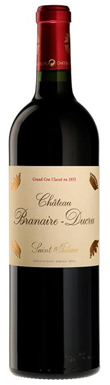
Sleek and seductive, quite highly charged with such a potent perfume and black bramble fruit aroma on both the nose and palate. Silky, smooth, suave...
2020
Château Branaire-DucruSt-Julien