
Producer profile: Wakefield Estate
Internationally renowned for its big, bold wines – with the medals to prove it – Wakefield is showing no signs of slowing in its bid for world domination, finds Huon Hooke…


To celebrate its 50th anniversary in 2019, Wakefield Estate – Taylors in Australia and New Zealand – has released a new wine that the company boldly claims is its best wine yet. Named Wakefield The Legacy, it’s quite a departure in stylistic terms: suavely textured, elegant, with great length, complexity and fine-grained tannins.
Scroll down for Huon Hooke’s pick of the best from Wakefield Estate
Established in 1969 in South Australia’s sunny Clare Valley, Wakefield is still about 50% estate-based, has always been a proudly family-owned business and is a founding member of Australia’s First Families of Wine group. It has always placed strong emphasis on show results and has had impressive success in competitions both at home and abroad. Its critics say that its red wines are bold, oaky and obvious, and that this is the kind of red wine that tends to get results in shows. But it’s clear that its followers love that style.It’s an unusual company in that it markets its wines under two different brand names simultaneously. The company began as Taylors Wines in the early 1970s, and it wasn’t until it began to get serious about exporting that a problem arose. Says managing director and third-generation family member Mitchell Taylor: ‘This happened quite early on in our export journey, in 1988, when Taylor Fladgate [Taylor’s Port in the UK] challenged us when we marketed our wines in the UK.’

As well as Taylor’s Port, there was also Taylor California Cellars in the US. So as a result, all Taylors wines in the UK, Europe and North America have since been sold under the name Wakefield, while Taylors Wines is used in Australia and New Zealand. In Asia, the family is currently switching over to Wakefield Taylor Family Wines. And it’s working on a global co-existence deal with Taylor Fladgate. ‘The curse of such a common surname!’ adds Taylor.
King of Cabernet
Wakefield’s first plantings were Cabernet Sauvignon and it still sees itself as primarily a Cabernet company. ‘Cabernet was the grape variety we started with, and Cabernet is still the highest value wine being sold out of Australia,’ says Taylor. ‘And it’s still the highest value wine in the world market. Just think of Bordeaux, Napa Valley, Sassicaia, the Penfolds Special Bin wines…’
The company is very competition-focused, and enters its wines into a multitude of shows in Australia, Asia and Europe. A tasting with chief winemaker Adam Eggins and Mitchell Taylor is punctuated with comments about medals won and accolades achieved. They’re especially proud of such distinctions as The Visionary Cabernet Sauvignon 2014 having won gold at the Concours International des Cabernets in France in 2016.

Wakefield boasts that its wines are ‘the world’s most-awarded’ and its claim to be ‘the world’s number one winery’ is based on a 2017 ranking by the World Association of Wine Writers and Journalists, which looked at the performance of more than 50,000 producers in global wine competitions.
Wakefield / Taylors at a glance
Established 1969 Vineyard area 600ha Production 9.6m bottles
Main red varieties Cabernet Sauvignon, Shiraz
Main white varieties Riesling, Chardonnay, Sauvignon Blanc
Chief winemaker Adam Eggins
Exports All major markets
Wakefield’s green credentials
Wakefield is 100% family-owned by the founding Taylor family, and is very much estate-based in the dry, warm Clare Valley – factors that no doubt have helped the family in its quest to become as environmentally sensitive as possible. Committed to sustainable practices, it claims to take all available measures to prevent or eliminate as far as possible the production of waste or pollution. A key part of the strategy is the adoption of an environmental management system (EMS) and a strategic plan.
The company received ISO certification for its EMS in 2009; behind this is a risk management program providing a framework for ongoing improvements. It addresses the core risks of water consumption, waste, noise and air emissions, energy, storage and soil management. The company also began reducing its carbon footprint in 2008. As part of its emissions reduction plan, it has been buying carbon offsets since 2009 with the result that the Eighty Acres range of wines is carbon neutral. Thousands of trees have been planted as a result.
In addition, Wakefield was among the first wineries in Australia to introduce innovative Lean+Green™ lightweight glass, first into the Eighty Acres range, and later the Promised Land and Taylors Estate/Wakefield Estate ranges. The bottle is almost 40% lighter than the original one used for Eighty Acres and represents the equivalent of a 15% reduction in CO2 emissions per bottle.
The company’s bread-and-butter Shiraz pulled off a giant-killer act at the Great Australian Shiraz Challenge in 2015, winning not only best value wine, but best wine overall. ‘The 2014 seemed to win gold wherever we showed it,’ says Taylor. ‘It was a cracker vintage across the range.’ No surprise, then, that it was the 2014 vintage that was chosen for the Wakefield The Legacy Cabernet blend.
The best yet
Wakefield The Legacy is clearly, as claimed, the best wine the company has yet produced. Based on Cabernet Sauvignon, it includes minor proportions of Merlot and Cabernet Franc from Coonawarra. Only 1,080 bottles were produced and it was released on 16 April 2019, the exact date of the company’s 50th anniversary. The barrels used were extra special, as Eggins explains: ‘When [Cognacbased cooperage] Vicard celebrated its 80th anniversary, Jean-Louis Vicard sent us a special anniversary barrique, named Jean Vicard after his father. We liked it so much we ordered nine more. Jean-Louis said: “You have to promise to keep the wine in the barrels for 36 months, otherwise I won’t sell them to you.” This was unusual, but we agreed. We’ve been buying them every year since.’
The barrels are light-toast and made from very fine-grain, 36-month-matured oak. The wine itself is 97% Clare Valley and comprises 24 parcels of fruit, mostly from the St Andrews estate. Not all of the 10 barriques were used; the remainder went into the St Andrews Cabernet. Wakefield The Legacy confirms that the company, once synonymous with high-volume, modestly priced wines with a big supermarket presence, is making a big effort at the top end.

‘When I started with Taylors, it was about making the best value wines we could. But we are evolving as the industry is evolving,’ says Eggins, who will celebrate 20 years at Wakefield in 2020. Now, it’s about making the best wines he can, with no limits. This began with The Visionary Cabernet Sauvignon and The Pioneer Shiraz (starting with 2009 and 2012 respectively), pitched high at A$200 each, and, this year, Wakefield The Legacy.
Clare Valley roots
The first Taylors Clare Valley wines were the 1973 Cabernet Sauvignon and Shiraz, but the story actually begins much earlier. The Taylor family were Sydney hotel owners and wine merchants when, in 1950, they partnered with the Clare Valley Co-operative to bottle and distribute their own wines under the Chateau Clare label. Wanting to get more involved in growing and making wine, and inspired by the great châteaux of Bordeaux, the family explored the wine regions of Australia, finally deciding on the Clare Valley in 1969, where they bought land beside then Wakefield River at Auburn, in the southern part of the region.
Jim Barry, of the eponymous winery, was then winemaker at Clarevale. He helped the Taylors prepare and plant their first Cabernet Sauvignon vines, the stock gifted by David Wynn from Wynns Coonawarra Estate. The story goes that while excavating a dam for water storage, Bill Taylor senior found the fossilised remains of tiny seahorses in the limestone bedrock – a reminder that the area was once under sea, 600 million years earlier. The family adopted a trio of seahorses as its symbol.
A grand, white, château-style building, complete with battlements, was completed just in time for the inaugural 1973 vintage and named Chateau Clare Estate. The 1973 Taylors Estate Cabernet Sauvignon and Shiraz (then labeled Hermitage) were released and the Cabernet promptly won the Montgomery Trophy for the best red wine at the Royal Adelaide Wine Show.
Quality Riesling
Throughout the 1980s and 1990s Taylors bought more land and planted more vineyards in the district, its emphasis swinging more to whites in keeping with public tastes. The St Andrews estate was purchased in the mid-1990s and the St Andrews brand of premium wines – Cabernet, Shiraz and Riesling – was launched in 1999.
Taylors/Wakefield is known primarily for reds but Riesling is its unsung hero. Clare is of course famous for Riesling, and Eggins considers he has worked out the best way to vinify it. ‘All our Riesling is whole-bunch pressed, which gives juices of very low phenolics, high acidity and low pH. We can have very low residual sugars – say 1g/L – and yet the wines are not hard or astringent. I say we are the biggest whole-bunch presser in Australia after Chandon.’ (Whole-bunch pressing is normal for sparkling wine.)
In fact, what Eggins does is actually whole-berry pressing, because the grapes are mechanically harvested, leaving the stalks on the vines. And whole-berry pressing differs from the usual Australian Riesling technique of crushing the grapes.
That said, the company is likely to remain focused on big reds, especially Cabernet. Eggins says of the St Andrews Cabernet: ‘We want them big – as big and masculine as we can get in Clare.’
See Huon Hooke’s pick of the best from Wakefield Estate
You may also like
Leeuwin Estate Art Series Chardonnay: Bucking trendsTasting several vintages of Cullen’s flagship winesBest Penfolds wines: A selection of our top scorersTop Australian multi-regional blends
Wakefield Estate, St Andrews Riesling, Clare Valley, South Australia, Australia, 2015
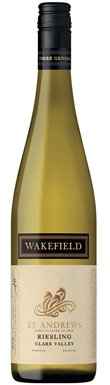

Intense lime-flower, lemon-juice aroma, fresh and vibrant, delicate and restrained. It’s tight and dry, clean and delicate in the mouth, with a soft, seamless flow....
2015
Wakefield EstateClare Valley

Wakefield Estate, Estate Riesling, Clare Valley, South Australia, Australia, 2016
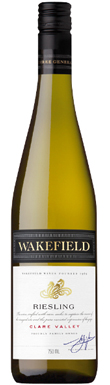
Meadow hay, silage and lightly toasty forward-developed aromas. The palate is soft and full, round and ample. Quite overt. An open style for early drinking....
2016
Wakefield EstateClare Valley
Wakefield Estate, The Visionary Cabernet Sauvignon, Clare Valley, South Australia, Australia, 2010
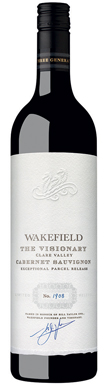
<p>Before the launch of the £550 Legacy Cabernet Sauvignon, The Visionary represented the pinnacle of the Wakefield portfolio, with the best fruit selected from the...
2010
Wakefield EstateClare Valley
Wakefield Estate, St Andrews Shiraz, Clare Valley, South Australia, Australia, 2015
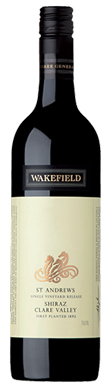
Rich, dark mocha bouquet with lashings of oak and overtones of fruitcake and preserved plums. Rich, full-bodied, plump and fleshy, with drying, savoury tannins, well-balanced...
2015
Wakefield EstateClare Valley
Wakefield Estate, St Andrews Cabernet Sauvignon, Clare Valley, South Australia, Australia, 2014
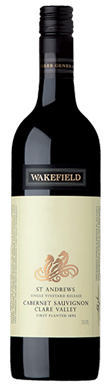
Bright, fresh, peppermint-scented bouquet, which translates onto a full-bodied palate, surprisingly smooth despite its ample tannins. Some tomato-bush flavours. Still young and fairly straightforward, full-bodied...
2014
Wakefield EstateClare Valley
Wakefield Estate, Jaraman Shiraz, South Australia, Australia, 2016
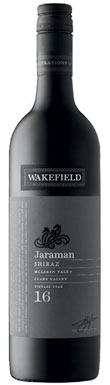
Very savoury bouquet, full of walnut and pecan nut, sweet-berry aromas. The palate is likewise very savoury and drying, with abundant alcohol warmth and glycerol...
2016
Wakefield Estate
