
Rioja vintage spotlight: 2014 and 2004
A tasting of two very different vintages, 10 and 20 years on, proves that vintage is key to Rioja quality and ageability, with only the top estates coming up trumps in less favourable years.

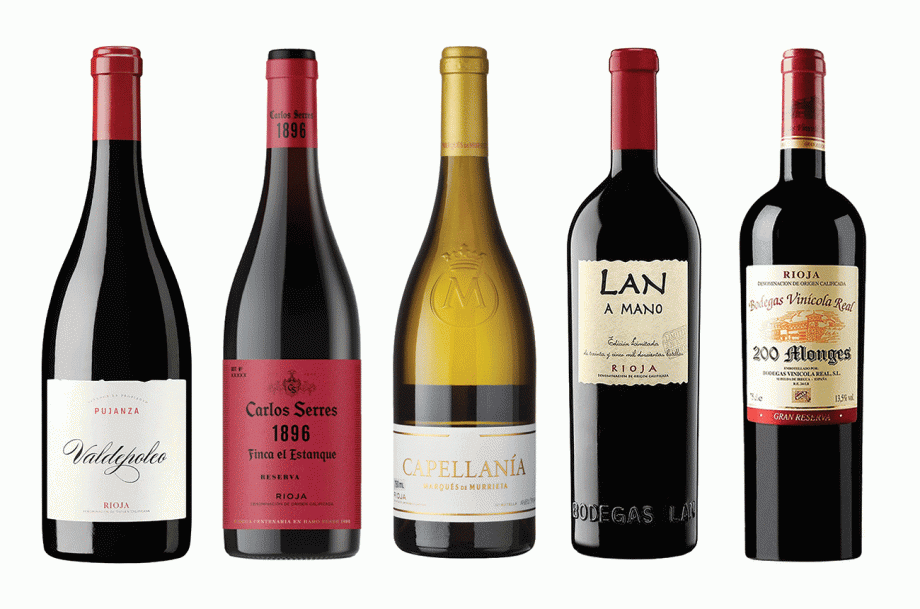
There’s no doubt that the best Riojas improve with cellaring. The idea behind this spotlight tasting, therefore, was to see how these wines were performing after 10 and 20 years. However, the comparison can’t be based on age alone: the vintage factor is crucial.
In this instance, the differences between the 2004 and 2014 vintages are striking. While 2004 is considered to be one of the greatest Rioja vintages of this century to date, some producers would rather forget 2014 altogether.
As Pablo Franco, technical director of the Consejo Regulador DOCa Rioja, diplomatically puts it: ‘2014 was a heterogeneous vintage, but hard work in the vineyards paid off spectacularly.’
Scroll down to see notes and scores for some selected wines from the two vintages
A perfect season
Everything that could go well went well in 2004, although the season got off to a gloomy start, with lots of rain and fear of disease in the vineyards. This was followed by perfectly sunny weather and well-nourished soils, though temperatures were, at the time, deemed a bit high (in light of climate change, 2004 temperatures would later come to be seen as ‘average’). Grapes were healthy and ripe, and young wines were delicious: balanced and fruity, with round tannins and relatively low pH – all the necessary conditions for ageing.
As a result, the 2004 vintage was generally viewed as ‘excellent’ by the experts. This rating applied across the three sub-regions, although Rioja Alavesa in particular benefited from the conditions and arguably Rioja Oriental less so, because temperatures there were particularly high.
It’s also worth noting that at the time there were fewer quality-minded wineries in Rioja Oriental, but the situation is different today.
A season to forget
Jump forward 10 years and 2014 was the opposite of 2004. It started well, after the rainy and cold 2013 (the last such vintage in Rioja to date), with plenty of water in the soils and good weather.
But then the season worsened considerably across the whole region, with some areas being hit particularly hard. Conditions were terrible in many vineyards, especially at harvest time, when the high rainfall led to botrytis.
Those growers who managed old vines undertook green harvesting, clearing and working the vineyards in a timely way so that they were ready to pick at the right time and could get healthy and ripe grapes.
Unfortunately, those producers with particularly high yields and less-careful viticulture practices suffered a lot, and subsequently had to make a number of corrections in the winery.
Winemaking shifts
Significantly, 2014 also marks a shift in attitudes towards winemaking in Rioja: 2014 was the last vintage for overripe wines. Since then, winemakers no longer boast that they are ‘the last to harvest’, as they had done previously.
While the switch to harvesting earlier has much to do with climate change, as well as a quest for finesse, the late rains that occurred in 2014 were definitely a catalyst for this change.
Despite the challenges, there were, however, a decent number of very good 2014 wines produced at the time of release, and there was no reason to discard the whole vintage. Indeed, I remember some wines achieved excellent scores back then.
It was therefore a useful vintage in at least one respect: it highlighted the differences between the best producers and the others.
Compare and contrast
With all this in mind, you might expect the 2014s to appear slightly younger than the 2004s, while the 2004s would be slightly more complex. However, the results of our tasting showed that this was not the case.
Over the years, the differences in quality potential become more and more evident. Based on the results of this tasting I would recommend keeping top 2004s for longer than 2014s – although the best of them, across both vintages, are highly enjoyable now.
In my opinion, 2004 is likely to enter the club of top Rioja vintages, alongside years such as 2001, 1964, 1929 and 1895. In that context, alongside these greats, 2014 is bound to be forgotten.
Wine lovers are well aware of vintage differences for Bordeaux and Burgundy, but tend to minimise the vintage effect in Rioja. This tasting proved that this notion is completely wrong – particularly for wines whose peak is often some decades ahead.
Indeed, the rule of ‘buy the greatest in poor vintages, buy the second greatest in the best vintages’ applies to Rioja as much as it does to the French regions.
How the tasting worked
The tasting was conducted blind. Each producer submitted samples from both 2004 and 2014, on the understanding that only one tasting note per producer would be published. Several producers had excellent wines in both vintages; practically all of them had a better wine in 2004 than in 2014.
As a result, the recommendations give priority to the best 2014s from a broad range of producers. The 2004s recommended are the best among those not selected for their 2014s. Note that all producers (except one, Carlos Serros) whose 2014 wines we selected got a higher mark for their 2004s.
Maturing well: vintage highlights from our tasting:
Related articles
Marques de Murrieta, Capellanía Reserva, Rioja, Alta, Northern Spain, Spain, 2014

Capellanía is definitely one of the most appealing wines in Rioja. Made with grapes from a single vineyard, it shows the complexities of ageing without...
2014
Marques de MurrietaRioja

Bodegas Vinicola Real, 200 Monges Gran Reserva, Rioja, Northern Spain, Spain, 2004
Everything is close to greatness in this wine. Restrained, elegant aromas, subdued fruit in a complex expression, with fine toasty notes, sweet spice and a...
2004
Bodegas Vinicola RealRioja
Baigorri, Reserva, Rioja, Alavesa, Northern Spain, Spain, 2004
A classic gran reserva from Alavesa at its peak. Great intensity on the nose, with mint, spice, dry fruit and leather, and toasty hints from...
2004
BaigorriRioja
La Rioja Alta, Viña Arana Reserva, Rioja, Northern Spain, Spain, 2004
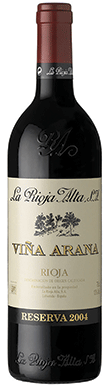
A great example of one of the key wine styles that made the region great. Sweet vanilla, forest floor, leather, truffle and coconut, with dessicated...
2004
La Rioja AltaRioja
Beronia, Gran Reserva, Rioja, Northern Spain, Spain, 2004
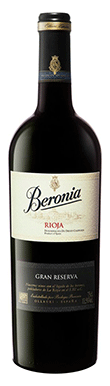
There are wines that show not only their origin and their vintage, but also the hand of a master. This gran reserva benefits from selected...
2004
BeroniaRioja
Faustino, Faustino I Gran Reserva, Rioja, Northern Spain, Spain, 2004
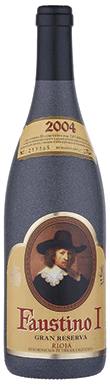
With high production levels and affordable prices, Faustino crafts the wines in the winery, and in the best vintages its Faustino I shows all the...
2004
FaustinoRioja
Carlos Serres, 1896 Finca el Estanque Reserva, Rioja, Northern Spain, Spain, 2014
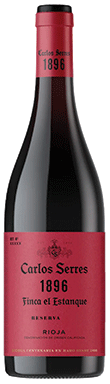
This is probably the only wine in this series for which the 2004 is not better than the 2014. The effort of strict selection in...
2014
Carlos SerresRioja
Pujanza, Valdepoleo, Rioja, Alavesa, Northern Spain, Spain, 2014
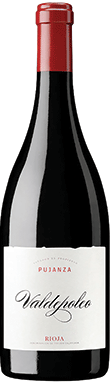
A single vineyard at the heart of Rioja Alavesa, divided into seven plots that are worked separately until ageing is completed, is the raison d'être...
2014
PujanzaRioja
Señorío de Villarrica, Delicia de Baco, Rioja, Northern Spain, Spain, 2014
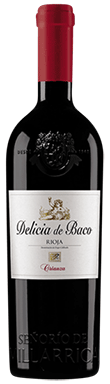
Really surprising for the vintage, a wine redolent of dense and elegant fruit, with generous oak. Made with grapes from old Tempranillo vines from a...
2014
Señorío de VillarricaRioja
Miguel Merino, Gran Reserva, Rioja, Alta, Northern Spain, Spain, 2004
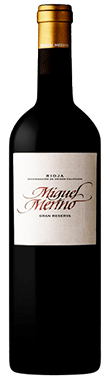
Quite rich, despite the obvious ageing, with impressive intensity, very clean. On the palate it is juicy, velvety, probably a little bit meaty, which gives...
2004
Miguel MerinoRioja
Bodegas Lan, Lan a Mano, Rioja, Northern Spain, Spain, 2014
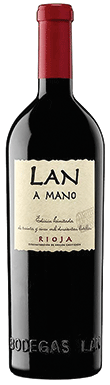
Lan a Mano is one of those understated Rioja wines that performs very well in blind tastings. Careful fruit selection from a low-yielding vineyard very...
2014
Bodegas LanRioja
Bodegas Perica, Oro Reserva, Rioja, Northern Spain, Spain, 2014
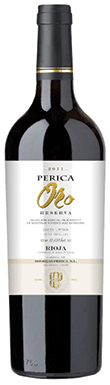
This is a wine that keeps lovely fruit and an impressive concentration. It is quite oaky on the nose, and velvety and intense in the...
2014
Bodegas PericaRioja
Marqués de Riscal, Gran Reserva, Rioja, Northern Spain, Spain, 2014
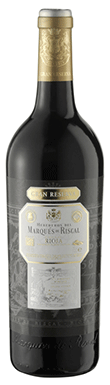
Top Rioja used to be made in two styles: very long ageing in barrels, with yearly refreshments, or shorter ageing with vintage indication. Riscal was...
2014
Marqués de RiscalRioja
Martínez Lacuesta, Gran Reserva, Rioja, Northern Spain, Spain, 2004
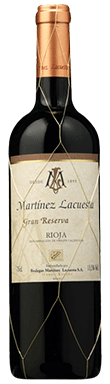
A classic gran reserva, this is a very well-made wine with good fruit. Martínez Lacuesta is the last artisan of barrel management, still doing all...
2004
Martínez LacuestaRioja
Finca Valpiedra, Reserva, Rioja, Northern Spain, Spain, 2004
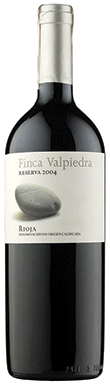
There is something magic in great appellations. No matter the innovations applied during winemaking, after some years the wines tend to converge towards more classic...
2004
Finca ValpiedraRioja
Ramón Bilbao, Mirto, Rioja, Northern Spain, Spain, 2004
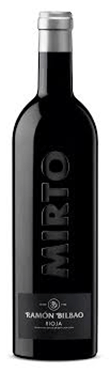
A wine made with much care by the Ramón Bilbao group, from selected plots, with strict selection and the best oak. This wine was a...
2004
Ramón BilbaoRioja
Cosme Palacio, Reserva, Rioja, Northern Spain, Spain, 2014
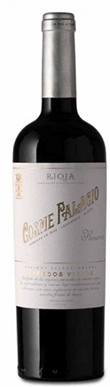
Cosme Palacio was one of the founders of modern high-quality Rioja, at the end of the 19th century. Today, it's one of the most representative...
2014
Cosme PalacioRioja
Roda, Roda I Reserva, Rioja, Northern Spain, Spain, 2014
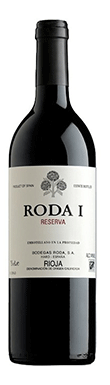
The greatest wines show their best attributes in bad vintages, and Roda's performance in 2014 is exemplary. The fruit expression, with lots of ripe blackberries,...
2014
RodaRioja
Bodegas Bilbaínas, Viña Pomal Gran Reserva, Rioja, Alta, Northern Spain, Spain, 2004
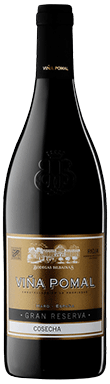
Brands are quintessential to Rioja's identity, and Viña Pomal is one of the most renowned. This wine is consistent with the brand profile, with a...
2004
Bodegas BilbaínasRioja
Bodegas Ostatu, Reserva, Rioja, Alavesa, Northern Spain, Spain, 2014
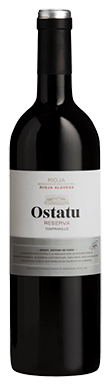
A very classic style of Rioja, with ripe fruit notes, cinnamon and sweet spice, forest undergrowth and coconut. Balanced and suave, with a soft touch,...
2014
Bodegas OstatuRioja
