Champagne’s brands and blends may be better known than its villages or vineyards, but if there’s one place in the region that has broken through it is Le Mesnil-sur-Oger.
What makes the Chardonnay grown in this sleepy Côte des Blancs village just south of Épernay ascend to such mythical status?
Perhaps it’s the famous names dotted discreetly around the village. Krug’s Clos du Mesnil and the house of Salon yield two of Champagne’s rarest blanc de blancs, often commanding bottle prices that exceed the cost of entire cases of other prestige cuvées.
Meanwhile, the famous Chétillon vineyard that straddles the road beneath the village was responsible for catapulting Pierre Péters’ Les Chétillons to fame and desirability, attained by few grower Champagnes during the 2000s.
At the heart of the question is time. Le Mesnil’s legendary longevity makes time an essential ingredient in almost all of the region’s blended Prestige Cuvées from the famous houses, from Taittinger’s Comtes de Champagne and Charles Heidsieck’s Blanc des Millénaires to the likes of Dom Pérignon and Cristal.
Even if it would placate their bank managers, the vignerons of Le Mesnil have to wrestle with the truth that the village’s wines can’t be turned around quickly.
Perfection can't be rushed
Sisters Justine and Marie Charlemagne
(Image credit: Tom Hewson)
At Guy Charlemagne in the village, sisters Justine and Marie are just a few years into their journey to transform and modernise one of the great estates of the village.
Decanter newsletter
Get our daily fine wine reviews, latest wine ratings, news and travel guides delivered straight to your inbox.
Their entry-level wine has, somewhat remarkably, spent six years on the lees – more than double a normal time for a non-vintage Champagne.
‘You can’t drop the ageing, though,’ says Marie, ‘for Le Mesnil, you need time’.
When Eugène Salon released his first wine in 1905, the concept of a blanc de blancs was almost unheard of. Chardonnay was still primarily viewed as a blending variety for Pinot Noir rather than a standalone star.
At Salon, with no oak and no malolactic fermentation, it is time alone that reveals the village’s secrets: it ages on lees for around a decade and then often decades more afterwards.
Rodolphe Péters of Champagne Pierre Péters notes that the village’s austerity serves it well amid risks of overripeness elsewhere.
‘People mistake it for high acidity,’ he says. ‘But the freshness is driven by a crispy, electric perception from the chalk, alongside an iodine-like minerality that can feel almost metallic.’
Some, like both Marine Zabarino at Domaine Vincey and Paul Girard at Domaine Girard-Bonnet, suggest that Mesnil is slightly less sunny, and more exposed, than neighbouring Oger, explaining the more inward style of wines.
There’s a chalky austerity here which can’t really be explained away just by looking at the slope, or the aspect, though.
Péters explains that the chalk is ‘dryer’ here than in other villages, and has been more subject to crumbling under the surface thanks to repeated freezing and thawing.
‘There’s no science behind it,’ he continues, ‘but there are deep veins of fragmented chalk here, and the vines go deeper in search of water and mineral sources,’ he believes.
Heart of the terroir
(Image credit: Clos du Mesnil vineyard in Champagne)
The good news, though, is that the village’s treasures are more accessible than in the past thanks to the riper, fruitier grapes found in today’s warmer vintages, and a new generation of growers unlocking them.
Paul Girard of Domaine Girard-Bonnet manages the austerity with super-ripe grapes, careful oak vinification and plot selection, believing that some parts of the village can yield more accessible wines.
He feels the very lowest vineyards, such as Hautes Mottes, can be ready in three years, whereas the heart of the terroir – the ‘cœur du terroir’ as the Charlemagne sisters refer to it – needs longer.
Views differ, though, and unlike Burgundy’s love of the mid-slope, the flatter vineyards nearer the bottom of the Côte des Blancs are often viewed as the classical, long-lived terroirs thanks to the closeness of the chalk just beneath the surface.
The vines of the village are also severely hit with the court-noué virus in the historical mid-slope sector, which dramatically intensifies ripeness and drops yields.
Girard notes he may harvest only 2,000 kg/ha in the famous Volibarts plot (which, with its intensity and ripeness also makes Louis Roederer’s still white Coteaux Champenois), whereas Hautes Mottes can yield 12,000 kg/ha.
‘Of course, you’re going to say that Hautes Mottes is better!’ he jokes.
Ripples and bumps mean that adjacent vineyards even on the same slope can have markedly different topsoils, and markedly different wines.
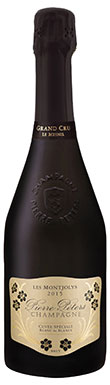
At Pierre Péters this is the source of the contrasting Les Montjolys cuvée, a companion piece to famous, chalky Chétillons that always offers a little more juicy breadth thanks, Péters believes, to the deeper topsoil that collected in the foot of one of these undulations.
‘Mesnil is very wavy thanks to erosion,’ he says, with Chétillons and Montjolys on ‘two extremes of soil’.
Blends and barrels
Adrien Dhondt
(Image credit: Champagne Dhondt-Grellet)
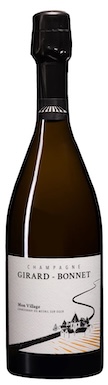
Girard, too, blends some of the purer chalk sites with those richer in colluvium for his Mon Village cuvée, aiming to keep the strictness and refreshment value in the wine but also yield something approachable (and sellable), with around three years on lees.
The strength of the village’s wines means he opens them up with 70% of the blend going through oak, something he feels a less structured, austere village such as neighbouring Vertus couldn’t take.
‘If I did this with Vertus,’ he says, ‘the wine would be dead’.
For some such as Girard, Zabarino or Mesnil expert Robert Moncuit, opening up the wines with a little oak helps soften the wines a little.
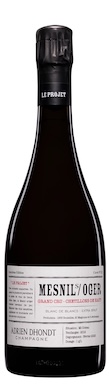
Adrien Dhondt, too, works with the higher part of Chétillon, Chétillon de Haut, which is richer with more clay than the famous Chétillons.
The beautiful concentration and oak fermentation yields a heady, intense yet not austere wine in the forcefully sunny 2020 vintage.
For more established names, though, reserve wines can help tame Le Mesnil’s force.
At Péters (where there’s no oak in the cellar), the family has maintained a perpetual reserve of base wines since 1988.
For Rodolphe, this is ‘security,’ not only smoothing out vintage variation but also allowing wines like his Cuvée de Réserve (two-thirds Le Mesnil Chardonnay) to achieve complexity without requiring extensive lees aging.
It’s a benefit, too, as the Côte des Blancs faces a second consecutive heatwave vintage in 2026, challenging its identity as the racy, restrained backbone of Champagne.
With frost wiping out some of the higher yielding parts of the village beneath the road – ‘the parts we usually use to compensate for the court-noué,’ Péters explains – the quantities of top blanc de blancs produced in both 2026 and naturally low-yielding 2025 are undoubtedly down on top years of the past.
More scarcity might drive up prices in an already elevated terroir, but thanks to the new growers on the scene this village’s mystical appeal is, for now, still relatively easy to access.
Pierre Péters, Les Montjolys Cuvée Spéciale Le Mesnil Grand Cru Brut, Côte des Blancs, Champagne, France, 2018
My wines
Les Montjolys tends to linger in the shadow of its more famous Chétillons, which shines with its long-lived, chalky focus and intensity. Here, deeper topsoil...
Adrien Dhondt, Mesnil-sur-Oger Chétillons de Haut Grand Cru Blanc de Blancs Extra Brut, Côte des Blancs, Champagne, France, 2020
My wines
Part of the side-project of Adrien Dhondt (of domaine Dhondt-Grellet), the Chardonnay here hails from the plot just above the famous 'Chétillon' vineyard, where a...
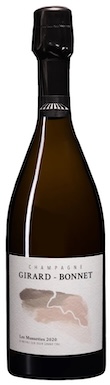
Girard-Bonnet, Les Mussettes Le Mesnil sur Oger Grand Cru Extra Brut, Côte des Blancs, Champagne, France, 2020
My wines
While 'Mon Village' is a balanced picture of Le Mesnil, Mussettes is a more intense, chalky and low-yielding plot that yields tigher, more compact wines...
Girard-Bonnet, Mon Village Le Mesnil sur Oger Grand Cru Extra Brut, Côte des Blancs, Champagne, France
My wines
A perfect example of a wine which is bursting with Le Mesnil brightness, tension and structure but remains ripe, fragrant and accessible. Paul Girard blends...
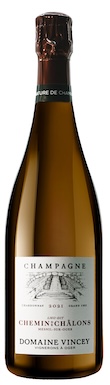
Domaine Vincey, Chemin de Châlons Le Mesnil sur Oger Grand Cru Brut Nature, Côte des Blancs, Champagne, France, 2021
My wines
Domaine Vincey's ripe, naturally-orientated zero sulphite, zero dosage, 100% barrel-fermented style does open up Le Mesnil's inwardness even in this tight vintage, where a beautiful,...
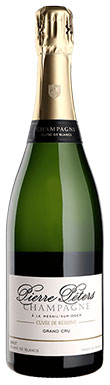
Pierre Péters, Cuvée de Réserve Blanc de Blancs Grand Cru Brut, Côte des Blancs, Champagne, France
My wines
Péters' Cuvée de Réserve is two thirds Le Mesnil Chardonnay, backed up with the house's highly complex perpetual reserve which adds an irresistable fresh, nutty,...
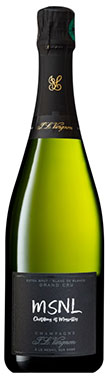
JL Vergnon, MSNL Chétillons et Mussettes Le Mesnil sur Oger Grand Cru Blanc de Blancs E, Côte des Blancs, Champagne, France, 2014
My wines
From the heart of Mesnil terroir in chalky, intense Chétilons and Mussettes, one of the village's top growers maintains its transparent, pure and vibrant style...
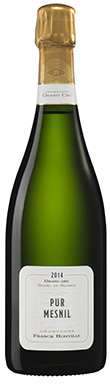
Franck Bonville, Pur Mesnil Grand Cru Blanc de Blancs Extra Brut, Côte des Blancs, Champagne, France, 2019
My wines
From the stellar 2019 vintage, specialist Côte des Blancs domaine Franck Bonville has turned out the best yet in their series of 'Pur' single-village blanc...
Tom Hewson writes about Champagne and sparkling wine. He authored the Tim Atkin Champagne Special Report in 2022, featuring over 600 wines and insights from five weeks spent in the region. As well as writing freelance, reviewing and presenting sparkling wines, Tom runs his own newsletter Six Atmospheres, reaching Champagne and sparkling wine enthusiasts all over the world every week.