
Clos de la Roche: A Burgundian grand cru for those in the know
Charles Curtis MW explores the history, producers and wines of an under-celebrated grand cru, which will more than reward any wine lover willing to take some time to understand it.

Clos de la Roche is the largest grand cru in the Côte de Nuits’ Morey-St-Denis, producing sumptuous and ageworthy wines that easily last 50 years in the cellar.
Despite its enviable location and undisputed quality, Clos de la Roche sometimes lacks the star power of the grands crus of Gevrey-Chambertin to the north or Chambolle-Musigny to the south.
With more than 20 proprietors, Clos de la Roche doesn’t have the cohesive, consistent image of Morey monopole Clos de Tart, or near-monopole Clos des Lambrays.
But for the astute wine lover who takes the time to understand this vineyard, there are some wonderful wines to discover.
Scroll down for Charles Curtis MW’s top Clos de la Roche grand cru wines
History
Despite tales of human sacrifice on a rocky druid altar giving rise to the name, the rock (roche) in Clos de la Roche is obvious to those who visit the vineyard and can see the underlying limestone periodically breaking through the surface.
However, this ‘clos’ has never been enclosed by walls, according to historian Jean-François Bazin.
Even the borders have shifted over time. Prior to the creation of the current appellation system in 1936, Clos de la Roche referred only to the 4.57ha lieu-dit. But when the Clos de la Roche appellation was created, authorities included the lieux-dits Mochamps, Froichots, Fremières, Chabiots and the lower slopes of Monts Luisants, totalling 15.34ha.
In 1971, the appellation was expanded again, with further portions of Genavrières (0.88ha) and Chaffots (0.07ha) added. Most of the reclassified portion of Chaffots (1.34ha) was included in Clos St-Denis Grand Cru. Four rows of Chaffots vines were added into Clos de la Roche Grand Cru, increasing the size to 16.9ha, making it the largest grand cru in the village of Morey.
Some commentators blanched at a quadrupling of the area, and connoisseurs have long argued over which of these terroirs were the finest.

Dr Jules Lavalle’s influential History and Statistics of the Côte d’Or, published in 1855, was mostly formalised in 1861 as the Burgundian classification system we know today.
Lavalle singled out only Clos de Tart in the top (tête de cuvée) category in Morey, while the Clos de la Roche had to be content with next best (première cuvée).
He thought even less of some of the later additions: Chabiots, Fremières, and Mochants [sic] were listed as deuxième cuvée; Froichots and ‘Bas de Chaffots’ merely quatrième cuvée. Lavalle did not even mention Monts Luisants or Genavrières.
By 1861, thinking had changed. The map produced by the Beaune district agricultural committee (Comité d’agriculture de l’arrondissement de Beaune) accorded most of these lieux-dits equal standing in the top category.
Today, there is a nearly continuous stretch of grands crus stretching from Mazis-Chambertin down to Bonnes Mares.
Clos de la Roche bears a strong resemblance to Latricières-Chambertin, which it borders at the top of the slope. Like the Gevrey grands crus, it can be dark and somewhat monolithic in its youth, with more brooding power than elegant grace, but also like Latricières, the wines, with time, become seductively expressive.

The taste
It can be difficult to generalise about Clos de la Roche wines because of the diversity of vine ages and winemaking styles of the various domaines. However, the wines are often full-bodied and rich, with more black-fruit aromas than red, and a firm, muscular texture with plenty of tannic grip.
Rose-Marie Ponsot and Alexandre Abel of Domaine Ponsot say that, ‘it is the lieu-dit Clos de la Roche that gives substance to our wine, while Les Monts Luisants brings the freshness.’
There is often also a savoury, gamey element to the wines, which I often think can be attributed to Clos de la Roche’s lower reaches.

The terroir
The pioneering work of geologist Françoise Vannier suggests that the bedrock is generally consistent along the band of grands crus from Mazis-Chambertin to Bonnes-Mares.
Prémeaux limestone is found higher up the slope; the slightly older crinoidal limestone is found nearer the base of the slope. There are occasional layers of limestone pebbles (as in Monts Luisants), and alluvial fans near the valleys that interrupt the slope.
Clos de la Roche is protected from the cooling influence of these valleys; the main variation (besides the bedrock) is that there is more topsoil at mid-slope and less at the top and the base.
Despite the seemingly haphazard expansion of the appellation, today’s Clos de la Roche is remarkably consistent. Talented growers can produce genuinely great wines throughout.
Eight names to know
Domaine Ponsot

Domaine Ponsot is the largest landowner in the Clos de la Roche, with 3.2ha.
The first acquisition in the Clos was made by William Ponsot in 1872. He also purchased a plot in Les Monts Luisants, which was later added to Clos de la Roche.
These holdings were expanded in 1920 by his godson and nephew Hippolyte Ponsot, who acquired more vines in lieu-dit Clos de la Roche.
Hippolyte was succeeded by his son Jean-Marie, and in turn, his son and daughter Laurent and Rose-Marie who took over in 1997. Laurent left to form a négociant business with his eldest son in 2017.
Today, Rose-Marie and manager Alexandre Abel continue the house style, picking late, destemming the grapes completely, and using no new casks to age their superb Clos de la Roche.
Domaine Dujac

Domaine Dujac is indisputably at the top of its game.
The domaine was founded by Jacques Seysses and his father, Louis Seysses in 1968, when the family purchased and renamed Domaine Marcel Graillet, proprietor of 0.5ha of Clos de la Roche and parcels in Clos St-Denis and other sites.
Today, in addition to the original holding in lieu-dit Clos de la Roche, the domain has 0.5ha in Monts Luisants, 0.59ha in Les Chabiots and small holdings in several other sub-sections of the grand cru.
Jacques’ son Alec finds there is a minerality in Dujac’s Clos de la Roche similar to that from its large parcel in nearby Premier Cru Aux Combottes in Gevrey-Chambertin. Comparing the wines from these nearby sites, he notes that there is more richness in the Clos de la Roche since the vines are located further down the slope in deeper clay soils.
There is perhaps more elegance in the Clos St-Denis.
Domaine Armand Rousseau

At Domaine Armand Rousseau, the attention is all on Chambertin and Gevrey; Clos de la Roche can seem almost like an afterthought.
Yet, it is the third-largest proprietor, after Dujac, with nearly 1.5ha: a plot at the southern extremity of lieu-dit Clos de la Roche and another larger one (almost 1ha) in Fremières.
The grapes are destemmed and aged in used casks, as at Ponsot. The wines, however, are very different; the Rousseau seems lighter, with more purity of fruit but less complexity.
Rousseau’s Clos de la Roche is a superb wine of great finesse and elegance.
Domaine Hubert Lignier

The origins of Domaine Hubert Lignier date back to 1885; vineyards were initially purchased by Jacques Lignier and his son Jules, whose sons Georges, Henri and Maurice eventually took over.
Henri and his wife bought a plot in Monts Luisants in 1955, and their son, Hubert, continued to expand the family holdings and introduced on-site bottling.
Today, under the leadership of Hubert’s son Laurent, the domaine organically farms 11ha in total, including 0.92ha in the appellation of Clos de la Roche; two-thirds in Monts Luisants, one-third in Fremières.
The grapes are partially destemmed before a gentle fermentation and ageing in cask (typically one-third new).
The domaine has produced a second cuvée from Clos de la Roche Grand Cru since 2017; the wine made from the 0.2ha planted in 1955 is bottled as an homage to Henri, called MCMLV (1955 in Roman numerals).
Domaine Georges Lignier

Domaine Georges Lignier is led today by Georges’ nephew, Benoit Stehly, who farms a total of 16ha spread over 50 parcels, including 1ha of Clos de la Roche.
The vines here are scattered throughout the appellation, mainly in the lower part – Cabiots, Fremières and Mochamps – and a little in lieu-dit Clos de la Roche and Genavrières.
Stehly describes his winemaking as ‘pure pumping over – the key is not in punching down; it is in the sorting table’.
The domaine picks earlier rather than later, ‘more like Lambrays than Ponsot,’ says Stehly, and likes a clean winemaking style, with limited use of whole clusters and a moderate ageing regime.
The results deliver lovely, perfumed floral fruit of considerable elegance.
Domaine Leroy

Maison Leroy was founded in 1868 by François Leroy of Auxey-Duresses, providing the solid base for today’s legendary domaine. His grandson, Henri, purchased an interest in Domaine de la Romanée-Conti in 1942, and in 1955, his great granddaughter, Lalou Bize-Leroy, joined the business.
Bize-Leroy founded Domaine Leroy in 1988 with the purchase of Domaine Charles Noëllat in Vosne-Romanée; further acquisitions followed, notably the Philippe Remy estate in Gevrey-Chambertin, from whom Bize-Leroy acquired her 0.67ha of Clos de la Roche.
Viticulture and winemaking at Domaine Leroy are biodynamic, and the wines are certified organic. Vines are pruned short and are never hedged to encourage photosynthesis; sorting is exceptionally rigorous.
The grapes are vinified as whole clusters, foot-trodden two to three times daily, and the bottling is done following the moon’s phases, on fruit days between Sagittarius and Leo.
Domaine Chantal Remy
As one travels south from Gevrey-Chambertin, the first trace of Clos de la Roche is a charming old gate inscribed with the words JH Remy, an estate that dates to 1820. The Remy domaine became an important proprietor here in the early 20th century, as cited in Camille Rodier’s 1920 book, La Vin de Bourgogne.
Later that century, the Remy heirs split the domaine in two, creating Domaine Philippe Remy (based in Gevrey-Chambertin) and Domaine Louis Remy (based in Morey).
When Louis Remy died in 1982, his daughter Chantal returned to assist her mother; her brothers later sold their shares. Today Chantal farms 0.4ha of Clos de la Roche with her son Florian.
The grapes are mostly destemmed before a cold soak, fermentation of about two weeks, and ageing in cask (one-third new).
Domaine David Duband
David Duband is based in Chevannes, in the Hautes-Côtes de Nuits, but much of his organically farmed 25ha are located in the main villages of the Côte, between Nuits-St-Georges and Gevrey-Chambertin.
His friend and partner François Feuillet acquired many of the vineyards, including the domaine of Morey-St-Denis legend Jacky Truchot (who retired in 2005) that included 0.41ha in Clos de la Roche, mostly in the lieu-dit Clos de la Roche, between the Dujac and Rousseau parcels.
The winemaking style is Duband’s own. ‘I never use a cold soak, and at least 60% is fermented as whole clusters. I start the ferment right away and try to vinify without sulphur. Extraction is by foot, so we don’t break the stems,’ he says.
The wine ages in 40% new casks before bottling without fining or filtration, and the delicious results speak for themselves.
Charles Curtis MW’s top Clos de la Roche Grand Cru wines
Wines are listed by producer then score.
Related articles
- Burgundy 2023: What to expect from a rollercoaster vintage
- Domaine François Raveneau: Taking the pulse of Chablis’ greatest wine
- White Burgundy 2022: Three domaines with wines worth waiting for
Hubert Lignier, Clos de la Roche Grand Cru, Burgundy, France, 1976
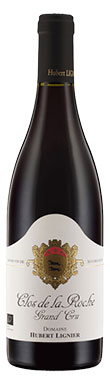

Displays a charming, nuanced bouquet of exotic black tea, dried rose petals, chocolate and truffle. The texture is silky and very fine, with all the...
1976
Hubert LignierClos de la Roche Grand Cru

Hubert Lignier, Clos de la Roche Grand Cru, Burgundy, France, 2015
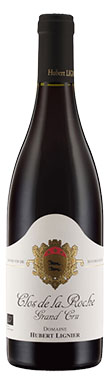
This opens in the glass to reveal a brooding, dark plum and fig fruit character, underscored by a savoury note and a hint of saline...
2015
Hubert LignierClos de la Roche Grand Cru
Domaine Georges Lignier, Clos de la Roche Grand Cru, Burgundy, France, 2022
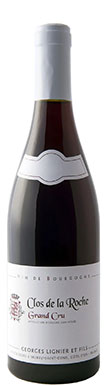
The 2022 Clos de la Roche boasts rich, plummy fruit with hints of smoke and earth. The wine is full-bodied, with firm, grippy tannins, yet...
2022
Domaine Georges LignierClos de la Roche Grand Cru
Domaine Georges Lignier, Clos de la Roche Grand Cru, Burgundy, France, 2023
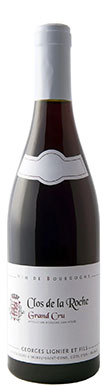
A wine with moderate concentration and attractive aromas of ripe blackberry and plum, underscored with floral notes and a hint of earth. The texture is...
2023
Domaine Georges LignierClos de la Roche Grand Cru
Domaine Georges Lignier, Clos de la Roche Grand Cru, Burgundy, France, 2021
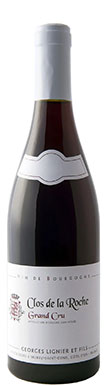
Benoit Stehly turned out a lovely Clos de la Roche in the challenging 2021 vintage. The nose shows bright raspberry and pomegranate fruit with notes...
2021
Domaine Georges LignierClos de la Roche Grand Cru
Domaine Ponsot, Vieilles Vignes, Clos de la Roche Grand Cru, Burgundy, France, 2023
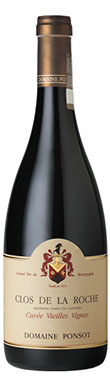
This preview of the 2023 Clos de la Roche at Ponsot shows a wine of intensity and elegance, with ripe blackberry fruit, hints of violets...
2023
Domaine PonsotClos de la Roche Grand Cru
Domaine Ponsot, Vieilles Vignes, Clos de la Roche Grand Cru, Burgundy, France, 2004
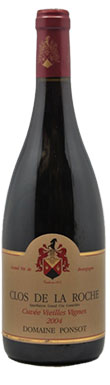
A genuinely delicious 2004, upsetting my preconceived idea of red wines from this vintage. Surprisingly youthful, with charming pomegranate and wild strawberry aromas, accented with...
2004
Domaine PonsotClos de la Roche Grand Cru
Domaine Dujac, Clos de la Roche Grand Cru, Burgundy, France, 1999
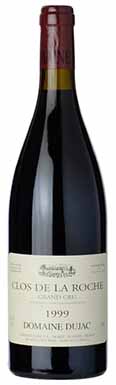
Retasting the 1999 at the domaine in 2024, I am struck by how much it is opening up. Always great, the wine now shows astonishing...
1999
Domaine DujacClos de la Roche Grand Cru
Domaine Dujac, Clos de la Roche Grand Cru, Burgundy, France, 1995
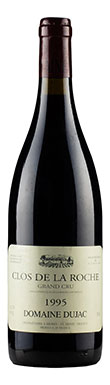
The 1995 is now mature, with abundant, concentrated aromas of ripe, plummy fruit accented with notes of forest floor, game and truffle. However, nothing is...
1995
Domaine DujacClos de la Roche Grand Cru
Domaine Dujac, Clos de la Roche Grand Cru, Burgundy, France, 2006
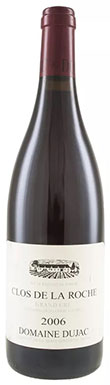
The 2006 is showing well, with ripe, lush notes of mulberry fruit and a suggestion of lilac and spice on the initial attack. There is...
2006
Domaine DujacClos de la Roche Grand Cru
Domaine Dujac, Clos de la Roche Grand Cru, Burgundy, France, 2004
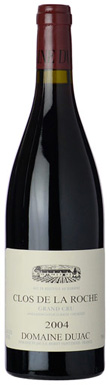
According to Alec Seysses, 'the 2004s are showing well now.' This has a dried currant character with an edge of Havana cigars, earth, smoke, and...
2004
Domaine DujacClos de la Roche Grand Cru
Domaine Armand Rousseau, Clos de la Roche Grand Cru, Burgundy, France, 2021
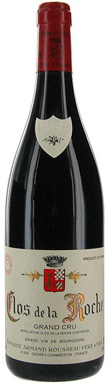
The Rousseau Clos de la Roche is superb, without qualification – this would be a marvellous wine in any vintage. It boasts seductively sweet ripe...
2021
Domaine Armand RousseauClos de la Roche Grand Cru
Domaine Armand Rousseau, Clos de la Roche Grand Cru, Burgundy, France, 2012
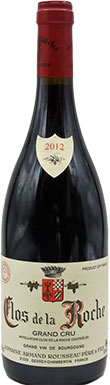
This 2012 is ripe and spicy, with blackberry and plum fruit notes, anise and liquorice on the attack. On the palate, the wine is dense...
2012
Domaine Armand RousseauClos de la Roche Grand Cru
Domaine Armand Rousseau, Clos de la Roche Grand Cru, Burgundy, France, 2010
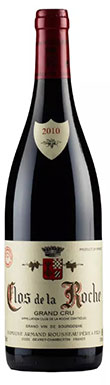
The 2010 Rousseau Clos de la Roche speaks equally of Rousseau's elegant touch and of the thrilling character of the 2010 vintage. There is a...
2010
Domaine Armand RousseauClos de la Roche Grand Cru
Domaine Castagnier, Clos de la Roche Grand Cru, Burgundy, France, 2021
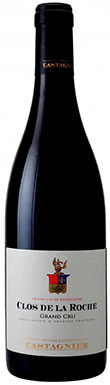
A bit lean, the 2021 Clos de la Roche from Castagnier reflects the slightly old-fashioned style of the vintage, with high-toned pomegranate and cranberry fruit,...
2021
Domaine CastagnierClos de la Roche Grand Cru