
Valentin Zusslin: Riesling Grand Cru Pfingstberg vertical
Yohan Castaing explores the terroirs and winemaking approach of this historic Alsace estate and tastes a seven-vintage vertical of the Zusslin Riesling Grand Cru Pfingstberg from 2009-2015.


Domaine Valentin Zusslin is a textbook example of the qualitative evolution that Alsace is experiencing today.
Owned by the same family for 13 generations, the estate benefits from a long heritage in the region while adopting a very contemporary approach to viticulture.
Scroll down for tasting notes and scores on Domaine Valentin Zusslin Riesling Grand Cru Pfingstberg 2009-2015
Jean-Marie Zusslin – the father of Marie and Jean-Paul, who now run the family enterprise – was a pioneer of biodynamic farming in Alsace, introducing the practice at the estate in 1997.
When Marie and Jean-Paul took the reins in 2000 (responsible respectively for the commercial and wine-growing activities), both shared the vision of perpetuating their father’s legacy while also fine-tuning the viticulture, notably by adopting a more parcellary, plot-focused management of the vineyard holdings.
Site-specific approach
A significant result was the decision to produce a special bottling from the Clos Liebenberg, four hectares of vines sheltered by wild hedges, stone walls, and a forest.
Entirely owned by the estate, this vineyard is thus what the French wine-growers designate as a ‘monopole’. Their site-specific approach reaches a summit with the single grand cru of their portfolio, Alsace Grand Cru Pfingstberg.
Passionate about biodynamic farming, Jean-Paul implements an ambitious, haute-couture approach to both viticulture and barrel ageing for certain wines, using oak sourced from the Vosges forest.
The result is a fine selection of aromatically complex and precise wines that have both density of texture and vivacity on the palate.
Today, the estate owns 16ha of vines and produces around 900,000 bottles per year, including their top-level sparkling Crémant d’Alsace.
Among the different bottlings, Zusslin highlights three terroirs for their particular characteristics:
Bollenberg
This site is also called ‘la colline aux sorcières’ or Witch Hill. It is hard to understand why this terroir, of which a central element is its soil composed of marl-sandstone limestone, is not classified as a grand cru site.
The climatic conditions here are almost identical to those of Marseille on the south coast of France, with very little rainfall (350 to 450 mm per year), making this a sunbaked terroir where water stress is frequent.
Zusslin produces Riesling, Muscat, Pinot Gris and Sylvaner from this site.
Clos Liebenberg
This 4ha monopole is located at the top of the Pfingstberg hill at an altitude of 380m. It has marly-sandstone soils and benefits from a south to southeast orientation. Only Riesling is grown here.
Grand Cru Pfingstberg
This sizeable, southeast-facing grand cru vineyard covers 28ha on marly-limestone-sandstone soils. Its altitude varies between 270m and 370m.
The wines produced here are always less exuberant than other grands crus. While Gewurztraminer from some sites can tend to be a bit heavy-handed, the terroir of Pfingstberg imparts a welcome lively tension.
The same goes for the Muscat, which is fresh and fine-boned, while the ageworthy Rieslings have remarkable density and aromatic clarity.
The wines
Like many estates in Alsace, Domaine Zusslin produces wines that offer unbeatable value for money – all the more so in that they age well.
This vertical tasting focused on seven vintages of the Riesling Grand Cru Pfingstberg: 2009 through to the current release, 2015.
The characteristics of each vintage are described in the tasting notes, and provide a telling demonstration of how wide a scope of climatic conditions exists in the Alsace region of eastern France.
These can run the gamut from the cold winters of 2011 and 2010 to hot summers such as the ones that marked 2009 and 2010, as well as cooler years as in 2014 or very wet ones, as was the case for the 2012 and 2013 vintages.
Domaine Zusslin is currently looking for a UK importer. In the US, its wines are imported by Avant Garde Wine & Spirits (New York, Texas, Georgia, Florida, North and South Carolina), Weygandt Wines (California, Illinois, Washington DC, Maryland, Virginia, Pennsylvania, Washington State), and Estelle Imports (Oregon).
See the Valentin Zusslin Riesling Grand Cru Pfingstberg 2009-2015 vertical tasting notes and scores:
You may also like
Grosset: producer profile and Riesling verticalCanadian Riesling: the top-scoring winesAustrian dry Riesling: Expert’s choiceDomaine Jean Sipp: Unlocking Alsace’s potential
Valentin Zusslin, Grand Cru Pfingstberg, Alsace, France, 2015
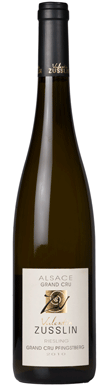

A very wet spring followed by a dry summer in 2015. Some hydric stress, but an ideal harvest. A bit closed at this stage, but...
2015
Valentin ZusslinGrand Cru Pfingstberg

Valentin Zusslin, Grand Cru Pfingstberg, Alsace, France, 2014
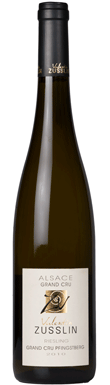
2014 saw a mild, dry winter, a very hot spring, and a summer with relatively low temperatures. There were incidents involving the invasive pest named...
2014
Valentin ZusslinGrand Cru Pfingstberg
Valentin Zusslin, Grand Cru Pfingstberg, Alsace, France, 2013
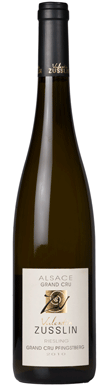
Flowering occurred late in 2013, hindered by a very wet and cool winter and spring, resulting in quite a bit of millerandage and coulure (abnormal...
2013
Valentin ZusslinGrand Cru Pfingstberg
Valentin Zusslin, Grand Cru Pfingstberg, Alsace, France, 2012
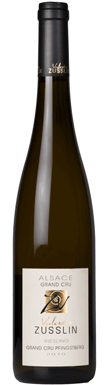
During the 2012 harvest, weather conditions alternated between spells of sunshine and rain, after a rather classic growing season. The wines are, on the whole,...
2012
Valentin ZusslinGrand Cru Pfingstberg
Valentin Zusslin, Grand Cru Pfingstberg, Alsace, France, 2011
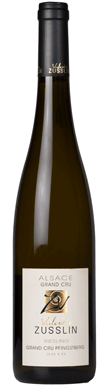
A year marked by a cold winter and mild spring weather followed by a dry summer. From the start, the 2011 wines were fruit-driven and...
2011
Valentin ZusslinGrand Cru Pfingstberg
Valentin Zusslin, Grand Cru Pfingstberg, Alsace, France, 2010
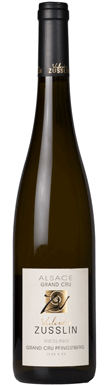
An extremely cold winter and a very hot summer that led to incidents of water stress resulted in wines of remarkable purity and vivacity in...
2010
Valentin ZusslinGrand Cru Pfingstberg
Valentin Zusslin, Grand Cru Pfingstberg, Alsace, France, 2009
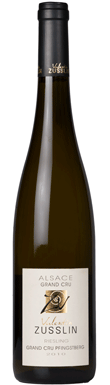
2009 was a precocious, sun-drenched vintage producing healthy, ripe grapes that resulted in powerful, exuberant wines possessing considerable ageing potential. The dominant scent is very...
2009
Valentin ZusslinGrand Cru Pfingstberg
