

Uruguay as a wine country is still to a great degree waiting to be discovered. Its vineyards sit unassumingly in their landscape; gentle hills are swept by breezes from the Río de la Plata and Atlantic Ocean.
Local cuisine is typified by smoky grilled meats, fresh fish and a resolutely unhurried dining culture. The wines follow suit: fresh rather than forced, expressive but understated, intimate in scale but also increasingly sure of their ambition.
With over 5,700ha under vine and a strong core of family wineries, Uruguay cannot compete on volume. Its allure lies elsewhere: a boutique scale, coastal sensibility and an enhanced ability to transform place into texture, energy and precision. While Tannat is still the country’s signature variety, today Uruguay also excels with other grapes.
Uruguay in figures
• Vineyard area: 5,797ha
• Main red variety: Tannat, with 1,536ha, accounting for around 26.5% of the national vineyard
• Other key red varieties: Merlot, Cabernet Sauvignon, Marselan, Cabernet Franc and Pinot Noir
• Key white varieties: Albariño, Sauvignon Blanc, Chardonnay, Viognier, Muscat de Hamburgo, Ugni Blanc
• Around four times more red wine is produced than white wine
• Registered vineyards: around 1,048, mostly smallholdings
• Official wineries: 205
• Wineries active in export markets: around 40
• Sustainability: 238 certified vineyards, covering 2,355ha
• Certification: Uruguay Sustainable Winegrowing
Tannat: A matter of precision
Tannat accounts for more than a quarter of national output; this red variety offers real value when it delivers freshness, texture and precise readings of the local vineyards.
Gustavo Pisano at Pisano Wines describes how over the past twenty years ‘more refined, elegant, fresher wines have been appearing that convey the character of different places as well as the personalities of their makers.’
Francisco Carrau at Cerro Chapeu identifies two lessons learned during this evolution: allowing greater ripeness of fruit in the vineyard and applying methods tailored to suit Tannat, not simply adaptations of Bordelais models.
The objective is to conserve longevity and character but with ripe tannins, texture and elegance. He enthuses over the variety’s ‘gastronomic energy’, which goes well with smoked and grilled meat and vegetables.
‘More refined, elegant, fresher wines have been appearing that convey the character of different places as well as the personalities of their makers.’
Gustavo Pisano, Pisano Wines
Success on a global stage
Recent scores given at the Decanter World Wine Awards show how Uruguay’s flagship red maintains its prestige, but now in a variety of voices. In 2026, the Garzón Petit Clos Tannat 2023 won a Platinum medal and the Bouza Tannat 2023 a Silver, while the Altos de José Ignacio Reserva Tannat 2023 won Silver in 2025.
Red blends are another quiet strength, with blends including Merlot, Cabernet Franc, Cabernet Sauvignon, Marselan and Petit Verdot allowing for cellaring potential and complexity.
At Bodega Garzón, Germán Bruzzone prefers the term ‘texture’ to ‘structure’: ‘structure is rigid while texture is dynamic’. This sums up blends such as the Cerro Negro Open Barrel 2021 from Viña Edén, which won Silver at DWWA 2025 and the Sacromonte Carapé 2021, which won Silver in 2024.

Albariño: Seeking freshness
This celebrated white grape has been a gamechanger, providing Uruguay with a different way to break onto global markets. While Tannat has built its identity in part on its unfamiliarity, Albariño is already well known across the world and is widely appreciated for its fresh, contemporary qualities.
Its history in Uruguay goes back a quarter of a century: the grape was first planted in 2001, with wines appearing in 2004. Albariño is now one of the country’s most widely planted white varieties, narrowly outdoing Sauvignon Blanc and Chardonnay.
Eduardo Boido, winemaker at Bodega Bouza, believes that Uruguay is extremely well positioned thanks to a climate which favours ‘extremely drinkable whites with balanced acidity’. In his view, Uruguayan whites share similarities with Galician versions but often have greater volume in the mouth and age better.
Santiago Deicas at Bodega Familia Deicas underlines that the fresh white style comes naturally to the region: ‘We’re not making these whites because they’ve suddenly become fashionable.’ For Deicas, the wines are characterised by their energy, acidity, depth, intensity, balance, juiciness and saline touch.
These whites have garnered plenty of recent acclaim: the Garzón Reserva Albariño 2025 and Redamare Albariño 2025 from Varela Zarranz won Silver at DWWA 2026, while the Altos de José Ignacio Reserva Albariño 2024 and Bouza Albariño 2023 also earned praise.

Vineyards in Maldonado.
Diversity with deep roots
The country’s portfolio of interesting whites doesn’t end with Albariño. Sauvignon Blanc, Chardonnay, Riesling, Viognier, Marsanne and white blends are also turning heads at a time when freshness and drinkability are especially prized: Bouza Pan de Azúcar Riesling 2023 and 2024 won Gold at the DWWA in both 2025 and 2026 respectively, underlining that potential.
Bruzzone reports that Uruguay is seeking out new terroirs in which each variety will find its best expression. Thus Cabernet Franc, Marselan, Pinot Noir, sparkling wines and more unusual styles are also joining the conversation.
With this diversity, Uruguay is looking to expand its identity. Amid the Atlantic weather, river breezes, family wineries and vineyards still to reveal their secrets, Uruguay is producing ageworthy reds together with vibrant whites just waiting to be discovered.
Learn more about the wines of Uruguay
Connect on Instagram | Facebook | Youtube | LinkedIn


-
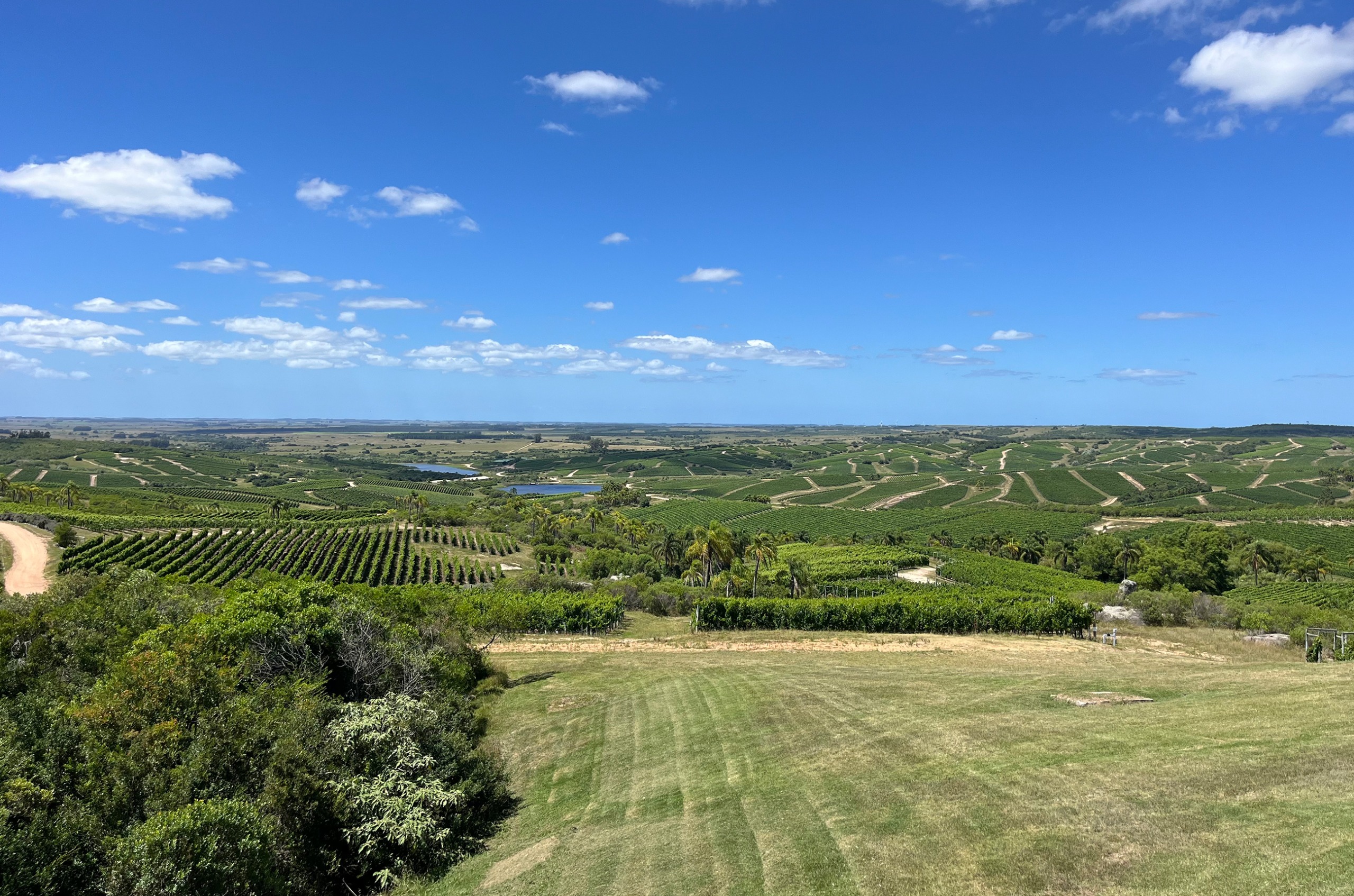 The wine regions of Uruguay
Sponsored Small but diverse...
-
 Ruggeri: Valdobbiadene Prosecco Superiore DOCG that’s made to last
Sponsored From the Cartizze hills...
-
 Uruguay: A country guided by possibility
Sponsored Embracing self-discovery...
-
 Vallepicciola: Tourism and winemaking in the Chianti hills
Sponsored Winemaking and luxury hospitality...
-
 A standout voice in Valpolicella
Sponsored A key name for Valpolicella and Amarone...
-
 Discover the world of Castello di Verrazzano
Sponsored An ancient castle set amid sprawling vineyards...
-
 Barbera d'Asti DOCG: Tradition and modernity in Piedmont
Sponsored Many expressions of one variety...
-
 Sergio Mottura: Excellence in Tuscia
Sponsored A renowned figure in Lazio...


