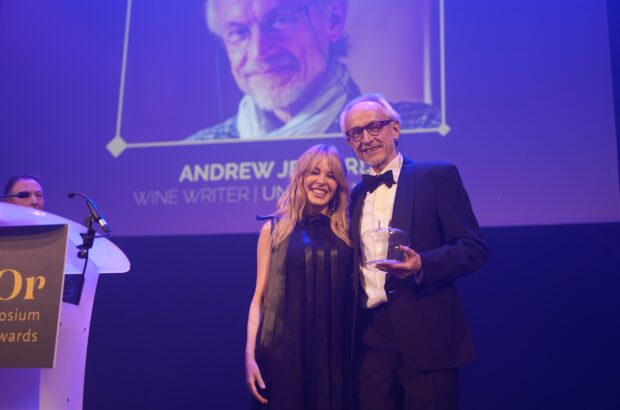
Did you realise that, with every glass of Meursault and Montrachet, you are drinking wine faeces? No, nor did I, writes Andrew Jefford in this column re-published from Decanter.com's archive and featuring his interview with renowned soil consultants Claude and Lydia Bourguignon in Burgundy.
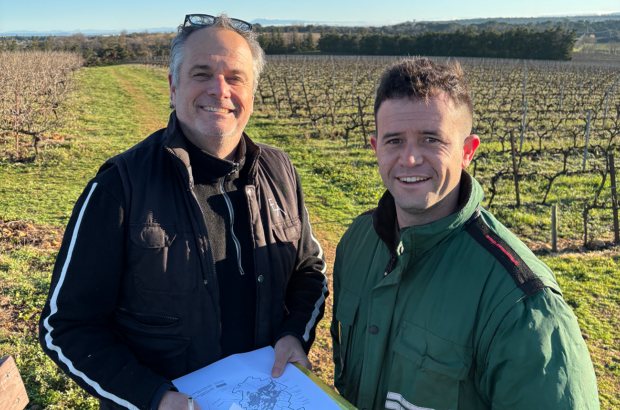
This sobering insight came my way back in March 2012, when I sat down one evening to talk at length to Claude and Lydia Bourguignon.
“Acidity,” confided Claude, “is plant excrement. In ordinary plants like cereals, that excrement is evacuated via the roots, into the soil. But fruits evolved a system to propagate themselves by creating fruit around a seed. The animal eats the fruit, swallows the seed and then propagates the plant, via its own excrement. If animals are going to find the fruit attractive, it must be sweet. The problem with sugar, though, is that it ferments. To avoid having that happen right away, the plant sends its excrement, its acidity, up into the fruit. And we drink it.”
The Bourguignons are best known nowadays as viticultural consultants, but for much of their early careers they were involved in helping subsistence farmers in Asia, Africa and South America make a better living. They are in no doubt that wine, on which they now spend around 80 per cent of their time, is special. “Viticulture is the sort of agriculture which is closest to the consumer,” Lydia points out. “It’s also where what you do in the fields has maximum effect. And you can actually show that and talk to consumers about it.” Much of this significance, Claude adds, is due to the fact that “wine is fermented grapes. When you ferment, you have an exacerbation of perfumes, of flavours, of everything which has been inscribed in the fruit by the place in which it grew. You don’t have that with cereal growing: the trace is soon lost.”
The consensus surrounding terroir in English-speaking countries is that it is climate which is most important in revealing (both aesthetically and economically) the propitiousness of a region, and that soil is secondary. Once a region has proved itself, of course, soil then becomes more important in teasing out the differences between that region’s distinguished sites. When I put this theory to them, the pair bristle.
“It’s false,” retorts Claude. “The soil comes before the climate. Why is Alsace overwhelmingly a white-wine region? The climate is warm enough for reds. It’s because it has white-wine soils. From the point of view of climate, you should be able to produce Burgundy’s best wines in Chalon and Mâcon, not the Côte d’Or. But the monks in Burgundy found that soil is important, which is why the greatest wines come from the Côte d’Or.” “All the air gives you is sugar,” adds Lydia. “The atmosphere is responsible for 94% of sugar in the plant.”
They are now into their stride and, when I suggest that we might put soil first and climate second because soil factors are easier to research and to measure than the significant minutiae of atmospheric conditions, they soon have me tackled. “What matters,” insists Claude, “is microbial activity in the soil, interacting with the vine’s roots, processing oligo-elements and stimulating enzymatic activity. If you grow fruits in a hydroponic regime, they don’t have any flavour, any aroma. It’s the microbes in the soil which permit the synthesis of the aromas. This has got nothing to do with the atmosphere. There’s no zinc in the atmosphere, no cobalt, no manganese. That’s why canopy management chiefly affects sugar levels in the grapes, and nothing else.”
My credibility now shot, I decide to see how far I can probe their espousal of biodynamics. I suggest, warily, that it’s hard to find scientific support for many aspects of biodynamics, citing the use of ‘dynamised’ homeopathic teas as one example. Claude swiftly refers me to Jacques Benveniste’s controversial work on ‘the memory of water’ as counter-evidence, before unexpectedly adopting a more emollient tack.
“The problem is that pure science is not good as embracing the complexity of living things. In wine, you don’t just have science. You have art, culture, many other things. The rational or scientific dimension doesn’t explain everything. We have measured the biological activity in biodynamic horn compost, and found an enormous amount there. For us, that’s not absurd. But if you ask why it’s there, and you read Steiner, it gives you a fright, at least if you have a scientific mentality.” “We never reject a conventional client,” stresses Lydia; “quite the opposite. Our real challenge is to work with those who are practising conventional viticulture, and lead them towards organics. That’s very rational.”
And on that, we agree, chink glasses, and swallow a little more diluted plant excrement.