Why we should all be drinking darker rosé this summer (and all year round!)
Stop being snobbish about the shade of your rosé, and discover the pleasure, and food friendliness, that darker styles from France, Spain and beyond can offer.

Rosé as a category needs no promotion - bucking a general downward trend in the wine sector, sales of pink wine continue to boom, and not only during the hot summer months that we’re enjoying in the northern hemisphere right now. Rosé has succeeded in becoming a year-round choice.
But let’s add a qualifier here. When we’re talking about rosé taking off in popularity, we’re talking overwhelmingly about pale rosé, whether from Provence, or from other regions seeking to cash in on the demand for the pale Provence style. Most rosé drinkers shun darker rosés – and it’s a shame, because these are some of the most interesting and tastiest rosés around!
Myth busting
World-leading expert on rosé Elizabeth Gabay MW is so passionate about darker rosés that she, and her son Ben Bernheim, are planning to write a book on the subject. ‘We’ve been championing the style for a few years now, and urging people not to judge rosé by its colour,’ she explained. ‘Many wine drinkers seek out pale rosé to the exclusion of all other rosé because they (wrongly) associate darker shades with sweetness, and believe that paler equals drier. But it’s just not true.’
So why the myth that dark rosé equals sweet rosé? Gabay explains that historically, until around 100 years ago, rosé wine was a byproduct of red wine. Juice was bled off to concentrate the red wine, and producers then added sugar to this tannic juice and sold it as rosé.
‘It’s not surprising that many people expect more deeply coloured rosé to be sweeter,’ adds Tom Fahey, owner-restaurateur of The Terrace Rooms & Wine on the Isle of Wight. ‘Think how popular the sweet white Zinfandel style was. Then Provence rosé took the market by storm, and the contrast seemed absolute.’
An education in rosé
Fahey is on the same mission as Gabay, running rosé tastings at his hotel to illustrate that there is no correlation between sweetness and shade of rosé. He encourages guests to explore all styles – pale rosé, darker rosés and extending into light reds – so that they understand the spectrum available.
‘Rosé as a category is still immature, in that drinkers expect it always to taste the same, like a single grape variety. You don’t see that with white or red wine.’ He has found it easier to sell some of his darker rosés – for example, the Señorio de Sarría Cinco recommended below – as a light red. Gabay has found the same, and the rosé that she makes in Slovakia is sold in Germany as a red wine.
Regions and appellations producing dark rosé wines
Cerasuolo d’Abbruzzo – Abruzzo, Italy
Chiaretto di Bardolino – Verona, Italy
Cigales and Ribera del Duero – Spain (namely Clarete styles)
Nemea – Peloponnese, Greece
Tavel – Rhône, France
Rosé colour spectrum
The shade of rosé colour in the bottle and glass will be shaped by two main factors: winemaking method and grape variety.
The longer the grape juice is in contact (or macerated) with the skins, the more colour, aroma, flavour and tannin will be extracted.
Given how ubiquitous the style is now, it’s hard to remember that pale, Provence-style rosés are a relatively recent phenomenon, dating back to the 1980s – and only made possible by technological advancements in refrigeration, cold stabilisation and sterile filtration. These wines are produced mainly using the direct press method, without extended maceration.
Winemakers in Tavel by contrast typically macerate for up to 48 hours, giving wines that are far more intense and deeper-hued. For context, in red wine production the juice macerates on the grape skins for anything from a week to over a month.
Wine gets its colour from the grape skins. Grapes with thicker skins will produce more colour in the wine than thin-skinned varieties. Hence why a rosé made from Garnacha is generally more intense than one produced from Pinot Noir, if macerated for a similar number of hours.
Beautifully joyous wines
Given the extended period of skin contact that darker rosés undergo, it’s logical to assume that you could sometimes expect to find greater varietal expression in these wines. ‘Darker rosés can be beautifully joyous wines,’ said Gabay. ‘They really bring out the fruit, but also allow some varieties to be better expressed.
‘It’s a shame that consumer demand for pale means that even very good dark rosés from regions such as Rioja, Bandol and Tavel struggle to gain traction in the market,’ she continued. ‘It’s not helped by some wine educators still perpetuating the myth that Provence rosé is always the best in the world. Much of my work involves trying to give producers the confidence to say “darker rosé is ok”, and to help them work out how best to sell it.
One ray of hope she identifies is in the Champagne category. ‘Many houses were using a yeast for their rosé cuvée that was developed to reduce the amount of colour,’ explained Gabay. ‘But in the grower Champagne world, there are lots of darker rosés emerging these days, and the growers identify themselves more with Burgundy than with Provence. Is Champagne a litmus test? Let’s hope so.’
Perfect food companions
It’s not by chance that the French call these deeper hued wines ‘rosés d’assiette’ – in other words, rosés to eat with. Dark rosés are ideal food companions and versatile when it comes to pairings.
Whether you are planning the season’s last barbecues or looking for a dry alternative to serve alongside fruit-based desserts, an intense rosé will not let you down. Their textural richness, aromatic intensity and subtle tannins are the ideal combination to handle a wide range of foods, and therefore often favoured by sommeliers.
Fahey particularly enjoys serving them with carpaccio and tartares. ‘Red wines are too powerful for these rare meat dishes,’ he explains, ‘so a darker rosé is perfect. Venison carpaccio and redcurrants is a must-try pairing. The other standout match, he says, is barbecued fish – ‘you get a bitterness from the chargrilling that makes dark rosé the perfect pairing.’
Nine dark rosé wines to seek out:
Wines shown in descending score order
Related content

Rosé myths: Why most of what you think you know about pink wine is probably wrong

Best rosé wines: 20 under £25 to try

Eliza Dumais: From rosé all day, to no way rosé. Has pink wine lost its lustre?
Les Vignerons de Tavel & Lirac, Cuvée Royale, Tavel, Rhône, France 2025

A total crowd pleaser, this won Gold at this year's Decanter World Wine Awards. A field blend of 50% Grenache and other Rhône grapes, it...
2025
Les Vignerons de Tavel & LiracTavel

Señorío de Sarría, Viñedo Cinco Garnacha de Viñas Viejas, Navarra, Spain 2025
95
Señorío de Sarría's basic rosé is a deep pink. mouthful of juicy fruit, and a great everyday buy. But this old-vine cuvée, is worth every extra penny, and a perfect example of the darker Navarra rosé style. Made by the saignée method, the wine sees the grapes macerated on skins for around 15 hours before a long and cool fermentation of the free-run juice in stainless steel. I could drink this Garnacha rosé all summer long. Vibrant electric pink in the glass, and bursting with ripe strawberry, cherry and raspberry flavour, it's about as extrovert as they come. But it's not just a frivolous wine to drink and dismiss – the 67 year-old bush vines grown at altitude give the wine a depth, juicy tannic structure and freshness that make this a first-class choice for sipping alone or pairing with food. Run don't walk to snap this one up.
2025
Señorío de SarríaNavarra
Château d'Acqueria, Heritage Acqueria, Tavel, Rhône, France 2023
This is the second vintage of the Héritage cuvée, a more serious and ageworthy of Château d'Aqueria's enjoyable entry-level rosé. A field blend of Rhône...
2023
Château d'AcqueriaTavel
Château Unang, Les Yeux de la Terre, Ventoux, Rhône, 2025
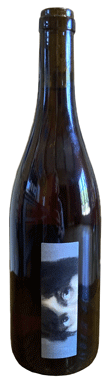
This brand-new cuvée, named after the two wells (les yeux) fed by a natural spring, next to the estate vineyard, bears a distinctive label designed...
2025
Château UnangVentoux
Château d'Acqueria, Rosé, Tavel, Rhône, France, 2025
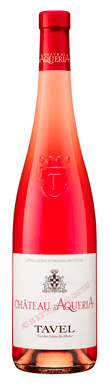
Tavel is classic darker rosé territory, and Château d'Aqueria is a respected name with a long history in the region, owned by Guigal since 2022....
2025
Château d'AcqueriaTavel
Kechris, Roza, Goumenissa, Macedonia, Greece, 2025
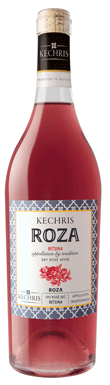
Kechris is a leading name when it comes to retsina, and continues to innovate, most recently exploring the terroir of pine resin (see our 'Drink...
2025
KechrisGoumenissa
Viñas Queirolo, Intipalka Syrah Rosé, Ica Valley, Peru, 2026
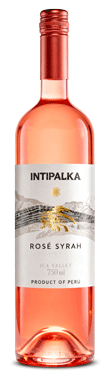
Made from grapes grown at 500m above sea level, this rosehip-hued Syrah rosé is made with the involvement of renowned Argentinian consultant Alejandro Sejanovich. The...
2026
Viñas Queirolo
Château Unang, Rosé, Ventoux, Rhône, France, 2025
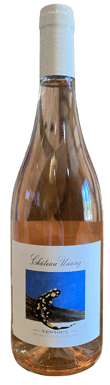
This blend of roughly a third each Syrah, Grenache and Cinsault isn't really dark in colour, but certainly darker than the nearly transparent rosés ubiquitous...
2025
Château UnangVentoux
Novus, Altitude Rosé, Peloponnese, Greece, 2025
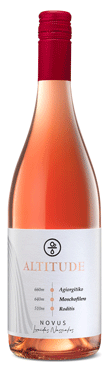
There's only 30% Moschofilero in this pretty, salmon-hued rosé made from grapes grown at 500-650m altitude, but it feels like more. (The balance is Agiorgitiko...
2025
Novus
