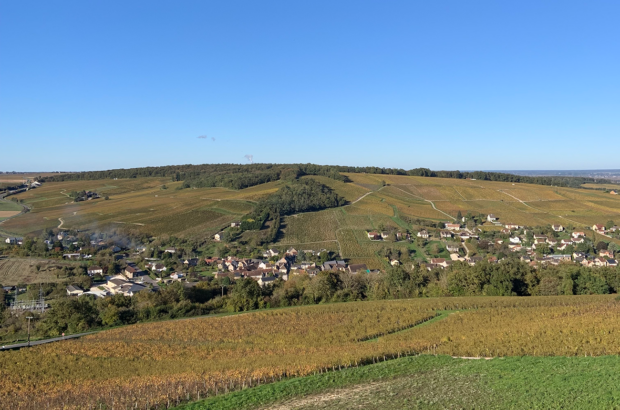
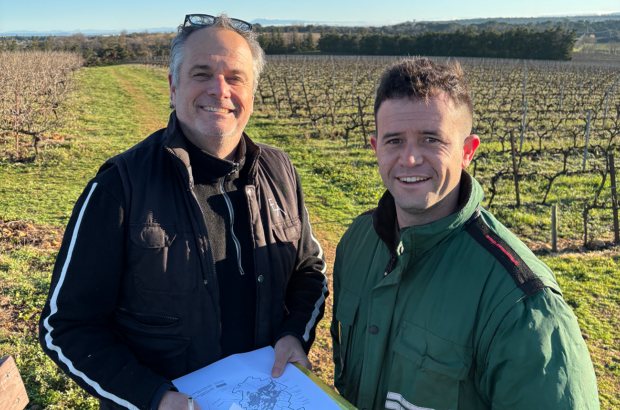
It was a grey, rainy start to a winter's day in Chablis: darkness was sliding from the long, sinewy shoulder of hillside outside Didier Defaix's tasting room in Milly.
“I had an Australian winemaker here once,” he remembered. “‘How do you do that?’, he asked. ‘How do you create so much minerality?’ I pointed out of the window, to the Côte de Léchet. ‘We don’t do anything,’ I said. ‘It’s the place that does it. You can create opulence in the cellar, but you can’t create minerality.’ That’s the strength of Chablis. It’s never just fashion.”
Stoniness may be neither new nor modish in Chablis, but there’s nothing more fashionable in other wine regions than the search for minerality, whether real or imagined. Allusions to minerality in tasting notes, too, are now common. A quick flick through the latest copy of the Wine Advocate (issue 198) plus the December/January issue of Australia’s Gourmet Traveller Wine and the January edition of Decanter reveals ‘minerality’ in such diverse wines as a Tupungato Malbec (the 2008 Single Vineyard Viña Cristina y Bibiana Coletto from Trapiche), a Yarra Valley Pinot Blanc (the 2010 Hoddles Creek Estate) and a Châteauneuf du Pape (the 2009 Domaine de la Janasse Vieilles Vignes) — just three examples among dozens in each publication.
The fact that minerality is the hottest quality in wine right now hasn’t escaped attention in Chablis itself, where it is regarded as a birthright. The BIVB’s Chablis press dossier is entitled ‘De pures émotions minérals’ (whatever those might be). More rigorously, the region’s leading co-operative La Chablisienne has produced an 11-page discussion of the subject, while the Burgundy-based Revue des oenologues published a study in October 2011 entitled (my translation) Wine minerality – a sensorial reality?
Note the question mark: the study showed that there was absolutely no agreement among the 34 Burgundy experts and the 33 trained wine tasters about what minerality might actually smell or taste like, or about the wines in which it was considered to be present (from a range of white burgundies from up and down the region). Some found it chiefly in fruity and floral wines; others seemed to associate it with reductive or lactic notes; a third set of tasters found it chiefly in oaked or spicy examples. The one point of agreement was that it was least associated with slightly sweeter dry white burgundies, and most associated with dryer and more acidic dry white burgundies.
Scientific thinking about ‘minerality’ remains resolutely sceptical. The consensus thus far is that it may be a quality associated with one of the 30 to 40 acids found in wine (and particularly white wine). It may also be a feature of white wines whose flavours are less fruity than most. ‘Minerality’, though, is not a simple mineral residue in wines, nor does it equate to dry extract.
I suspect that the term is beginning to be over-used in wine descriptions: ‘crisp, minerally and tight’ is an almost standard formulation for any fresh, dry white. The basic snare is the assumption that any acidic white wine is ‘mineral’. Low-acid whites like Hermitage Blanc often strike me as more mineral than acidic whites, particularly when high acidity is the result of early picking and hence raw and lacking in glycerol (which seems to act as a vehicle for minerality).
Associating minerality with a lack of fruitiness seems unsatisfactory, though – what about all those slaty Mosel Riesling Kabinetts? I’d also turn tetchy if asked to limit minerality to white wines alone; for me it’s a quality of many of the world’s greatest wines, reds included (we all know about the earthiness of wines from Pessac-Léognan, but those of Roussillon and Priorat can be decidedly mineral, as can wines from Bendigo, the Pyrenees and Heathcote in Australia). Principally dry? More nonsense: minerality is a structural element of the composition of sweet Loire wines and Tokaji Aszú, as well as Germany’s sweet Rieslings and unctuous, low-yielding Gewurztraminer and Pinot Gris in Alsace.
The problem, I suspect, is that we are too literal about minerality as a tasting descriptor. Write or say ‘mineral’, and we instantly imagine vines growing in stony rubble, sucking mineral juice from them, and pumping it into the grapes. It doesn’t happen. We have to forget those images if we are to understand the use of the term as a descriptor.
We have no trouble accepting that blackcurrant, cherry, chocolate and coffee are meant analogically (though the words, understandably, often puzzle newcomers to wine). Minerality is no different. Its use in wine description is primarily metaphorical, to describe a distinctive sensorial spectrum which evokes stones, rocks and earth (something which anyone who has ever dug a garden or hammered a rock for fossils will be familiar with). Yes, it’s a quality common to many fine wines — though it’s not essential, either. We should be fastidious about using it, but unapologetic when we find it. Why? Only wine can do that.
Written by Andrew Jefford