In partnership with the New York Wine & Grape Foundation
New York, the Empire State, is one of the USA’s most important wine-producing states, ranking third in production, right after California and Washington.
The state’s wine heritage is steeped in history, with a fascinating combination of deep-rooted native tradition and pioneering entrepreneurship. Home to the nation’s oldest continuously operating winery, there’s a trademark dynamism and ingenuity in the local winemaking community that have allowed it to adapt and respond to many natural and political challenges.

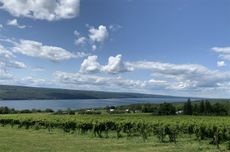
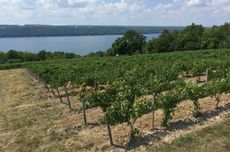
Located between the 40° to 45° north parallel, New York state shares the same latitude as some of the world’s most renowned wine regions at the limit of viable viticulture. The state has a predominantly continental climate, with bitter winters moderated by different bodies of water in each of the AVAs (American Viticultural Areas): the Atlantic; the Finger Lakes; the Hudson River; and Lake Ontario. While these water bodies moderate temperatures, they also increase disease pressure – a complex combination which, for centuries, prevented Vitis Vinifera to thrive.
Native grape varieties, on the other hand, were well adapted to New York’s challenging conditions and, even if dismissed for their flavour profile, were valued for their hardiness and resistance to phylloxera. Attempts to successfully introduce European varieties were not in vain though: serendipitous crossings of native and Vitis Vinifera, i.e. hybrid varieties, proved to combine the latter’s softer flavour profile with the former’s resilience, and became an important part of the local grape portfolio.

The map above shows New York’s seven major AVAs. Further to these, there are four sub-AVAs: Seneca Lake and Cayuga Lake in the Finger Lakes; The Hamptons and North Fork of Long Island within Long Island.
The pivotal point in the region’s modern winemaking history happened in the 1950s with the first successful commercial planting of Vitis Vinifera. Working first with the New York State Agricultural Experiment Station, then with Fournier at Gold Seal Vineyards, Ukrainian-born Dr. Konstantin Frank showed the viability for cold-hardy vinifera varieties (namely Riesling and Cabernet Franc) to not only survive, but produce great quality wines. Thus started the ‘vinifera revolution’ that led New York to today’s success.
Since then, and thanks to many other like-minded pioneers, New York has been able to consistently produce award-winning Rieslings, Cabernet Francs, Chardonnays, Lembergers, and Bordeaux blends. Sparkling and sweet styles have also come to the forefront.
Climate change and consumer curiosity have, however, generated renewed interest for native and hybrid varieties and there’s a growing willingness to explore their potential to withstand extreme conditions and produce characterful wines.
New York City’s vibrant hospitality community has played a key role in the development and revival of the state’s winemaking traditions. Sommeliers, chefs, restaurateurs and passionate consumers placed the state’s word-class Rieslings, elegant Cabernet Francs and intriguing native varieties in the spotlight. Many sommeliers became directly involved in wine ventures, championing alternative styles, pét-nats in particular, and forgotten grapes. Cornell University, with its renowned Viticulture and Oenology department, has also been at the epicentre of the region’s winemaking evolution, having long pioneered research, development and the support of local talent. Such potential has also attracted winemakers and viticulturists from across the world, many of which have spearheaded some of the region’s most successful wine ventures.
This diverse and knowledgeable community is fuelling an exciting transformation, placing New York wines on the world stage and revealing the region as one of the best equipped to deal with the future challenges to viticulture.
New York Wine Region – Key figures
– Six wine-growing areas with 11 AVAs (American Viticultural Areas)
– 444 wineries
– 14,164 ha (35,000 acres) under vine
– Approximately 15% of the total area under vine is planted to Vitis vinifera varieties
– The most planted Vitis vinifera variety is Riesling with 405 ha (1,000 acres)
– The second most planted Vitis vinifera grape is Chardonnay (344 ha – 850 acres), followed by Merlot at 324 ha (800 acres) and Cabernet Franc at 202 ha (500 acres)
-
 Best Manhattan restaurant wine lists: 10 venues to try
Our insider guide on where to eat and drink...
-
 ‘We tasted 4,000 American wines this year. These are Decanter’s Top 50 US Wines of 2025’
The best of the best...
-
 Singular US Pinot Noir: 20 vineyards where the variety has found a home
The zenith of US Pinot...
-
 Top-rated American sparkling wines for New Year’s Eve
See the best US fizz to see in the new year...
-
 Thanksgiving wine pairings and 10 American wines to try
Pairing principles for Thanksgiving food and wine...
-
 New York State: A look at the ‘unpredictable’ 2023 vintage
An in-depth look at the challenging 2023 vintage in New York State...
-
 Nathan Kendall: Rising star of New York’s Finger Lakes
A look at home-grown Finger Lakes talent, Nathan Kendall...
-
 American Syrah: 30 top buys
Shining a spotlight on the manifold expressions of American Syrah...
-
 Expert’s Choice: US Riesling
Celebrating the diversity of US Riesling...
-
 Harvest 2023 forecast for New York State
New York State looks to harvest 2023...
-
 Long Island celebrates 50 years of winemaking
Long Island celebrates 50 years of viticulture and winemaking...
-
 Forge Cellars: Producer profile plus 10 wines to try
The Seneca Lake producer's focus on Riesling is second to none...
-
 New York State’s Pinot Noir potential and 18 wines to try
New York State's precocious Pinot Noir...
-
 New York rosé wines – Diversity and character
Sponsored
-
 International Riesling Day: American style
Celebrate International Riesling Day with our picks from the US…
-
 New York Wines: A Sommelier’s Love Affair
Sponsored
-
 Discovering Long Island
Explore the coastal AVAs just a stone's throw from New York...
-
 The rise of New York State wine
New York-based winemakers on the draw of the Empire State...
-
 New York State: a winemaking melting pot
Sponsored
A place where anything is possible
-
 Finger Lakes sparkling & sweet wines: best new releases
Finger Lakes' cool-climate fizz...
-
 Finger Lakes white wines: best new releases
Finger Lakes' delicious white wines...
-
 Finger Lakes red wines: best new releases
The classy red wines of Finger Lakes...
-
 New York State of Fizz: The Sparkling Wines of NY
Sponsored
Delivering complexity and fun across styles
-
 Sustainability in the New York Wine Region
Sponsored
A journey of self-awareness and discovery
-
 Long Island, New York: regional profile
The producers to know and the wines to buy…
-
 Ravines Wine Cellars: a pioneer of dry Riesling from the Finger Lakes
Current and museum releases, including Argetsinger Rieslings…
-
 New York State: Red wines to try
17 to seek out...
-
 New York State: White wines to try
Seven to seek out...
-
 New York State: Sparkling wines to try
Six to seek out...
-
 American discoveries: 10 USA wines to try
The Decanter team looks back at notes from recent tastings and picks exciting – and some great-value – bottles from the USA worth stocking up on.


