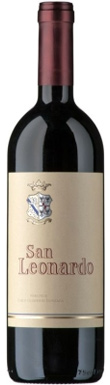
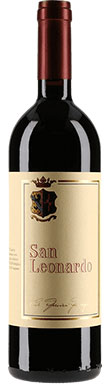
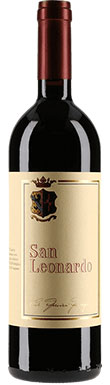
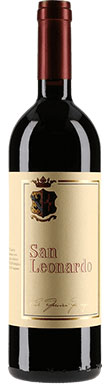
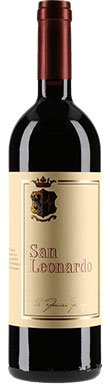
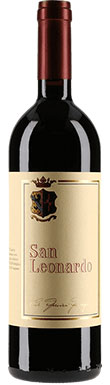
Tenuta San Leonardo profile and wine ratings
Stephen Brook meets the father-and-son team at the helm of the Trentino trailblazer, Tenuta San Leonardo. , members can see recently updated scores and tasting notes for Stephen Brook's top wines across three decades.
Get our daily fine wine reviews, latest wine ratings, news and travel guides delivered straight to your inbox.
You are now subscribed
Your newsletter sign-up was successful
Trentino is a thin wine region sandwiched between Valpolicella to the south and Alto Adige to the north.
There is little doubt that its potential is far from being fully realised, though there are two stellar estates here. Foradori specialises in wines from local varieties such as Teroldego, while Tenuta San Leonardo is firmly in the international variety camp.
There are also good sparkling wines being made by established firms like Ferrari, but Trentino production is dominated by large cooperatives. Some good wines are made, but not in sufficient quantities to put the region on the map.
Scroll down to see Stephen Brook’s San Leonardo vertical tasting
Tenuta San Leonardo at a glance
- Estate 25 hectares; organic since 2015
- Owner Marchesi Guerrieri Gonzaga
- Consultant winemaker Carlo Ferrini
- Production 300,000 bottles
- Main wines San Leonardo (65,000 bottles), Villa Gresti (15,000 bottles)
- Typical blend for flagship San Leonardo wine: 60% Cabernet Sauvignon with Carmènere, Cabernet Franc and Merlot.
Article continues beneath the wines
Stephen Brook’s Tenuta San Leonardo vertical tasting
The following vintages were tasted in 2016: 1999, 2000, 2001, 2008, 2010. The rest were tasted in late 2017.
History
San Leonardo is a noble estate that was in the hands of the Gresti family until 1894, and in the 19th century they provided wines such as Riesling and ‘Borgogna’ (likely a Burgundy type red blend) to the Austrian court under the name of Château St Leonard.
In 1894, Marchese Guerrieri Gonzaga married into the family and took over running the estate. His son Anselmo renovated the property, and after his death the present owner, Carlo Guerrieri Gonzaga, inherited it in 1974.
Get our daily fine wine reviews, latest wine ratings, news and travel guides delivered straight to your inbox.
Carlo was no amateur, having studied oenology at Lausanne in Switzerland and worked in the early 1960s with his relative Mario Incisa at San Guido in Bolgheri, Tuscany. But in those days the Incisa estate was just two hectares and its most famous wine, Sassicaia, hadn’t even been born. As there was no space for him at San Leonardo, Carlo remained in Tuscany for eight years.
At that time, San Leonardo was a polycultural estate, but parts of the property had been sold, and on Anselmo’s death, taxes required the sale of about half the property. So despite the noble history, the Guerrieri Gonzagas had been tightening their belts. Carlo was keen to invest in San Leonardo, and took a job at a cousin’s cement business to earn the money that would allow him to do so.
Hallmark elegance
As at San Guido, there was a distinct French influence at San Leonardo. The main varieties were Merlot and Cabernet Franc, although subsequently it became clear that much of the latter was in fact Carmenere. Cabernet Sauvignon cuttings were brought in from France, and on the recommendation of Piero Antinori, head of the Tuscan wine dynasty, Giacomo Tachis was hired as a consultant and helped to create the discreet, elegant style that is the hallmark of San Leonardo. Another constant presence here is Luigino Tinelli, who was born on the estate and has been its general manager since the 1970s.
Today the consultant winemaker is Carlo Ferrini from Tuscany, who replaced the ageing Tachis in 2000. A year later Marchese Carlo’s son Anselmo came back to help run San Leonardo after his father fell ill. Anselmo admits: ‘There have been some difficult times here, and I won’t pretend the period when I came back to help run the estate was easy, with my father pulling in one direction, and I pushing in another. And we were slow to develop our marketing in tune with the age of social media. But today my father and I work well together and have found the right balance, and I respect him hugely for having stuck to his vision.
‘He never wanted to make big, concentrated, oaky wines, even when they were all the rage and scored top points from the Italian wine guides. He can be stubborn but he has been true to his stylistic signature.’
Marchese Carlo showed me around the estate in a rickety jeep. Tall and lean, he exudes an urbane charm. We started from the sprawling estate buildings alongside the valley road. The offices and winery are here, and some workers’ apartments; there is a chapel with remarkable 12th-century frescoes. In the courtyard are shelters for a fleet of estate Fiat 500s, painted gaudily in camouflage tones, as well as a collection of ancient working tractors. Behind, there is a children’s playground, a donkey enclosure, rabbit hutch and other child-friendly animals. Clearly the estate is paternalistic in the very best sense.
Some vineyards are planted on fairly flat land near the buildings, while others climb the slopes towards the woodlands. Hidden within them by a small park is the 19th-century Villa Gresti, a capacious if not especially attractive mansion. Surprisingly, a substantial part of the vineyard is planted on pergola, a high-trained system not usually associated with wines of fine quality. Much of the Carmènere is here.
Singular style
Marchese Carlo explains: ‘We’ve always had Carmènere, but we used to believe it was Cabernet Franc. We wanted to plant more and bought some vines from a nursery in France. The berries were smaller than our old vines, and it was then that we realised those original vines were in fact Carmènere. It’s a variety that produces almost nothing on Guyot trellising, but gives reasonable yields on pergola, where the canes are longer. We can get Carmènere fully ripe at 13% potential alcohol, though our wines aren’t as powerful as most Chilean ones.’
‘We’ve persisted with Carmènere as it’s the fingerprint of San Leonardo,’ adds Anselmo. It’s the variety that’s linked to our land. It has a strong character that somehow combines elegance with a slight rusticity.’
There are two principal red wines here: San Leonardo itself, from 60% Cabernet Sauvignon with Carmènere, Cabernet Franc and Merlot; and Villa Gresti, first made in 2000 – a blend of Merlot with 10% to 15% Carmènere. San Leonardo is not made in mediocre vintages.
The grapes are sorted and destemmed, then fermented in cement tanks using indigenous yeasts. It is aged for some 10 months in cement tanks, in partly new barriques for 18 to 24 months, and then in bottle for 20 months. Villa Gresti spends up to 14 months in barriques.
In their youth these wines can be shy, even austere. This is largely due to the climate: here in the lower stretches of the Alps, nights can be very cool and this diurnal range preserves acidity. At the same time a warm wind blows in each afternoon from nearby Lake Garda. ‘This gives us a special microclimate that results in our wines showing both freshness and ripeness,’ explains Marchese Carlo. ‘But it does mean they need time in bottle to become approachable.’ With bottle age they emerge as being among Italy’s most elegant wines.
There were fears that when Carlo Ferrini came on board the style might change, as his wines (he consults to many top names: Barone Ricasoli, Castello di Fonterutoli, Poliziano, Principe Corsini…) usually have more opulence and flamboyance than San Leonardo’s. But he agreed to retain the existing style, and though the wines of the past 15 years do seem a bit fleshier than older vintages, that may also have much to do with climate change.
In 2007 and 2010 the estate produced a pure Carmènere, which is vinified in the same way as the other red wines. And there are two white wines: a Sauvignon Blanc called Vette was introduced in 2012, made from purchased fruit from growers around Rovereto further north; and a Riesling with grapes from northern Trentino, first made in 2013. Anselmo would like to add a spumante to the range, but this is still at the discussion stage.
Standard-bearer
Anselmo seems to find it frustrating that Trentino as a whole is less quality-oriented than San Leonardo and a very small number of other private estates. ‘The average vineyard holding here is 1.5ha, so growers are reliant on the co-ops buying their fruit. We have good co-ops here. They make excellent everyday wines but few outstanding wines.
‘Alto Adige to the north of us has wonderful wines that fetch good prices, with high quality driven by village co-ops, but the same isn’t really true here. As every grower needs to be rewarded, there’s little incentive to push up quality. Yet the potential here is amazing: we have beautiful soils, clean water, and a perfect climate with warm days and cool nights. But Trentino is little known, and that holds it back.’
Nonetheless, the Guerrieri Gonzagas have refused to allow standards to slip and, stylistically, the whites are surely a nod to the crystalline wines from Alto Adige. Tenuta San Leonardo and Villa Gresti are unflinching tributes to the vision of the family over generations, and to the terroir of the estate. Despite the wines’ reserve and somewhat austere style in their youth, they deserve their places as Italian classics.
Profile originally published in 2016 and new wine ratings added in March 2018.
More like this:
Producer profile: Giacomo Conterno
Decanter travel guide: Trentino-Alto Adige, Italy
Amarone della Valpolicella – panel tasting results
Tenuta San Leonardo, Trentino-Alto Adige, Italy, 1986
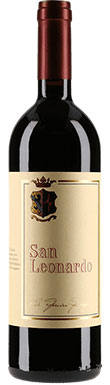
After a rainy flowering season, the summer and early autumn were relatively dry, so the fruit could safely stay on the vine until late October....
1986
Trentino-Alto AdigeItaly
Tenuta San Leonardo
Tenuta San Leonardo, Trentino-Alto Adige, Italy, 1988
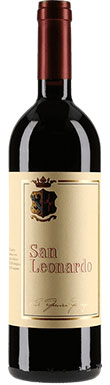
A splendid year, with warm, dry conditions, and cooler autumn nights that preserved freshness. The harvest was spread throughout October. The colour is very deep,...
1988
Trentino-Alto AdigeItaly
Tenuta San Leonardo
Tenuta San Leonardo, Trentino-Alto Adige, Italy, 1990
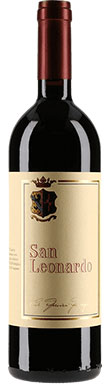
Steady sunshine marked the growing season and the harvest was over by 18 October. Tasted from magnum, yet it shows considerable maturity of colour. The...
1990
Trentino-Alto AdigeItaly
Tenuta San Leonardo
Tenuta San Leonardo, Trentino-Alto Adige, Italy, 1995
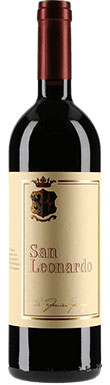
A normal growing season, but October was exceptionally warm and sunny. The harvest was over by 18 October. The colour is lightening up and showing...
1995
Trentino-Alto AdigeItaly
Tenuta San Leonardo
Tenuta San Leonardo, Trentino-Alto Adige, Italy, 1996
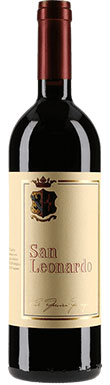
Although this was a year with higher than average rainfall, the estate is very proud of the result. Tasted from magnum, the wine is still...
1996
Trentino-Alto AdigeItaly
Tenuta San Leonardo
Tenuta San Leonardo, Trentino-Alto Adige, Italy, 1997
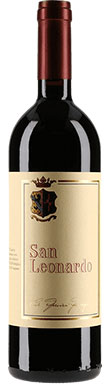
The growing season was exceptionally dry in 1997, and the autumn was warm with plenty of sun. Trentino’s microclimate seems to have prevented the wine...
1997
Trentino-Alto AdigeItaly
Tenuta San Leonardo
Tenuta San Leonardo, Vigneti delle Dolomiti, Trentino-Alto Adige, Italy, 1999

Rich toasty nose that seems to suggest a slight change in style. The palate is ripe, juicy, and concentrated, with vivid fruit, ample freshness and...
1999
Trentino-Alto AdigeItaly
Tenuta San LeonardoVigneti delle Dolomiti
Tenuta San Leonardo, Vigneti delle Dolomiti, Trentino-Alto Adige, Italy, 2000

<p>Lush oaky blackcurrant nose, forthright and assertive but not too charred. This has a sweet attack, its richness and concentration cut by sinewy tannins. This...
2000
Trentino-Alto AdigeItaly
Tenuta San LeonardoVigneti delle Dolomiti
Tenuta San Leonardo, Vigneti delle Dolomiti, Trentino-Alto Adige, Italy, 2001

<p>Rich blackcurrant nose with enough cut to resemble a St Julien, assertive but with no greenness, Rich wih moderate tannins, but zesty and lively too,...
2001
Trentino-Alto AdigeItaly
Tenuta San LeonardoVigneti delle Dolomiti
Tenuta San Leonardo, Vigneti delle Dolomiti, Trentino-Alto Adige, Italy, 2003

A ferociously hot and dry summer in 2003 led to early ripening and low acidity in many wines from most parts of Italy. The slightly...
2003
Trentino-Alto AdigeItaly
Tenuta San LeonardoVigneti delle Dolomiti
Tenuta San Leonardo, Vigneti delle Dolomiti, Trentino-Alto Adige, Italy, 2004

After a rainy spring and June, the summer proved hot and stable, with perfect diurnal ranges in the autumn. The result is a triumph, with...
2004
Trentino-Alto AdigeItaly
Tenuta San LeonardoVigneti delle Dolomiti
Tenuta San Leonardo, Vigneti delle Dolomiti, Trentino-Alto Adige, Italy, 2007

A warm dry summer, interrupted by some welcome August rain, led to an easy and precocious harvest of perfectly ripe grapes. The nose is rich...
2007
Trentino-Alto AdigeItaly
Tenuta San LeonardoVigneti delle Dolomiti
Tenuta San Leonardo, Vigneti delle Dolomiti, Trentino-Alto Adige, Italy, 2008

Muted blackcurrant nose, rather closed yet still has some aromatic lift. Firm and robust, with integrated tannins and ample freshness. Powerful, tight, and youthful, with...
2008
Trentino-Alto AdigeItaly
Tenuta San LeonardoVigneti delle Dolomiti
Tenuta San Leonardo, Vigneti delle Dolomiti, Trentino-Alto Adige, Italy, 2010

Muted nose, quite smoky, with brooding black fruits. Rich, juicy, and concentrated, with good acidity to cut through the palate. Firm but integrated tannins, lifted...
2010
Trentino-Alto AdigeItaly
Tenuta San LeonardoVigneti delle Dolomiti
Tenuta San Leonardo, Vigneti delle Dolomiti, Trentino-Alto Adige, Italy, 2011

The summer of 2011 was normal and dry. By September 20 the harvest was already under way, and was completed by 10 October. There's a...
2011
Trentino-Alto AdigeItaly
Tenuta San LeonardoVigneti delle Dolomiti
Tenuta San Leonardo, Vigneti delle Dolomiti, Trentino-Alto Adige, Italy, 2013

A welcome balance of warmth and rainfall led to an easy harvest. The nose shows its youth, being surprisingly delicate and reticent, with restraint, poise,...
2013
Trentino-Alto AdigeItaly
Tenuta San LeonardoVigneti delle Dolomiti
Stephen Brook has been a contributing editor to Decanter since 1996 and has won a clutch of awards for his writing on wine. The author of more than 30 books, his works include Complete Bordeaux, now the definitive study of the region and in its third edition, and The Wines of California, which won three awards. His most recently published book is The Wines of Austria. Brook also fully revised the last two editions of Hugh Johnson’s Wine Companion, and he writes for magazines in many countries.