Get our daily fine wine reviews, latest wine ratings, news and travel guides delivered straight to your inbox.
You are now subscribed
Your newsletter sign-up was successful
An account already exists for this email address, please log in.
Decanter at Home: Bonneau du Martray masterclass – one site, two grands crus
Burgundy expert Charles Curtis MW joins Bonneau du Martray estate manager Thibault Jacquet for a special Decanter at Home masterclass featuring six of the estate's Corton and Corton-Charlemagne wines - including those from the 2019, 2017, 2015 and 2009 vintages.
The hill of Corton is one of the rare grand crus in Burgundy where both red and white wines are produced. The only other one is Musigny, but Musigny Blanc is essentially a curiosity, with only 0.65 hectares of Chardonnay planted.
The proportion of white to red on the hill of Corton is more equitable – 44% is white, and 56% is red. This split makes perfect sense given the unique situation of the terroir.
Scroll down to see Charles Curtis MW’s Bonneau du Martray masterclass tasting notes and scores
The hill is separated from the rest of the côte, with vines that wrap nearly all the way around the hill, ascending to almost 400 metres. They are spread over three villages from east-facing Ladoix-Serrigny to northwest-facing Pernand-Vergelesses, the only grand cru in Burgundy with this exposition.
Facing west helps the vines avoid the morning heat, and the location of the vines at the exit of the Pernand-Vergelesses valley also keeps them cool in warm years, making this an ideal location in times of global warming.
The Bonneau du Martray vineyards on the Hill of Corton
(Image credit: Credit Unknown)
The vines carpet the slope from just under the wood at the top to the base, and Bonneau du Martray counts three distinct terroirs between the thin white marl soils at the top to the deepest marl mixed with clay at the bottom, dividing their holdings into fifteen blocks that are farmed and vinified separately, including the three blocks of Pinot Noir at the foot of the slope.
Only after the first year of ageing are they blended before a final six months maturation.
History
The history of grape growing on the hill of Corton goes back to at least 775 AD when Emperor Charlemagne donated the vineyards he had planted there to the monks of Saulieu.
Decanter newsletter
Get our daily fine wine reviews, latest wine ratings, news and travel guides delivered straight to your inbox.
The vines remained the property of the church for over a thousand years until they were sold as ‘property of the nation’ during the French Revolution to Simon Véry, proprietor of Domaine Chanson at this time.
Véry’s daughter Marie-Eugénie married Charles Bonneau du Martray, and the winery stayed in the Bonneau du Martray family until they sold it in 2017 to American real estate developer Stanley Kroenke.
Jean-Charles le Bault de la Morinière, who directed the estate from 1994 until its sale in 2017 did much to analyse the terroir of his holdings. He was very concerned by the endemic erosion of the 1990s, which he resolved to combat in any way possible.
Over time he became convinced that biodynamic methods in the vineyard were the best solution and engaged Fabien Esthor (vineyard manager since 2003) to oversee the process. The estate was gradually converted and was certified by Demeter in 2014.
Winemaker Emmanuel Hautus (hired in 2011) put the improved raw material to use, declassifying portions of the harvest as necessary. Since the arrival of estate manager Thibault Jacquet in 2017, the team has focused their efforts, renting out 2.91 hectares in a métayage agreement with Domaine de la Romanée-Conti to further refine their work.
2019 was the first vintage to employ this slightly smaller footprint, and if the results we taste with this vintage are any indication, the team at Bonneau du Martray is on the right path.
Bonneau du Martray masterclass vintage notes
2019
Jacquet notes that 2019 is ‘…everywhere we want to be; a perfect bridge between 2017 and 2015′. The year was a warm vintage, with a flowering somewhat diminished by millerandage, which combined with the drought-driven concentration of the fruit to a harvest that was half of a normal year.
The concentration produced a superb wine that Jacquet describes as; ‘well-behaved purebred power, yet not overwhelming. The wine has a tension and precision that I like—this is real Charlemagne DNA.’
The theme of the 2019 vintage for the Pinot Noir was precision. The domaine had just invested in a state-of-the-art destemmer which was placed at the head of the sorting table instead of at the foot, so that only the finest grapes entered the tank.
2019 was also the first year of ‘changing the recipe’: the grapes were picked later, and there was more extraction, but at the same time gentler extraction. There was also just a bit of experimentation. The best bunches were fermented as whole clusters in terracotta amphorae to bring a remarkable burst of fruit to the final blend.
2017
2017 was an easy vintage, and the results were ‘classic Burgundian’ according to Jacquet. The mild winter was followed by a growing season that had no excess at all. ‘Upright, lean, and profound’.
The crop was larger: 38 hl/ha in 2017 compared to just 25 hl/ha in 2019. Because of the added volume, the estate experimented a bit, and there were small lots aged in different vessels, from clay amphora to concrete eggs, to larger barrels, longer (‘cigar’) barrels, and even glass globes. These can help minimise the effect of the oak, which is increasingly extracted as higher alcohol due to global warming, giving more oak aromas and flavours in the wine.
2015
According to Jacquet, in 2015; ‘The sun came out in April and didn’t go away’. The flowering occurred in the first week of June; veraison was finished by late July, and the harvest, in perfect health, began on 1 September.
2015 saw a bit of concentration due to the warm, dry conditions. However, with a 32 hl/ha yield, the year produced 80% of an average crop.
Although vintages such as 2010 and 2007 have a chiseled, mineral character, the exotic nature of the 2015 vintage is showing well now. ‘So generous it wants to jump out of the glass,’ according to Jacquet.
2009
2009 was a spectacular vintage for winemakers: warm, luminous, overall ‘blessed by the gods’.
Flowering was quickly and thoroughly done between 1 June – 4 June. There was no heatwave, no yield reduction, just perfectly healthy grapes and a yield of 39 hl/ha.
It is, however, impossible to compare the 2019 and 2009 vintages, since it seems that 2009 is a combination of both 2017 and 2015. Nature set a large crop on the vine (as in 2017) but then ripened it to perfection because of the surfeit of heat and light.
The 2009 vintage was even more generous for the reds than for the whites. The yield was slightly lower, and shows as a classic warm vintage, with ripeness, elegance, and a refined character, although the style was more ‘classical’ than what the domaine is looking for today: they want refinement, but they also want more flesh.
See Charles Curtis MW’s Bonneau du Martray masterclass tasting notes and scores
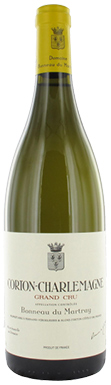
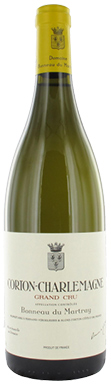
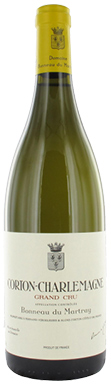
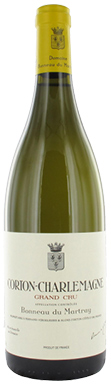
Domaine Bonneau du Martray, Corton-Charlemagne Grand Cru, Burgundy 2019
My wines
The newest vintage of Bonneau du Martray points the direction the estate will now chart. This is an imperious wine, powerful, concentrated, and richly...
2019
BurgundyFrance
Domaine Bonneau du MartrayCorton-Charlemagne Grand Cru