{"api":{"host":"https:\/\/pinot.decanter.com","authorization":"Bearer MjZhMTFiNDFlMTE5YjE1ZTY3NzVhMTFlY2VhOWY1YjVmNjgxMDQ4NmM5NTEzOWE0ZjFlZGFkNzkzY2ZiOGUzOA","version":"2.0"},"piano":{"sandbox":"false","aid":"6qv8OniKQO","rid":"RJXC8OC","offerId":"OFPHMJWYB8UK","offerTemplateId":"OFPHMJWYB8UK","wcTemplateId":"OTOW5EUWVZ4B"}}

Ukraine’s wine industry endures hardships and adapts amid ongoing war

Nearly four years into a grinding war, resilient Ukrainian wine producers are coping with an existential crisis while carving out new paths into export markets.

Winemaking in war time

In the early hours of 28 August 2025, in one of Russia’s largest drone and missile attacks of the war, a drone ploughed into the distribution warehouse of Pilot’s Wines in Kyiv. The explosion left a smouldering mess of twisted metal and shattered glass.

Economic losses aside, ‘nearly all sample bottles that had received Decanter and other awards’ were destroyed, which was ‘especially painful’, company representative Olena Sizarova told Decanter.

‘These bottles were… part of our brand’s history. We planned to use them for professional tastings, masterclasses, staff training and presentations. We wanted Ukrainian consumers to taste the very wines that had been recognised by experts.’

The attack was only the latest in a seemingly endless series of blows to the wine industry in Ukraine. Since the war began, wineries have been bombed, occupied or abandoned. Supply chains have been upended and employees have fled or joined the fight against Russia.

Ukraine’s preeminent sparkling wine producer, Artwinery, had to relocate from the eastern city of Bakhmut, which now lies in ruin. At Koblevo winery in the Mykolaiv region, Russian paratroopers reportedly landed in the vineyards.

At nearby Beykush winery on the south coast, Russian troops are only about 8km away on a strip of land across the water, from where they routinely shell Ukrainian towns and villages.

Yet throughout the nearly four years of grinding war, Beykush has not ceased production, and a new wave of small independent wineries like it are radically reshaping the Ukrainian wine scene.

Damage to Pilot’s Wines’ Kyiv warehouse following a Russian air strike.

Damage to Pilot’s Wines’ Kyiv warehouse following a Russian air strike. Credit: Olena Sizarova / Pilot’s Wines

Finding a way ‘out’

The conflict has not only highlighted the resilience of Ukraine’s wine producers, it has also catalysed change and spurred wineries to look abroad, according to Svitlana Tsybak, Beykush’s CEO and head of the Ukrainian Association of Craft Winemakers.

She recently had to deal with the theft of thousands of bottles of Ukrainian wine in the UK from the back of a lorry bound for London City Bond.

After Russia’s 2022 invasion there were tight liquor restrictions. ‘I decided at the time to switch my focus to export markets, which helped us survive,’ said Tsybak. Other wineries did the same.

‘Before the full-scale war, small wineries didn’t export, except for a few bottles here and there, because the domestic market was the main market.’

In the weeks after Russia invaded, Tsybak, whose husband is a former sommelier serving in Ukraine’s armed forces, frantically set out to find new overseas buyers and promote an industry facing an existential threat.

That year, Beykush was short of staff and couldn’t bottle its latest vintage because of a lack of glass. But the 2022 Decanter World Wine Awards (DWWA), judged in London, were approaching, which Tsybak felt was an unmissable opportunity to showcase Ukraine’s top wines.

Amid the chaos and clogged borders, Tsybak couldn’t ship wines that were already registered for export from Ukraine and the window for awards entries was about to close.

With the help of a friend, she managed to get samples out of the country to Hungary and from there an acquaintance from the UK carried them back in two suitcases and delivered them to the Decanter warehouse.

The effort paid off. Beykush’s 2019 Reserve Chardonnay won a gold medal at the awards that year.

A Ukrainian wine list

Two years later, in the spring of 2024, Polish Master of Wine Wojciech Bońkowski set off for western Ukraine with wine exporter and former global marketing director for New Zealand Winegrowers Chris Yorke, whom Bońkowski credits with the boom in New Zealand wine exports.

Bońkowski and Yorke held a two-day tasting involving winemakers from across Ukraine. ‘One idea that emerged was that a competition is a very useful tool to select the best wines and showcase the country,’ Bońkowski said. He is also the regional chair of Central and Eastern Europe at DWWA. He envisioned 24 leading Ukrainian wines that could serve as a ‘presentable shortlist of wine to show in any country’.

At a tasting in Warsaw that July, Bońkowski and five other MWs came up with the list, which included sparkling, orange and late-harvest wines, capturing the rich array of styles, varietals and terroir in a region with an ancient winemaking tradition.

Booming small-scale wineries

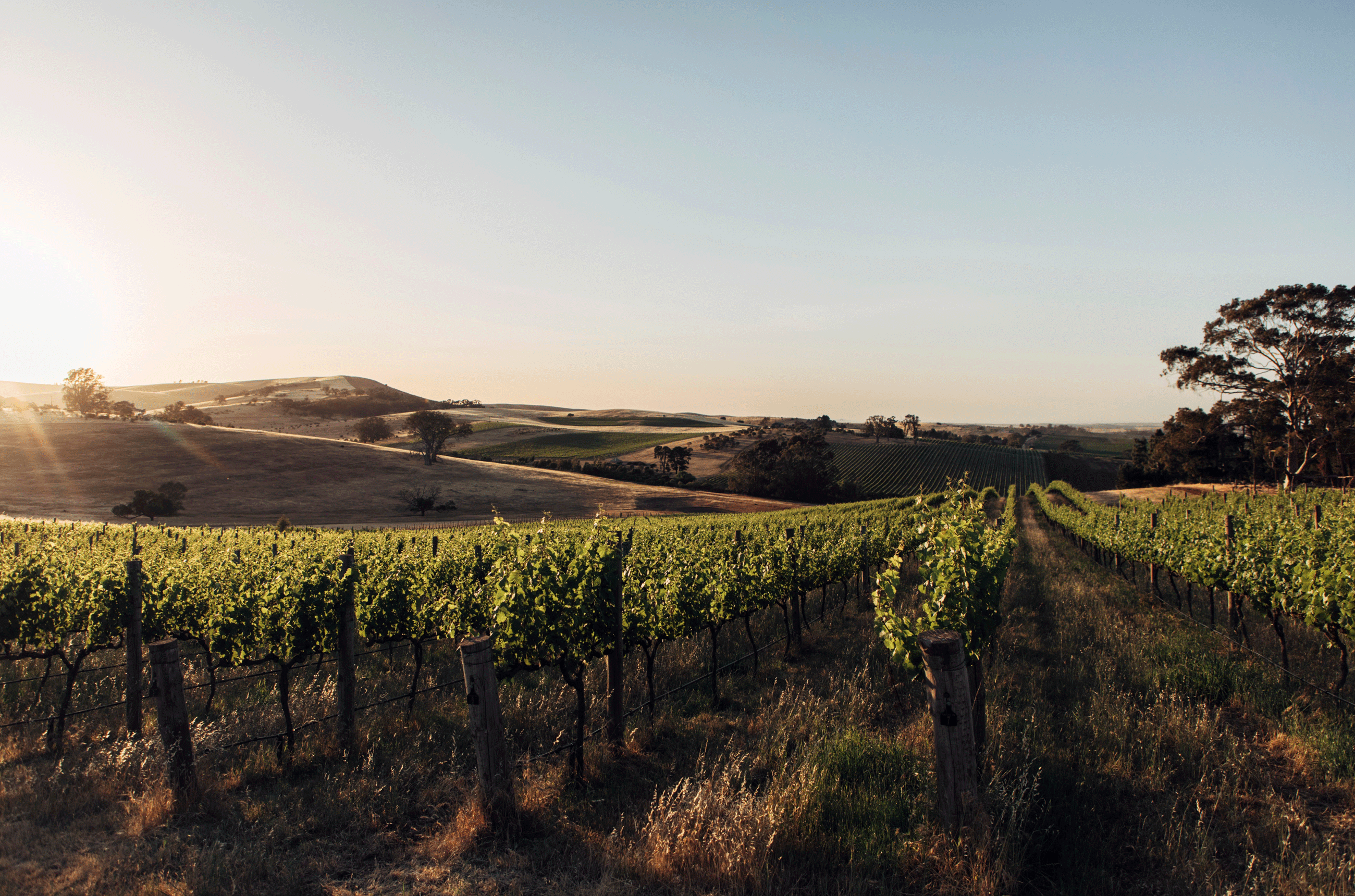
Vineyard harvest shots by the late wine photographer Arsen Fedosenko.

Vineyard harvest shot. Credit: Arsen Fedosenko, who died in the war in 2024.

Meanwhile, Tsybak pointed to the rising number of small-scale wineries as evidence of green shoots in Ukraine’s wine sector.

‘New family-owned wineries are opening every year, and about twenty opened last year. They’re small wineries, producing a few thousand bottles a year,’ she explained.

Her association now represents nearly 80 small-scale wineries and their exports are steadily growing. But the bigger picture is complex. The loss of the Russian market meant a dramatic decline in overall exports – from about $38m in 2017 to only around $9m in 2022, according to Ukraine’s state customs service. Bulk wine from big producers accounted for much of that.

According to Tsybak, boutique wineries entering new markets are now driving the rebound in foreign sales. Still, international consumers are yet to fully appreciate Ukraine’s wine heritage, she added. ‘I participated in many wine events in many countries, and you usually get the same question: Ukraine produces wine?’

And yet Ukrainian wine is truly Old World. The country was a thoroughfare for successive waves of invaders and settlers who have left their imprint on Ukrainian wine – ancient Greeks, Romanians, Ottomans and others.

The industry’s modern history, however, has been fraught. During Soviet times, Ukraine was a major producer, but under the stifling weight of a command economy wineries prioritised volume, churning out sugary bulk wine. In the 1980s, Mikhail Gorbachev’s campaign to curb alcoholism dealt a devastating blow to Ukraine’s wineries. Vast areas of vineyards were uprooted.

Before the Kremlin’s 2022 full-scale invasion, Ukraine was still reeling from the loss of its most historic wine-growing region, Crimea, which Russia annexed in 2014. With Crimea no longer under Ukrainian control, the country effectively lost around half of its vineyards overnight.

The much-needed aid

Today, Ukraine lags behind other regional wine producers like Georgia and Moldova, where viticultural revolutions are well under way.

In both those countries, a crisis helped precipitate change when, in 2006, Russia, their main export market, suddenly embargoed their wine, ostensibly over quality concerns. The real reason was widely believed to be retaliation for the two post-Soviet states shifting westwards.

Foreign aid has been considered key to Georgia and Moldova’s success, helping their industries innovate and open new markets. In Moldova especially, The United States Agency for International Development (USAID) ‘completely revolutionised the industry’, said Wojciech.

USAID also assisted Ukrainian wine producers in recent years, worked with Wines of Ukraine to promote the country’s products abroad and ‘financed their going to wine fairs, business missions and so forth’, he said. But Trump’s funding cuts ended that, depriving Ukrainian winemakers of much-needed support as they continue to grapple with the hardships of a war.

The end of war may seem a long way off, but that day will eventually come, and Sizarova of Pilot’s Wines believes that Ukrainian wine could become a ‘confident, respected player on shelves and wine lists worldwide’ backed by ‘a growing wine-tourism culture’.

Wojciech agrees. Peace will bring increased investment and rising local consumer affluence, greater EU integration and, he said – pointing to a Ukrainian bakery franchise next to the coffee shop in Warsaw where we met – a massive expansion of potential markets.


Related content

Ukraine: A wine odyssey

Ukraine wine harvest 2023: Sipping resilience

Ukrainian wine photographer Arsen Fedosenko dies in war

Latest Wine News